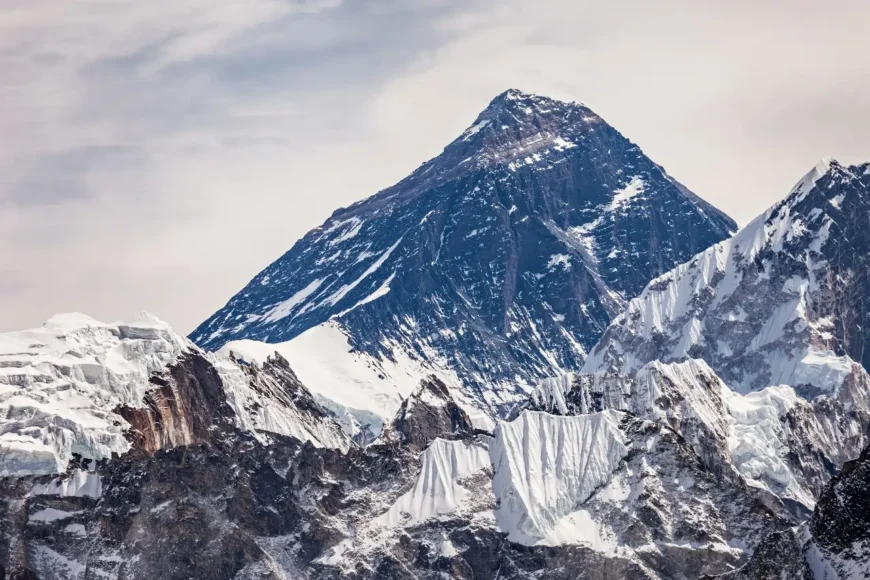
Mount Everest, the highest mountain in the world, is not just a pile of rocks and snow; it’s a living legend. Standing proud at a surprising altitude of 8,848.86 meters, Mount Everest has become a powerful symbol of natural magnificence, human ambition, and the spirit of adventure. It’s more than just a mountain; it’s a story of courage, dreams, and dramatic challenges.
From its rocky base to its icy summit, Everest carries not just snow but layers of history, epic stories of hard work, victory, and yes, plenty of failures too.
Let’s climb through some of the most interesting facts of Mount Everest that make it so overwhelming.
15 Incredible Facts About Mount Everest
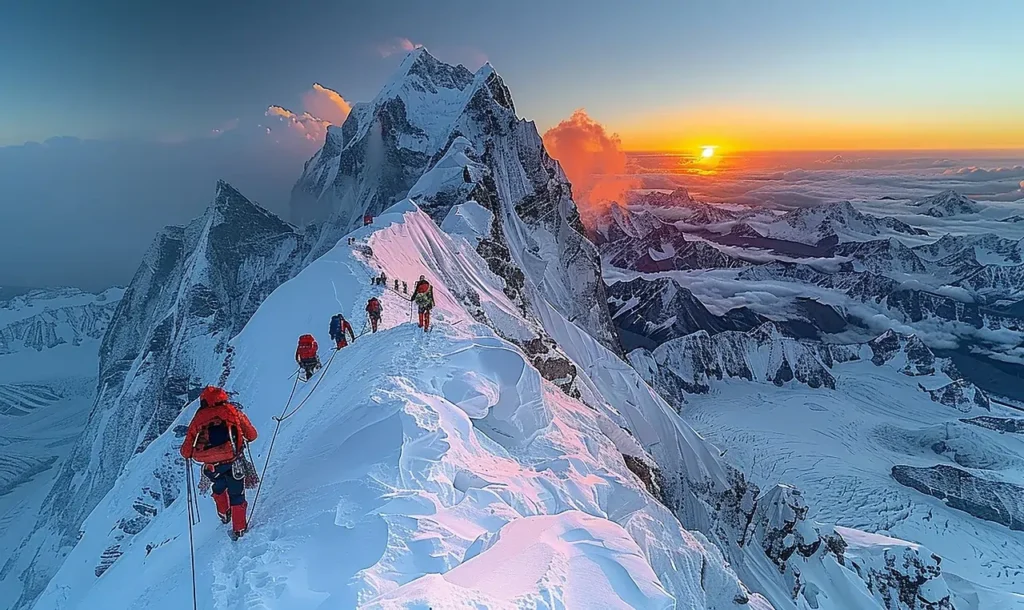
1. Mount Everest stands proud as the world’s highest peak at 8,848.86 meters
Mount Everest stands proud as the world’s highest peak with an altitude of 8,848.86 meters.
Everest was first measured in 1856 at a height of 8,840 meters. In 1955, it was adjusted to 8,848 meters. Then, in 2020, a new official height of 8,848.86 meters was announced jointly by Nepal and China. This is one of the most accurate and interesting facts about Mount Everest.
2. Edmund Hillary and Tenzing Norgay, the First people to climb Everest
One of the most iconic facts about Edmund Hillary, along with Tenzing Norgay, is that they became the first people to summit Mount Everest on May 29, 1953. Their legendary climb opened the doors for all future expeditions and made history forever.
3. Everest stands at the border of Nepal and Tibet, uniting two cultures under one summit
Mount Everest lies on the border between Nepal and Tibet. It stands as a natural boundary while also symbolising the unity of two cultures that both hold the mountain sacred.
4. Mauna Kea: The True Tallest Mountain?
Although Mount Everest is the highest peak in the world at 8,848.86 meters above sea level, it isn’t the tallest mountain when measured from base to tip.
The title belongs to Mauna Kea, a massive volcano in Hawaii that stands about 10,200 meters tall. However, the majority of Mauna Kea is hidden below sea level. This is a fascinating comparison that shows Everest’s title depends on how you measure “tallest mountain.”
5. The 2 PM Rule: A Scary Fact About Mount Everest
When climbing Mount Everest, climbers must begin their descent by 2 PM. This is known as the 2 PM rule. Failing to descend in time can lead to dangerous weather conditions and darkness, increasing the risk of death.
A scary fact about Mount Everest is that it highlights the harsh reality that climbers face at extreme altitudes.
6. Sherpas perform puja rituals to seek blessings from the mountain gods.
Before every expedition, Sherpas of Mount Everest perform a puja ritual to ask for blessings from the mountain gods. These ceremonies are deeply spiritual and symbolise unity, good fortune, and safety. This is one of the most respected Mount Everest Sherpa facts and reflects the cultural and religious traditions of the Himalayan people.
7. Kami Rita Sherpa’s World Record
Kami Rita Sherpa from Nepal holds the world record for the most Everest summits for 31 times. This achievement not only shows physical strength but also deep experience and respect for the mountain.
8. Everest isn’t just a mountain; it’s made of ancient marine limestone from an ocean
One of the most fascinating scientific facts about Everest is that its peak was once part of the ocean floor, around 400 million years ago. The presence of marine limestone at the summit proves its underwater origins.
9. Fun Fact About Everest Weddings
People have gotten married on Mount Everest. In 2005, a Sherpa couple from Nepal had a 10-minute wedding ceremony at the summit.
Later, a couple from California held their ceremony at Everest Base Camp. These are truly fun facts about Everest that show its role in unforgettable life moments.
10. Everest has been climbed by both the youngest and oldest adventurers on Earth

There is no official age restriction for climbing Everest.
The youngest male climber was Jordan Romero from the U.S., who summited at age 13. The youngest female was Malavath Purna from India at age 12 in 2014.
The oldest male to summit was Yuichiro Miura from Japan at age 80, and the oldest female was Tamae Watanabe, also from Japan, at age 73. Truly inspiring examples of human endurance!
11. Fastest Everest Summit with Unbelievable Speed
Shocking fact about the Everest summit: Lhakpa Gelu Sherpa from Nepal reached the top in just 10 hours, 56 minutes, and 46 seconds from the South side on May 26, 2003. This remains one of the fastest recorded climbs in history.
12. Frozen Corpses of Everest
Over 300 climbers have lost their lives on Everest, and many of their bodies are on the mountain, frozen by the extreme cold. These hauntings are the reminders of the dangers that come with attempting to conquer the world’s highest summit. Some of these bodies have become infamous landmarks for those making the climb.
One of the most well-known is that of George Mallory, a British mountaineer who disappeared during an expedition in 1924. His body was discovered 70 years later, still lying far below the summit. Whether he reached the top before his death remains one of Everest’s greatest mysteries.
13. Everest’s weather: change in an hour
The weather on Mount Everest is extremely unpredictable. Conditions can change completely within an hour, turning clear skies into deadly storms. That is one of the reasons preparation and timing are very critical and crucial for survival.
14. Best Time to Climb Mount Everest (explain more)
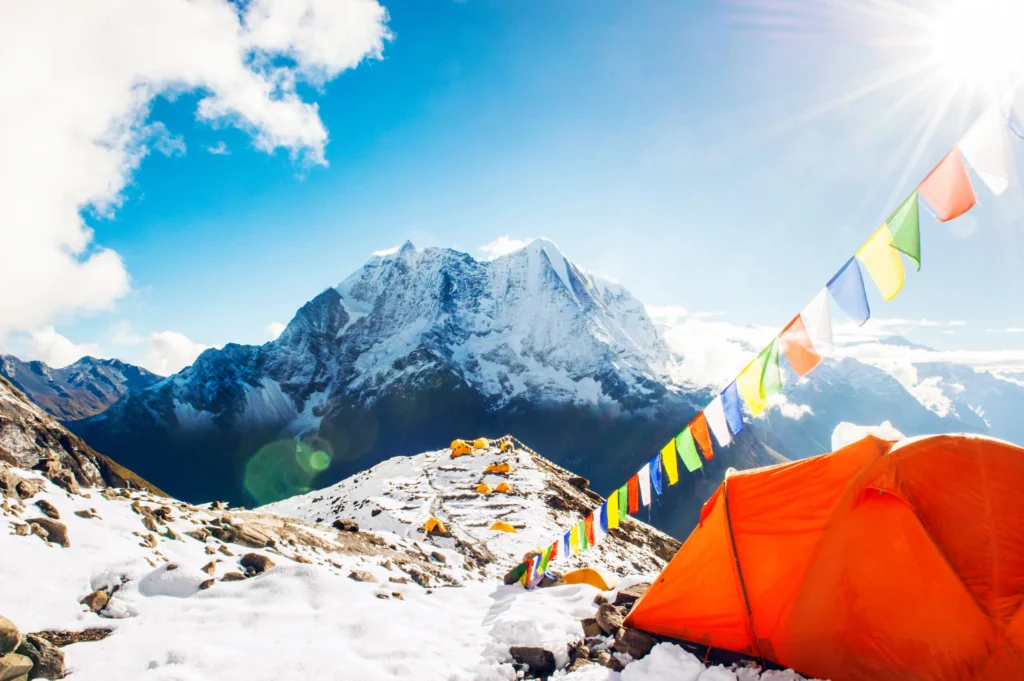
The best seasons to summit Everest are Spring (April–May) and autumn (September–October). These months offer clearer skies, stable weather, and safer climbing conditions, which is why most expeditions are scheduled during these periods, making them the most popular season for Everest expeditions. which follows
Stable weather and late April to May bring longer daylight hours and milder winds, which are crucial at higher altitudes.
Note: Monsoon (June–August): Heavy rain, cloud cover, and a high risk of landslides and avalanches make it too dangerous.
15. The mountain is still alive, growing 44mm every year
One of the most amazing scientific facts about Mount Everest is that it is still growing by about 44 millimeters every year. This growth is caused by the tectonic plates below the Himalayas continuously pushing upward, making the mountain truly alive.
Also Read: Trek in Nepal for Beginners
Conclusion
From its fluctuating measurements to icy paths with fascinating records, Mount Everest is packed with stories that make it so much more than just the highest peak. It carries facts, feelings, and fascination in every icy breath. The more you learn, the more magical and mysterious it becomes.
Whether you dream of climbing it or just admire it from afar, the facts of Mount Everest are a reminder of how small we are next to nature and how big our dreams can be.
FAQS
What is the 2 PM rule on Mount Everest?
Climbers must summit by 2 PM, and beginning to descend after staying longer increases the risk of death due to weather.
What is Mount Everest famous for?
Everest is the highest mountain in the world, standing at 8,848.86 meters.
What are the shocking facts about Mount Everest?
It’s called Sagarmatha in Nepal and Chomolungma in Tibet.
Wind speeds can reach over 200 km/h.
Some bodies on Everest serve as landmarks.
It grows about 4mm taller every year.
How many people have died on Mount Everest?
Over 300 climbers have died on Everest since the 1920s.
What is the height of Mount Everest?
After 2020, data height of Mount Everest is 8,848.86 meters (29,031.7 feet).
What country is Mount Everest in?
It lies on the border of Nepal and China, but the southern face (main route) is in Nepal.
Where is Mount Everest in Asia?
In the Himalayas, between Nepal and the Tibet Autonomous Region of China.
2014 Mount Everest avalanche facts?
It took place in Khumbu Icefall near Everest base camp on the Nepal side, which was caused by to large ice block breaking, triggering the avalanche, and it impacted the climbing season and highlighted the risk for Sherpa.
How many Sherpas have died on Mount Everest?
Sherpas, who are the backbone of the Everest trek, many of them have lost their lives. Over 120 Sherpas have lost their lives ever since the 1920s