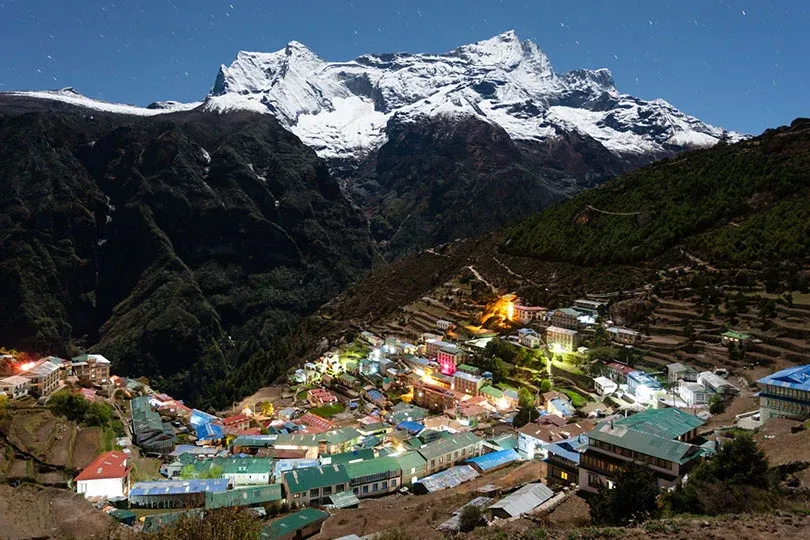
Everest Base Camp Trek Packages – Cost, Itinerary & 12, 14 & 16 Day Options – 12, 14 & 16 Days
Trip Overview
| Country | Nepal |
| Duration | 12, 14 & 16 Days |
| Difficulty | HARD |
| Max Altitude | 5,545 meters/18,192 feet (Kalapatthar) |
| Meals | Breakfast, Lunch, Dinner |
| Accommodation | Hotel + Teahouse |
| Best Season | March–May, September–November |
Trip Highlights
Fly into Lukla (2,845 m), home to one of the world's most famous mountain airports, with spectacular Himalayan views during the flight.
Cross several high suspension bridges, including the famous Hillary Suspension Bridge above the Dudh Koshi River gorge.
Spend an acclimatization day in Namche Bazaar, the historic Sherpa trading hub, with panoramic views of Kongde Ri, Thamserku, and surrounding peaks.
Visit Tengboche Monastery, one of the most important Buddhist monasteries in the Khumbu region, with the stunning Ama Dablam peak rising behind it.
Walk through the Thukla Memorial area, where stone chortens honor climbers and Sherpas who lost their lives on Everest and other Himalayan peaks.
Reach Everest Base Camp (5,364 m) and stand beneath the dramatic surroundings of the Khumbu Icefall.
Watch sunrise from Kala Patthar (5,545 m), the highest point of the trek and one of the best viewpoints for panoramic Everest views.
Stay in traditional Sherpa teahouses, experiencing authentic mountain hospitality from local families along the trail.
Experience the natural beauty of Sagarmatha National Park, home to Himalayan wildlife including Himalayan tahr and danphe, Nepal's national bird.
Trip Description
Which Everest Base Camp Trek Should You Choose?
Choosing the right itinerary depends on your available time, preferred trekking pace, and the type of experience you're looking for.
Choose the 12-Day Express Trek if:
You have limited time but still want to complete the classic Everest Base Camp route. This itinerary is best suited to trekkers with good physical fitness who are comfortable with slightly longer trekking days.
Choose the 14-Day Classic Trek if:
You want the most balanced Everest Base Camp experience. With proper acclimatization, a comfortable trekking schedule, and a contingency day for Lukla flight delays, this is our recommended itinerary for most first-time trekkers.
Choose the 16-Day Extended Trek if:
You prefer a slower journey with more opportunities to enjoy the mountain scenery, Sherpa culture, and the unique atmosphere of the Everest region without feeling rushed.
Note: All three Everest Base Camp itineraries follow the same classic route to Everest Base Camp and Kala Patthar. The differences lie in the overall trip duration, daily trekking pace, acclimatization schedule, and additional buffer or sightseeing days.
Pricing Note: The displayed prices are per person and apply to bookings for 2 or more trekkers. Private trek pricing may vary based on group size, departure date, and requested services. Please contact us for a customized private trek quotation.
Private Trek Note: The 12-Day Express and 16-Day Extended itineraries are operated as private treks, allowing you to trek solo or with your own partner, family, or group. The 14-Day Classic follows fixed group departure dates but can also be arranged as a private trek upon request. Solo trekkers are welcome on all itineraries, with private-trip pricing applicable.
Detailed Itinerary
14-Days Classic
Day 1 – Day 1: Arrival in Kathmandu (1,400 m / 4,593 ft)
| Accommodation | Hotel |
| Meals | Welcome Dinner (D) |
Land at Tribhuvan International Airport, where a Walk Through Nepal representative meets you and transfers you to your hotel. If you arrive early enough, the rest of the day is free, most trekkers use it to walk around Thamel, pick up any last-minute gear, or rest before an early Lukla flight. In the evening, your guide runs a short trip briefing covering the route, packing check, and permit paperwork, followed by a welcome dinner together.
Day 3 – Day 2: Fly to Lukla (2,845 m / 9,334 ft) & Trek to Phakding (2,610 m / 8,563 ft)
| Descent | ~250 m |
| Distance | 8 km |
| Accommodation | Teahouse |
| Meals | Breakfast, Lunch, Dinner |
Flight duration: ~30 min | Trek: 3–4 hrs
The early morning Lukla flight usually departs before 7:00 AM, touching down at Tenzing-Hillary Airport (2,845 m / 9,334 ft). Landing on one of the shortest, most sharply angled runways in commercial aviation is a genuine, adrenaline-spiking highlight in its own right.
From Lukla, your foot journey officially begins. The trail drops gently through the hillside village of Chheplung (2,700 m / 8,858 ft) and traces the glacier-fed Dudh Koshi River down to Phakding (2,610 m / 8,563 ft). Along this stretch, you'll walk past beautifully carved stone mani walls and catch your first close look at traditional prayer wheels turned continuously by the river's current.
By losing roughly 250 meters of altitude from your initial landing point, this short 3-to-4-hour trek is a deliberate design choice. It gives your body a comfortable, low-stress head start to adapt to the mountain environment before the rigorous uphill climbing begins tomorrow.
Day 2 – Day 3: Trek from Phakding (2,610 m / 8,563 ft) to Namche Bazaar (3,440 m / 11,286 ft)
| Ascent | ~830 m |
| Distance | 11 km |
| Duration | 6–7 hrs |
| Accommodation | Teahouse |
| Meals | Breakfast, Lunch, Dinner |
This is your first genuinely challenging day on the trail. Leaving Phakding behind, the route snakes along the valley floor, crossing the roaring Dudh Koshi River multiple times via high-slung steel suspension bridges.
You will first arrive at the vibrant village of Monjo (2,835 m / 9,301 ft), where our team handles your official permit registration at the gateway checkpoint for Sagarmatha National Park. From there, the trail dips down to the riverside settlement of Jorsalle (2,740 m / 8,989 ft) before hitting Larja Dobhan, the dramatic, crashing confluence of the Dudh Koshi and Bhote Koshi rivers.
Here, you will cross the celebrated Hillary Suspension Bridge (2,900 m / 9,514 ft), an exhilarating span hung approximately 125 meters directly over the river gorge.
Once across, the real test begins: a steady, steep two-hour uphill grind through deep alpine pine forests. This climb requires a slow, rhythmic pace, but your hard work is beautifully rewarded halfway up at a distinct clearing where, weather permitting, you will catch your very first, unforgettable glimpse of Mount Everest peeking over the Lhotse ridge. Your day ends as you step into the natural amphitheater of Namche Bazaar (3,440 m / 11,286 ft), the bustling cultural heart of the Khumbu.
Day 4 – Day 4: Acclimatization Day — Hike to Everest View Hotel (3,880 m / 12,730 ft)
| Accommodation | Teahouse |
| Meals | Breakfast, Lunch, Dinner |
Nestled in a dramatic horseshoe-shaped mountain basin, Namche Bazaar (3,440 m / 11,286 ft) is where we stage your first dedicated acclimatization day. But don’t let the word "rest" fool you, this day is all about active recovery, following the golden mountaineering principle: climb high, sleep low.
In the morning, we take a steady uphill acclimatization hike to the iconic Hotel Everest View (3,880 m / 12,730 ft). Perched high on a ridge, this spot rewards your effort with an unbelievably close, wide-angle panorama of Mount Everest, Lhotse, and the sharp, elegant spire of Ama Dablam. Pushing your body up to nearly 3,900 meters triggers your system to safely adapt to lower oxygen levels before you head back down to Namche's lower altitude to sleep.
Your afternoon is completely free to explore the vibrant terraced streets of the Sherpa capital. You can browse the local bakeries for a great cup of coffee, visit the Sherpa Culture Museum, or explore Namche’s famous Saturday Market if our itinerary timing aligns.
Why Active Acclimatization Works: Staying completely still at high altitude actually slows down your body's adaptation process. Light, uphill trekking increases your heart and respiration rates, safely signaling your body to produce more red blood cells without over-exhausting your muscles.
Day 5 – Day 5: Trek from Namche Bazaar (3,440 m / 11,286 ft) to Tengboche (3,867 m / 12,687 ft)
| Ascent | ~420 m |
| Distance | 10 km |
| Duration | 5–6 hrs |
| Accommodation | Teahouse |
| Meals | Breakfast, Lunch, Dinner |
Leaving Namche Bazaar, the trail snakes along a high, panoramic ridge line. This section is widely considered one of the most scenic walks on earth, offering near-constant, unhindered views of Mount Everest, Lhotse, and the striking, elegant profile of Ama Dablam directly ahead.
Eventually, the trail dips out of the high alpine air, descending gently through shaded woods to the rushing waters of the Dudh Koshi River at Phunki Thanga (3,250 m / 10,663 ft). This tranquil riverside settlement serves as our scheduled lunch stop, allowing you to rest and refuel right before tackling the afternoon's challenge.
From the river crossing, the path turns directly upward. You will begin a steep, steady two-hour physical climb through deep pine and brilliant rhododendron forests. While demanding, the canopy offers cool shade until you finally crest the ridge and step onto the wide saddle of Tengboche (3,867 m / 12,687 ft).
Tengboche Monastery, perched against a backdrop of towering Himalayan giants, is the undisputed spiritual heart of the entire Khumbu region. If our trail timing aligns perfectly, the monastery doors open to visitors for the late afternoon puja (monastic prayer ceremony), a deeply moving, peaceful experience of chanting and horns that is absolutely worth staying for.
Day 6 – Day 6: Trek from Tengboche (3,867 m / 12,687 ft) to Dingboche (4,410 m / 14,468 ft)
| Ascent | ~550 m |
| Distance | 11 km |
| Duration | 5–6 hrs |
| Accommodation | Teahouse |
| Meals | Breakfast, Lunch, Dinner |
The day begins with a gentle descent from the Tengboche ridge through the deep, moss-draped rhododendron and birch forests of Deboche (3,820 m / 12,532 ft). Keep an eye out for wildlife along this peaceful stretch, as Himalayan tahr and musk deer frequently graze near the trail.
The path soon reaches the bottom of the gorge, where you will cross a suspension bridge over the rushing waters of the Imja Khola (~3,750 m / 12,303 ft). From here, the trail steadily climbs up the valley wall to Pangboche (3,930 m / 12,893 ft). This historic village is one of the oldest permanent settlement in the entire Khumbu region and home to the revered Pangboche Monastery has long been associated with Everest expeditions and Sherpa mountaineering traditions.
As you push past Pangboche and hike toward the small settlement of Shomare (4,040 m / 13,254 ft), you will experience a dramatic environmental shift. The protective tree line disappears almost entirely, giving way to sparse alpine scrub, hardy bushes, and wind-scoured terrain. You have officially left the forest behind and stepped into the high-altitude alpine zone, where the massive, icy faces of Lhotse and Ama Dablam dominate an increasingly raw and beautiful horizon.
Day 7 – Day 7: Acclimatization Day — Hike to Nangkartshang Hill (5,083 m / 16,676 ft)
| Accommodation | Teahouse |
| Meals | Breakfast, Lunch, Dinner |
Your second scheduled acclimatization day takes place in the high valley settlement of Dingboche (4,410 m / 14,468 ft). Because you are now well above the critical 4,000-meter threshold, this day is absolutely vital for ensuring a safe and successful push toward Base Camp over the coming days.
Just like in Namche, we maximize your recovery by putting the "climb high, sleep low" strategy into active practice. In the morning, we take on a challenging, steep acclimatization trek up Nangkartshang Hill (5,083 m / 16,676 ft).
While the thin air makes this a genuinely tough, slow-paced climb, crossing the 5,000-meter mark pays off immensely. From the rocky ridge line, you are rewarded with an extraordinary, sweeping view of the Imja Valley and the massive, icy block of Makalu (8,485 m / 27,838 ft)—the world's fifth-highest mountain—towering majestically to the east.
After spending some time at the top to let your body adjust to the higher altitude, we head back down to the warmer, oxygen-rich environment of Dingboche for a well-deserved afternoon of rest, hydration, and a hearty dinner.
Day 8 – Day 8: Trek from Dingboche (4,410 m / 14,468 ft) to Lobuche (4,940 m / 16,207 ft) via Thukla Pass (4,830 m / 15,846 ft)
| Ascent | ~530 m |
| Distance | 9 km |
| Duration | 5–6 hrs |
| Accommodation | Teahouse |
| Meals | Breakfast, Lunch, Dinner |
The journey resumes as you ascend a gentle slope out of the Dingboche valley, crossing a wide glacial terrace to reach the tiny collection of tea houses at Thukla (4,620 m / 15,157 ft). This is a perfect place to pause and mentally prepare for the steep, grueling hour-long climb directly ahead up the terminal moraine of the Khumbu Glacier.
At the crest of this climb lies Thukla Pass (4,830 m / 15,846 ft), widely considered one of the most poignant and memorable segments of the entire trek.
The ridge is lined with dozens of stone chortens (monuments) wrapped in weathered prayer flags, dedicated to the memory of climbers and Sherpas who lost their lives on Everest and neighboring peaks. Standing among the memorials of legendary mountaineers like Scott Fischer and Rob Hall, who perished during the infamous 1996 storm, presents a quiet, deeply sobering moment that underscores the raw, uncompromising power of the Himalayas.
Once you pass the memorials, the trail flattens out significantly. You will follow a rough, rock-strewn path tracking alongside the lateral moraine of the Khumbu Glacier before arriving at your high alpine outpost for the night: the stark, glacier-framed settlement of Lobuche (4,940 m / 16,207 ft).
Day 9 – Day 9: Trek to Everest Base Camp (5,364 m / 17,598 ft) & Return to Gorak Shep (5,164 m / 16,942 ft)
| Ascent | ~200 m net |
| Descent | ~500 m |
| Distance | 11.5 km |
| Duration | 8–9 hrs |
| Accommodation | Teahouse |
| Meals | Breakfast, Lunch, Dinner |
The trek pushes higher as you follow the rocky moraine of the Khumbu Glacier toward Gorak Shep (5,164 meters / 16,942 feet), the highest permanent lodge settlement on the route. You will reach this desolate, ice-rimmed outpost by late morning. Here, we stop briefly to drop our heavy duffel bags, grab a quick lunch, and fuel up for the monumental push to our ultimate goal.
Leaving Gorak Shep, you begin the final 2.5-to-3-hour trek over the shifting rocks, gravel, and bare ice ridges of the active Khumbu Glacier toward Everest Base Camp (5,364 m / 17,598 ft).
As noted earlier, there is no view of the actual Everest summit from the ground here, the massive shoulder of Nuptse (7,861 m) entirely blocks it from this specific angle. However, standing directly at the base of the colossal, tumbling walls of the Khumbu Icefall is an intensely moving experience. If you trek during the spring climbing season, you will find yourself walking through a sprawling, vibrant city of colorful expedition tents filled with elite mountaineers preparing for the summit.
After spending time celebrating your arrival and taking photos at the iconic marker rock, you will retrace your steps for another 2.5 to 3 hours across the glacial moraine, returning to the relative shelter of Gorak Shep for a well-earned dinner and an early night.
Day 10 – Day 10: Sunrise Hike to Kala Patthar (5,545 m / 18,192 ft) & Descend to Pheriche (4,371 m / 14,340 ft)
| Ascent | ~381 m |
| Descent | ~1,170 m |
| Distance | 16 km |
| Duration | 7–8 hrs |
| Accommodation | Teahouse |
| Meals | Breakfast, Lunch, Dinner |
Today brings the ultimate mountain view of the entire journey. A pre-dawn start, usually around 4:30 AM in the freezing, biting air, begins the steep, demanding climb up to Kala Patthar (5,545 m / 18,192 ft). Kala Patthar is widely regarded as the best accessible viewpoint of Mount Everest during the trek. Watching the first golden rays of sunrise strike the apex of Everest, Lhotse, and Nuptse is a profoundly moving reward for your physical effort.
After capturing your landmark photos, you will descend back down the rocky slopes to the lodges at Gorak Shep (5,164 m / 16,942 ft) for a warm, heavy breakfast.
With bags packed, you'll begin the long journey home, retracing your steps back down the lateral moraine of the glacier. The trail winds past Lobuche (4,940 m / 16,207 ft) and shifts down the Thukla Pass before branching into the wide, wind-swept alpine meadows of Pheriche (4,371 m / 14,340 ft). By descending nearly 1,200 vertical meters from the morning's peak, your body is instantly flooded with thick, noticeably higher oxygen levels than Gorak Shep. This massive altitude relief brings immediate physical relaxation and almost always makes this the deepest, most restorative night of sleep of the entire trek.
Day 11 – Day 11: Trek from Pheriche (4,371 m / 14,340 ft) to Namche Bazaar (3,440 m / 11,286 ft)
| Descent | ~930 m |
| Distance | 18 km |
| Duration | 6–7 hrs |
| Accommodation | Teahouse |
| Meals | Breakfast, Lunch, Dinner |
This is a classic, rewarding descent day as you retrace your steps back down the valley. Leaving the high alpine flats of Pheriche, the trail drops smoothly through the stone walls of Pangboche (3,930 m / 12,893 ft) and dips briefly through the forest at Deboche before climbing back onto the wide, spiritual saddle of Tengboche (3,867 m / 12,687 ft).
From Tengboche, you will plunge down a steep, dusty decline through rhododendron canopies until you reach the bridge over the Dudh Koshi River at Phunki Thanga (3,250 m / 10,663 ft). After a final, steady push back up the opposite valley wall, the trail smooths out into a spectacularly wide, cliff-hugging path.
With altitude no longer a limiting factor and oxygen levels steadily increasing with every hour of descent, your pace will pick up noticeably. Lungs feel clear, muscles move easily, and the sheer joy of walking through thick air makes this one of the most celebratory and genuinely enjoyable days of the entire expedition. The day concludes as you walk back into the amphitheater of Namche Bazaar (3,440 m / 11,286 ft), where hot showers, bakeries, and Wi-Fi await.
Day 12 – Day 12: Trek from Namche Bazaar (3,440 m / 11,286 ft) back to Lukla (2,845 m / 9,334 ft)
| Descent | ~595 m |
| Distance | 19 km |
| Duration | 6–7 hrs |
| Accommodation | Teahouse |
| Meals | Breakfast, Lunch, Dinner |
The final trekking day brings your incredible Himalayan loop full circle. Leaving Namche Bazaar (3,440 m / 11,286 ft) in the morning, you will retrace your steps back down the steep valley walls toward the riverside pathways.
You’ll cross the Hillary Suspension Bridge one last time and pass through the national park checkpoints at Jorsalle (2,740 m / 8,989 ft) and Monjo (2,835 m / 9,301 ft). From there, the trail winds smoothly along the glacier-fed waters of the Dudh Koshi River, guiding you back through the familiar lunch stop of Phakding (2,610 m / 8,563 ft). While this is a long day of hiking, covering roughly 19 kilometers, the terrain is safely in your favor, almost entirely trending downhill or flattening out.
The final hour of the trek presents a gentle, steady uphill incline that brings you directly through the stone pillars of the Pasang Lhamu Memorial Gate in Lukla (2,845 m / 9,334 ft). Walking back into town with the entire 130-kilometer route behind you brings an unforgettable, profound sense of closure. Tonight, you'll share a celebratory final dinner with your guiding team and porters, raising a toast to an incredible journey before your early morning flight back to Kathmandu tomorrow.
Day 13 – Day 13: Fly back to Kathmandu (1,400 m / 4,593 ft) — Buffer & Contingency Day
| Accommodation | Hotel |
| Meals | Breakfast, Farewell Dinner (D) |
Flights out of Lukla (2,845 m / 9,334 ft) are strictly weather-dependent, and mountain flight delays are common, particularly during the shoulder seasons. We deliberately build this buffer day into our itinerary to absorb that weather risk, ensuring a flight delay never threatens your international departure out of Kathmandu (1,400 m / 4,593 ft).
If our morning flight departs exactly as scheduled, you will land back in the capital by mid-morning, leaving the rest of the day entirely yours to enjoy. It’s a perfect afternoon for a long, hot luxury shower, hunting for cashmere and spices in the bustling alleys of Thamel, or sharing a final, celebratory farewell dinner with your guiding team to toast your successful return from Everest Base Camp.
Our Safety Policy: Because your international connection is a priority, Walk Through Nepal actively monitors real-time Khumbu weather tracking networks. In the rare event of prolonged flight cancellations, having this built-in buffer day gives us the critical window needed to arrange alternative logistics, such as helicopter back-ups, without disrupting your travel plans.
Day 14 – Day 14: Final Departure — Transfer to Tribhuvan International Airport (TIA)
| Meals | Breakfast |
Your final day begins with a smooth, private transfer from your hotel to Tribhuvan International Airport (1,400 m / 4,593 ft) in Kathmandu, timed perfectly to align with your international flight's check-in window.
Because every Walk Through Nepal expedition is built around a fully coordinated, seamless loop, our service doesn't have to end in the capital. If your travel plans include extending your journey onward to the beautiful lakeside city of Pokhara (822 m / 2,697 ft), our team will completely coordinate those internal logistics for you.
We seamlessly manage your domestic flight or private vehicle bookings and handle your terminal transfers right from Kathmandu. Whether you are boarding your long-haul flight back home or heading out to explore the gateway of the Annapurnas, we ensure your departure is entirely fluid and stress-free up to the very last moment.
12-Days Express
Day – Day 1: Arrival in Kathmandu & Hotel Transfer (1,400 m / 4,593 ft)
| Accommodation | Hotel |
| Meals | Welcome Dinner (D) |
Logistics: Private airport pickup
Your Himalayan journey begins the moment you touch down at Tribhuvan International Airport (TIA) in Kathmandu. After clearing customs and retrieving your luggage, you will step outside to find your private vehicle waiting for a seamless airport pickup. As you travel through the energetic, historic streets of Kathmandu to your hotel, the contrasting blend of ancient architecture and modern city life welcomes you.
Once checked in, the afternoon is Yours to unwind from your long-haul flight or do any last-minute gear shopping in the bustling alleys of Thamel. In the evening, you will meet your trekking guide for a comprehensive pre-trip briefing, a thorough gear inspection, and a welcome dinner to toast the adventure ahead.
Day – Day 2: Fly to Lukla (2,845 m / 9,334 ft) & Trek to Phakding (2,610 m / 8,563 ft)
| Descent | ~200 m (from Lukla airport) |
| Accommodation | Teahouse |
| Meals | Breakfast, Lunch, Dinner |
Boarding an early morning direct flight from Kathmandu, you will experience an exhilarating 35-minute flight that treats you to sweeping views of the Himalayan chain before making its famous landing at Tenzing-Hillary Airport in Lukla. Stepping out into the crisp alpine air, you will meet your porter team, finalize your gear packs, and officially take your first steps onto the EBC trail.
The path drops gently through the terraced hillsides of Chheplung, eventually tracking the roaring, glacier-fed waters of the Dudh Koshi River. Along this introductory stretch, you will encounter beautifully carved stone mani walls and vibrant prayer wheels spun continuously by the river's flow.
By finishing the short 3-to-4-hour trek at a lower elevation than your starting flight, this initial day provides a gentle, low-stress transition that helps your body easily adapt to the mountain climate before the steep climbing begins tomorrow.
Day 3 – Day 3: Trek from Phakding (2,645 m / 8,678 ft) to Namche Bazaar (3,440 m / 11,286 ft)
| Ascent | +795 m |
| Distance | 11 km |
| Duration | 5–6 hrs |
| Accommodation | Teahouse |
| Meals | Breakfast, Lunch, Dinner |
Today’s trek is a beautiful but rigorous journey that introduces you to the high-altitude terrain of the Khumbu. Leaving Phakding, the trail crisscrosses the Dudh Koshi River via several high, swaying suspension bridges, passing through small Sherpa hamlets like Zamfute and Benkar.
You will officially cross into the Sagarmatha National Park at Monjo, where permits are checked, and descend briefly to Jorsalle for lunch. From here, the real challenge begins. You will cross the iconic, prayer-flag-draped Hillary Suspension Bridge, after which the trail transitions into a relentless, steep zigzag climb through dense pine forests.
Weather permitting, you'll catch your first glimpse of Mount Everest peeking through the trees. The climb concludes as you top the ridge and enter the bustling, amphitheater-shaped mountain town of Namche Bazaar.
Day 4 – Day 4: Acclimatization Day in Namche Bazaar (3,440 m / 11,286 ft)
| Distance | 5 km |
| Duration | 3–4 hrs |
| Accommodation | Teahouse |
| Meals | Breakfast, Lunch, Dinner |
Because this fast-track itinerary skips the traditional second rest day further up the valley, today’s active acclimatization is non-negotiable for your safety. Following the golden rule of high-altitude mountaineering, "climb high, sleep low," you will undertake a steep morning hike up the ridge toward the luxury Everest View Hotel.
As you emerge onto the ridge plateau, a jaw-dropping, panoramic vista unfolds, showcasing the striking faces of Mount Everest, Lhotse, Nuptse, and the elegant peak of Ama Dablam. After stopping for a warm beverage while soaking in the views, you will descend back to Namche Bazaar for lunch.
The afternoon is yours to explore the vibrant capital of the Khumbu, browse local bakeries, visit the Sherpa Culture Museum, or withdraw local currency at the world's highest ATMs before pushing deeper into the wild terrain.
Day 5 – Day 5: Fast-Track Push: Namche Bazaar to Pangboche (3,985 m / 13,074 ft) - Bypassing Tengboche
| Ascent | +545 m |
| Distance | 14 km |
| Duration | 6–7 hrs |
| Accommodation | Teahouse |
| Meals | Breakfast, Lunch, Dinner |
This day marks your first major tactical departure from standard trekking schedules. You will start with a spectacular, relatively flat walk winding along the side of the valley wall, offering uninterrupted views of Ama Dablam (6,812 meters / 22,349 feet). The trail then plunges steeply down to the riverbed at Phunki Thenga for a quick rest before tackling the long, notorious uphill climb through rhododendron forests to the spiritual heart of the region, Tengboche (3,867 meters / 12,687 feet).
Rather than stopping here for the night, you will take a short break to admire the famous Tengboche Monastery and then immediately push onward. The path drops slightly down into the shaded forests of Deboche (3,820 meters / 12,532 feet), crosses a roaring gorge via a steel bridge, and begins a steady, gradual climb up the valley wall to the upper settlement of Pangboche. Staying here positions you higher and further along the trail, significantly shortening tomorrow's grueling distance.
Day 6 – Day 6: Trek from Pangboche (3,985 m / 13,074 ft) to Lobuche (4,940 m / 16,210 ft) — Skipping Deboche Rest Day
| Ascent | +975 m |
| Distance | 11 km |
| Duration | 5–6 hrs |
| Accommodation | Teahouse |
| Meals | Breakfast, Lunch, Dinner |
This is the most demanding day of the Express itinerary. Our guides monitor each trekker carefully, maintain a steady pace, and encourage regular hydration and rest breaks as altitude increases.
Today you execute the ultimate fast-track maneuver by completely bypassing the traditional overnight stay and rest day in Deboche (3,820 meters / 12,532 feet). Leaving Pangboche, you will notice the tree line completely vanish, replaced by low alpine scrub and stark, windswept terrain.
The trail leads you past the small settlement of Shomare, tracing the high alpine valley floor before crossing the glacial meltwaters at Thukla for a much-needed lunch. Directly after lunch, you will tackle the infamous "Thukla Pass (4,830 meters / 15,846 feet)", a brutally steep, rocky wall that leads to the top of a glacial moraine.
At the crest, you will pass through the emotional Everest Climbers’ Memorial, a somber plateau filled with stone chortens dedicated to those who lost their lives on the high peaks. From the memorials, the trail flattens slightly, tracking alongside the massive Khumbu Glacier moraine until you reach the cold, high-altitude outpost of Lobuche.
Day 7 – Day 7: Trek from Lobuche (4,940 m / 16,210 ft) to Gorak Shep (5,164 m / 16,942 ft) & Hike to Everest Base Camp (5,364 m / 17,598 ft)
| Ascent | +204 m |
| Distance | 11.5 km |
| Duration | 8–9 hrs |
| Accommodation | Teahouse |
| Meals | Breakfast, Lunch, Dinner |
This is the massive pinnacle day you have been working toward. Leaving Lobuche early, you will navigate a technical, rocky trail that rolls up and down over rough glacial moraine debris. After roughly 3 hours of focused trekking, you will arrive at Gorak Shep (5,164 m / 16,942 ft), the final, desolate outpost of human habitation on the route.
You will quickly drop your heavy gear bags at your designated teahouse, eat a high-energy lunch, and immediately set out toward Everest Base Camp at 5,364 meters (17,598 feet). The trail to base camp winds along the lateral moraine of the active Khumbu Glacier, requiring careful footwork across shifting rocks and loose scree.
As you reach the iconic, prayer-flag-smothered Everest Base Camp rock, you will stand directly at the foot of the world's highest peak, watching the chaotic ice pinnacles of the Khumbu Icefall at 5,486 meters (17,999 feet). After celebrating your achievement and capturing photos, you will retrace your steps back along the glacier to Gorak Shep for a well-deserved, cold night's sleep.
Day 8 – Day 8: Sunrise Hike to Kala Patthar (5,545 m / 18,192 ft) & Descend to Pheriche (4,371 m / 14,340 ft)
| Ascent | +381 m |
| Descent | -1,174 m |
| Distance | 15 km |
| Duration | 6–7 hrs |
| Accommodation | Teahouse |
| Meals | Breakfast, Lunch, Dinner |
Your day begins in the pitch-black, freezing pre-dawn hours with a slow, deliberate climb up the steep, windswept face of Kala Patthar. This is physically the toughest ascent of the trek, but reaching the prayer-flag-strewn summit at 5,545 meters reveals the ultimate reward: the absolute best, unobstructed view of Mount Everest at 8,848.86 m (29,031.7 ft), glowing gold as the sun rises behind Lhotse and Nuptse.
After absorbing the breathtaking panorama, you will scramble back down to Gorak Shep for a hot breakfast, pack up your trekking gear, and begin your rapid descent down the valley. With gravity on your side and oxygen levels steadily rising with every step down, your body will feel an instant burst of renewed energy.
You will hike past the Thukla Pass moraine and drop directly down into the wide, windy valley floor to sleep in the cozy, river-side village of Pheriche.
Day 9 – Day 9: Rapid Descent: Pheriche (4,371 m / 14,340 ft) back to Namche Bazaar (3,440 m / 11,286 ft)
| Descent | -931 m |
| Distance | 18 km |
| Duration | 6–7 hrs |
| Accommodation | Teahouse |
| Meals | Breakfast, Lunch, Dinner |
Embracing the dense, oxygen-rich air of lower elevations, you will cover an immense amount of trail today. The morning route leads you down through the valley, passing through lower Pangboche before crossing the bridge back into the shade of the Deboche forests.
From here, you will face a short but sharp uphill climb to re-enter Tengboche. After stopping to appreciate the scenery from the monastery courtyard once more, you will dive into the long, steep descent through the rhododendron and pine forests back down to Phunki Thenga.
Crossing the suspension bridge at the bottom, the trail tracks along the high cliffs of the valley wall, passing Sanasa before smoothly winding its way back into the familiar, colorful horseshoe streets of Namche Bazaar. Here, you can indulge in a hot shower, celebrate at a local pub, or enjoy real espresso at a bakery.
Day 10 – Day 10: Trek from Namche Bazaar (3,440 m / 11,286 ft) back to Lukla (2,845 m / 9,334 ft)
| Descent | 595 m |
| Distance | 19 km |
| Duration | 6–7 hrs |
| Accommodation | Teahouse |
| Meals | Breakfast, Lunch, Dinner |
Your final full day of foot travel is a long, rewarding trek that retraces your very first steps. Leaving Namche Bazaar, you will make the steep, knee-jarring descent down the pine-covered ridge, crossing the high Hillary Suspension Bridge for the last time. The trail continues down along the Dudh Koshi River valley, passing through Jorsalle, Monjo, and Phakding, where you will stop for lunch.
The final stretch of the trek presents a notorious sting in the tail: a gradual, undulating uphill climb from the riverbank back up to the plateau of Lukla. Arriving back in Lukla, you will check into your teahouse and gather with your guide and porters for a warm team celebration and tipping ceremony, marking the successful completion of your trekking days on the trail.
Day 11 – Day 11: Fly from Lukla (2,845 m / 9,334 ft) back to Kathmandu (1,400 m / 4,593 ft)
| Descent | -1,445 m |
| Duration | ~35 min |
| Accommodation | Hotel |
| Meals | Breakfast, Lunch, Dinner |
Waking up early, you will head directly to the Lukla airstrip to board your morning flight back to Kathmandu. Saying a final goodbye to the mountains, the 35-minute flight brings you safely back to the capital city.
A private vehicle will be waiting at the domestic airport terminal to greet you and transfer you directly back to your city hotel. The rest of the afternoon is yours to enjoy completely at your own pace.
It serves as an invaluable buffer day in case mountain weather delays your flight out of Lukla. If your flight arrived on time, you can spend this stress-free afternoon exploring Kathmandu’s UNESCO World Heritage sites, pampering yourself with a massage, or hunting for souvenirs in Thamel.
Day 12 – Day 12: Final Departure — Transfer to Tribhuvan International Airport (TIA)
| Meals | Breakfast |
Your unforgettable 12-day Everest Base Camp adventure officially draws to a close today. After enjoying a final breakfast at your hotel, you can spend your remaining hours packing your gear or sipping a final cup of Himalayan tea. In accordance with your international flight schedule, your private vehicle will arrive at your hotel for your dedicated airport drop-off transfer.
You will be driven directly to Tribhuvan International Airport, arriving roughly three hours before your scheduled departure time to ensure a smooth check-in, carrying home lifelong memories of the world's highest peaks.
16-Days Extended
Day 1 – Day 1: Arrival in Kathmandu & Gentle Hotel Transfer (1,400 m / 4,593 ft)
| Accommodation | Hotel |
| Meals | Welcome Dinner (D) |
Logistics: Private airport pickup
Your grand Himalayan adventure begins with a warm welcome the moment your flight touches down at Tribhuvan International Airport (TIA) in Kathmandu (1,400 m / 4,593 ft). After clearing customs and retrieving your luggage, you will step out to meet your private representative for a smooth, air-conditioned airport pickup.
You will be driven directly to your hotel in the heart of Kathmandu. There is absolutely no rush today; the entire afternoon is yours to settle in, take a warm shower, and unpack. In the evening, you will enjoy a relaxed pre-trek briefing with your guide over a welcoming dinner featuring authentic local dishes.
Day 2 – Day 2: Kathmandu’s Secret Spaces Sightseeing & Trek Prep (1,400 m / 4,593 ft)
| Accommodation | Teahouse |
| Meals | Breakfast |
Activity: Cultural exploration and gear checks
This day is designed for slow, mindful exploration of Kathmandu (1,400 m / 4,593 ft). Instead of a rushed, standard tourist checklist, your private guide will lead you to the colossal, peaceful mandala of Boudhanath Stupa, where you can sit at a rooftop café, sip local tea, and watch the pilgrims spin prayer wheels.
Later, you will explore the serene, ancient brick courtyards of Patan Durbar Square, famous for its exquisite metalwork. The afternoon finishes back in Thamel with a laid-back gear inspection, ensuring your mountain clothing is perfectly sorted while you enjoy the city's vibrant pre-expedition energy.
Day 3 – Day 3: Scenic Direct Flight to Lukla (2,845 m / 9,334 ft) & Short Walk to Phakding (2,610 m / 8,563 ft)
| Descent | ~230 m |
| Accommodation | Teahouse |
| Meals | Breakfast, Lunch, Dinner |
Flight: ~35 min | Trek: 3 hrs, 8 km
You will take a short morning drive to the domestic terminal for a direct flight from Kathmandu (1,400 m / 4,593 ft) straight to the mountains. This stunning 35-minute aerial journey flies right alongside the snow-capped Himalayan peaks before executing a thrilling landing at Tenzing-Hillary Airport in Lukla (2,845 m / 9,334 ft).
After a relaxed cup of coffee at a local lodge to meet your porter team, your foot journey officially starts. The path is incredibly gentle today, dropping down through the quiet village of Chheplung (2,700 m / 8,858 ft) and following the pristine, glacier-fed Dudh Koshi River.
You will cross your first suspension bridges and walk past ancient stone mani walls before arriving early at your cozy teahouse in Phakding (2,610 m / 8,563 ft), leaving you with a completely free afternoon to read, relax, and breathe in the fresh pine air.
Day 4 – Day 4: River-Side Trek from Phakding (2,610 m / 8,563 ft) to Namche Bazaar (3,440 m / 11,286 ft)
| Ascent | +825 m |
| Distance | 11 km |
| Duration | 5–6 hrs |
| Accommodation | Teahouse |
| Meals | Breakfast, Lunch, Dinner |
Today’s trek combines a peaceful river walk with a solid uphill challenge. Leaving Phakding (2,610 m / 8,563 ft), the trail gently winds through blue-pine forests and crosses the turquoise river several times via spectacular suspension bridges. You will walk through the sleepy hamlet of Benkar (2,630 m / 8,628 ft) and check your permits at the quiet village of Monjo (2,835 m / 9,301 ft).
After a very unhurried, long lunch break at Jorsalle (2,740 m / 8,989 ft), you will walk along the rocky riverbed to cross the high, iconic Hillary Suspension Bridge. From here, you will take a slow, rhythmic pace up the forested ridge.
Your guide will point out a special clearing where you will catch your first magnificent view of Mount Everest (8,848.86 m / 29,031.7 ft) nestled between the ridges, before you finish the climb into the vibrant, amphitheater-shaped mountain capital of Namche Bazaar (3,440 m / 11,286 ft).
Day 5 – Day 5: Acclimatization & Local Exploration in Namche Bazaar (3,440 m / 11,286 ft)
| Distance | 5 km |
| Duration | 3 hrs |
| Accommodation | Teahouse |
| Meals | Breakfast, Lunch, Dinner |
Today is completely dedicated to resting your body and adapting naturally to the altitude. After a late breakfast, you will take a slow, easy walk climbing out of the village toward the panoramic ridge where the Everest View Hotel (3,880 m / 12,730 ft) sits.
Here, you can sit on the wide stone terrace and enjoy an unhurried morning soaking in views of Mount Everest (8,848.86 m / 29,031.7 ft), Lhotse (8,516 m / 27,940 ft), and the beautifully sharp peak of Ama Dablam (6,812 m / 22,349 ft).
Instead of rushing back, you will wander down through the traditional Sherpa village of Khumjung (3,790 m / 12,434 ft) to see its quiet monastery, then return down to Namche Bazaar to spend a relaxed afternoon enjoying local German bakeries or browsing the mountain markets.
Day 6 – Day 6: Panoramic Forest Walk from Namche Bazaar (3,440 m / 11,286 ft) to Tengboche (3,867 m / 12,687 ft)
| Ascent | +427 m |
| Distance | 10 km |
| Duration | 4–5 hrs |
| Meals | Breakfast, Lunch, Dinner |
Leaving Namche Bazaar you will enjoy one of the most scenic and visually stunning trail sections in the world. The path hugs the high valley wall, offering flat, easy walking with continuous views of the snow-peaks.
The trail then slopes down through rhododendron trees to the rushing waters of Phunki Thenga (3,250 m / 10,663 ft), where you will stop for a long, relaxed lunch by the waterwheels. In the afternoon, you will make a steady, slow climb up through shaded, moss-covered forests to the high alpine ridge of Tengboche (3,867 m / 12,687 ft).
Because you are stopping here for the night, you have the exclusive opportunity to visit the famous Tengboche Monastery late in the afternoon to hear the monks chanting, surrounded by a magical sunset over Everest.
Day 7 – Day 7: Easy, Immersive Valley Trek from Tengboche (3,867 m / 12,687 ft) to Pangboche (3,985 m / 13,074 ft)
| Ascent | +118 m |
| Distance | 4 km |
| Duration | 2–3 hrs |
| Accommodation | Teahouse |
| Meals | Breakfast, Lunch, Dinner |
This is a uniquely relaxed day that sets this itinerary apart from standard, exhausting trips. Instead of pushing all the way to Dingboche, you are stopping early to enjoy the incredible beauty of the upper valley.
You will wake up to a crisp morning view of Tengboche (3,867 m / 12,687 ft) and walk down through the fairytale-like birch forests of Deboche (3,820 m / 12,532 ft). After crossing a suspension bridge over a deep river gorge, you will make a brief, easy climb up the stone trails to the historic village of Pangboche (3,985 m / 13,074 ft).
You will arrive well before lunchtime. You can spend the entire afternoon visiting the oldest monastery in the Khumbu region or walking among the local potato fields, enjoying the deep peace of a traditional Sherpa village far away from the trekking crowds.
Day 8 – Day 8: Alpine Trail Trek from Pangboche (3,985 m / 13,074 ft) to Dingboche (4,410 m / 14,470 ft)
| Ascent | +550 m |
| Distance | 6 km |
| Duration | 3–4 hrs |
| Accommodation | Teahouse |
| Meals | Breakfast, Lunch, Dinner |
Because you stayed in Pangboche yesterday, today's walk up to the higher valley is remarkably short and low-stress. Leaving Pangboche, you will enter the true alpine zone where the trees fade into open, rolling pastures. You will walk past the small stone huts of Shomare (4,010 m / 13,156 ft), taking a very slow and steady pace to let your lungs easily adapt to the crossing of the 4,000-meter line.
The trail splits, and you will take the right path, dropping down slightly to cross the Imja Khola river before climbing gently into the wide, stone-walled valley of Dingboche (4,410 m / 14,470 ft). You will arrive in time for a hot lunch, leaving your afternoon free to relax with a book or enjoy a warm pastry at a local valley café.
Day 9 – Day 9: Off-the-Beaten-Path Acclimatization Walk in Dingboche (4,410 m / 14,470 ft)
| Distance | 4 km |
| Duration | 3 hrs |
| Accommodation | Teahouse |
| Meals | Breakfast, Lunch, Dinner |
Today is your second vital rest and acclimatization day. To make this experience highly unique, instead of climbing the steep, crowded front face of Nangkartshang Hill, your guide will lead you on a quieter, much more relaxed acclimatization walk up the slopes facing the Chhukung Valley (4,730 m / 15,518 ft).
This path gives you an incredibly unique, close-up look at the vast, hidden frozen north face of Ama Dablam (6,812 m / 22,349 ft) and the sheer, towering rock wall of Lhotse (8,516 m / 27,940 ft).
You will hike up to a beautiful viewpoint, sit down to enjoy a packed snack in the quiet wilderness, and then head back down to Dingboche (4,410 m / 14,470 ft) for a fully relaxed afternoon of reading and resting.
Day 10 – Day 10: Glacial Trek from Dingboche (4,410 m / 14,470 ft) to Lobuche (4,940 m / 16,210 ft) via Thukla Pass (4,830 m / 15,846 ft)
| Ascent | +550 m |
| Distance | 8 km |
| Duration | 4–5 hrs |
| Accommodation | Teahouse |
| Meals | Breakfast, Lunch, Dinner |
Refreshed from your gentle pacing, you will head out of Dingboche onto a high, open plain that offers incredible views of the Taboche and Cholatse peaks. The walking is smooth and steady until you reach the small cluster of huts at Thukla (4,620 m / 15,157 ft), where you will take a long rest and a warm drink.
Next, you will climb the famous Thukla Pass (4,830 m / 15,846 ft). By taking a very slow, step-by-step pace, you will reach the top of the ridge where the emotional Everest Climbers’ Memorial (4,830 m / 15,846 ft) rests.
You will spend some time walking among the stone monuments dedicated to historic climbers, then follow the gentle moraine path along the edge of the Khumbu Glacier until you reach the high-altitude outpost of Lobuche (4,940 m / 16,210 ft).
Day 11 – Day 11: Trek to Gorak Shep (5,164 m / 16,942 ft) & Journey to Everest Base Camp (5,364 m / 17,598 ft)
| Ascent | +204 m |
| Distance | 11.5 km |
| Duration | 8–9 hrs |
| Accommodation | Teahouse |
| Meals | Breakfast, Lunch, Dinner |
This is the incredible highlight day of your journey. Leaving Lobuche (4,940 m / 16,210 ft), you will follow the rocky trails along the Khumbu Glacier moraine, taking your time over sections of loose rock before reaching the final base-lodge at Gorak Shep (5,164 m / 16,942 ft).
After dropping your heavy bags and eating a warm lunch, you will set off with a light pack for Everest Base Camp (5,364 m / 17,598 ft). The trail rolls gently over glacial debris, bringing you right onto the edge of the active ice sheets. Standing at Everest Base Camp, you can look directly up at the glowing ice towers of the Khumbu Icefall.
You will have plenty of time to take photos, celebrate with your guide, and soak in the achievement before walking back to Gorak Shep (5,164 m / 16,942 ft) for a hearty dinner.
Day 12 – Day 12: Sunrise View from Kala Patthar (5,545 m / 18,192 ft) & Unhurried Descent to Pheriche (4,371 m / 14,340 ft)
| Ascent | +381 m |
| Descent | -1,174 m |
| Distance | 11 km |
| Duration | 5–6 hrs |
| Accommodation | Teahouse |
| Meals | Breakfast, Lunch, Dinner |
You will wake up early for a slow, steady morning climb up the open slopes of Kala Patthar (5,545 m / 18,192 ft). This climb is a challenge, but reaching the summit at 5,545 meters rewards you with the ultimate panoramic view of Mount Everest (8,848.86 m / 29,031.7 ft) glowing under the first morning sunbeams.
After capturing your photos, you will descend to Gorak Shep (5,164 m / 16,942 ft) for a hot breakfast. Instead of making a long, exhausting rush all the way down to Namche like standard trips, this itinerary keeps your day beautifully relaxed.
You will pack your gear and make a short, easy afternoon walk down the valley to the wide, comfortable settlement of Pheriche (4,371 m / 14,340 ft), where you can enjoy a long, restful evening.
Day 13 – Day 13: Relaxed Valley Descent from Pheriche (4,371 m / 14,340 ft) to Namche Bazaar (3,440 m / 11,286 ft)
| Descent | -931 m |
| Distance | 14 km |
| Duration | 5–6 hrs |
| Accommodation | Teahouse |
| Meals | Breakfast, Lunch, Dinner |
Today is an exceptionally comfortable walk because your body is fully acclimated and oxygen levels increase with every step down. Leaving Pheriche, you will stroll down the wide valley trail, passing through lower Pangboche (3,985 m / 13,074 ft) and crossing into the beautiful, shaded forests of Deboche (3,820 m / 12,532 ft).
You will make a short climb back up to Tengboche (3,867 m / 12,687 ft) for a peaceful lunch break on the grassy ridge. In the afternoon, you will descend smoothly through pine-scented paths down to the river and wind your way back into the familiar comforts of Namche Bazaar (3,440 m / 11,286 ft).
After days in the high wilderness, you can treat yourself to a hot shower, use reliable Wi-Fi, and celebrate your success at a local café.
Day 14 – Day 14: Final Trail Walk from Namche Bazaar (3,440 m / 11,286 ft) back to Lukla (2,845 m / 9,334 ft)
| Descent | -595 m |
| Distance | 19 km |
| Duration | 6–7 hrs |
| Accommodation | Teahouse |
| Meals | Breakfast, Lunch, Dinner |
Your final day on the trail is a celebration of your entire journey. Leaving Namche Bazaar (3,440 m / 11,286 ft), you will head down the steep forest hill and cross the high Hillary Suspension Bridge one last time.
The route follows a relaxed pace along the Dudh Koshi River valley, passing through the familiar checkpoints of Monjo (2,835 m / 9,301 ft) and Phakding (2,610 m / 8,563 ft) for a leisurely lunch.
The final stretch winds gently up through terraced hillsides, bringing you smoothly back onto the high plateau of Lukla (2,845 m / 9,334 ft). In the evening, you will share a special farewell dinner with your guide and porter team, celebrating your incredible achievement.
Day 15 – Day 15: Morning Flight back to Kathmandu & Leisure Afternoon (1,400 m / 4,593 ft)
| Duration | ~35 min |
| Accommodation | Hotel |
| Meals | Farewell Dinner (D) |
Logistics: Private hotel transfer
You will walk over to the Lukla airport early in the morning to board your direct flight back to Kathmandu. As your plane glides over the deep green valleys, you can enjoy your final views of the high peaks.
Upon arrival at the Kathmandu terminal, a private vehicle will pick you up and transfer you straight back to your hotel. This day is completely open and serves as an important buffer in case of any mountain flight delays.
Since you have arrived on schedule, you can spend a wonderful, relaxed afternoon shopping for unique hand-made souvenirs in Thamel, booking a massage, or relaxing in a quiet garden café.
Day 16 – Day 16: Final Relaxation & Private Transfer to Tribhuvan International Airport (TIA)
| Meals | Breakfast |
Logistics: Private airport drop-off | Elevation: 1,400 m (4,593 ft)
Your beautifully paced 16-day Himalayan journey comes to a relaxed close today. After enjoying a late breakfast at your hotel in Kathmandu, you have a free morning to pack your bags, look through your trekking photos, or enjoy a final stroll through the city streets.
Depending on your international flight time, your private vehicle will arrive at your hotel to provide your airport drop-off transfer. You will be driven smoothly to Tribhuvan International Airport (TIA) roughly three hours before your flight departs, ensuring a stress-free check-in as you head home with a lifetime of amazing mountain memories.
Price Includes
Private vehicle pickup and drop-off at Tribhuvan International Airport for both your international arrival/departure and domestic flight connections
Kathmandu–Manthali–Kathmandu ground transport by shared tourist vehicle (on days when flights operate from Manthali instead of Kathmandu)
Round-trip Kathmandu–Lukla flights (or Kathmandu–Manthali–Lukla during peak season), including all airport departure taxes
Sagarmatha National Park entry permit
Khumbu Pasang Lhamu Rural Municipality entry permit
A government-licensed, first-aid trained, English-speaking trekking guide (an additional guide is assigned for groups larger than 7)
Strong, experienced porters to carry your luggage (1 porter shared between every 2 trekkers)
Full wages, insurance, meals, accommodation, and gear for all guides and porters, so you don't need to worry about tipping for basic welfare
Twin-sharing hotel accommodation in Kathmandu with breakfast included (private rooms available on request for an extra cost)
Twin-sharing teahouse accommodation for every night spent on the trekking trail, with attached bathrooms available in Lukla, Phakding, and Namche Bazaar
Three full meals a day (breakfast, lunch, and dinner) throughout the trek, chosen from local teahouse menus
Kathmandu sightseeing tours and any related entrance fees or transport
Safe drinking water on the trail via filter or purification tablets
A farewell dinner in Kathmandu on your final night in Nepal
A comprehensive group first-aid kit
Daily pulse oximeter checks to monitor your oxygen saturation and heart rate at altitude
All government taxes, local tourism fees, and office service charges
Price Excludes
Nepal entry visa fee, payable in cash on arrival at Tribhuvan International Airport (USD 30 for 15 days, USD 50 for 30 days, USD 125 for 90 days)
International airfare to and from Nepal, including airport departure taxes
Comprehensive travel insurance covering medical emergencies, high-altitude trekking up to 6,000m, and emergency helicopter evacuation (mandatory, please arrange before departure)
Personal equipment such as down jackets, sleeping bags, hiking boots, and trekking poles (good-quality rentals are easily available in Kathmandu)
Lunch and dinner in Kathmandu (breakfast at the hotel is included; a farewell dinner on your final night is also included - see Cost Includes)
Hot showers, Wi-Fi access, and device charging fees on the trail (these are charged locally by teahouses and increase with altitude)
All beverages, including alcoholic drinks, sodas, and bottled or boiled water
Tips for your guide and porter team (customary, though not mandatory - a common guideline is around 10% of the trip cost for the guide and 5% for the porter)
Any personal expenses not explicitly listed in the Cost Includes section
Trip Map
Everest Base Camp Trek Route Map
The legendary Everest Base Camp (EBC) trek is a classic fly-in, fly-out corridor through the Khumbu Valley. The single, well-marked path begins with a thrilling mountain flight into Lukla, traces the Dudh Koshi River, and climbs steeply to Namche Bazaar.
The route demands built-in acclimatization days as you move through Sherpa hubs and glacial terrain, culminating in the ultimate push to Everest Base Camp and a pre-dawn climb up Kala Patthar (5,545 m) for panoramic views of Mount Everest.
EBC Trek Distance, Duration & Altitude Chart
The Everest Base Camp trek covers approximately 130 km (80 miles) round trip from Lukla, about 65 km (40 miles) one way. The table below breaks down the Everest Base Camp trek stop by stop, elevation, distance covered, and walking time for each stage.
Note: Thin air above 3,500 m makes distances feel much longer than at sea level. Elevation gain is intentionally limited to 400–800 meters per day to ensure safe acclimatization.
Stop | Elevation | Distance | Walking Time |
Lukla → Phakding | 2,845 m → 2,610 m | 8 km | 3–4 hrs |
Phakding → Namche Bazaar | 2,610 m → 3,440 m | 10–12 km | 5–7 hrs |
Namche Bazaar (acclimatization) | 3,440 m (hike to 3,880 m) | 3–4 km | 3–4 hrs |
Namche Bazaar → Tengboche | 3,440 m → 3,867 m | 10–11 km | 5–6 hrs |
Tengboche → Dingboche | 3,867 m → 4,410 m | 11–12 km | 5–6 hrs |
Dingboche (acclimatization) | 4,410 m (hike to 5,083 m) | 5–6 km | 3–4 hrs |
Dingboche → Lobuche | 4,410 m → 4,940 m | 12 km | 5–7 hrs |
Lobuche → Gorak Shep → EBC → Gorak Shep | 4,940 m → 5,164 m → 5,364 m | 13–15 km | 7–8 hrs |
Gorak Shep → Kala Patthar → Pheriche | 5,164 m → 5,545 m → 4,371 m | 13–14 km | 7–8 hrs |
Pheriche → Namche Bazaar | 4,371 m → 3,440 m | 14–15 km | 7 hrs |
Namche Bazaar → Lukla | 3,440 m → 2,845 m | 18–19 km | 7–9 hrs |
Major Stops Along the Trail
Lukla – Gateway to the Khumbu, reached by a short mountain flight into Tenzing-Hillary Airport at 2,845 m.
Namche Bazaar – The Sherpa capital and main acclimatization hub at 3,440 m, with the region's best infrastructure and mountain views.
Tengboche – Home to the Khumbu's most significant monastery, set against a backdrop of Ama Dablam.
Dingboche – A second key acclimatization stop at 4,410 m, marking the transition into high alpine terrain.
Lobuche – A small, high-altitude settlement at the edge of the Khumbu Glacier, the last stop before Gorak Shep.
Gorak Shep – The final overnight village at 5,164 m, launch point for both Everest Base Camp and Kala Patthar.
Classic Route vs Alternative Routes
The classic route described above is the standard fly-in, fly-out itinerary most trekkers choose, direct, well-supported by teahouses, and completable in 12–14 days.
Two common alternatives extend or vary this path:
Gokyo Lakes Extension (15–18 Days): Diverges to target the pristine, turquoise Gokyo Lakes and Gokyo Ri summit before crossing the challenging Cho La Pass to rejoin the main EBC trail.
Three Passes Circuit (18–21 Days): The ultimate high-altitude challenge looping through Kongma La, Cho La, and Renjo La passes alongside Base Camp.
Jiri / Salleri Overland Approach: Skips the Lukla flight entirely, adding 4 to 5 days of strenuous, low-altitude trekking through local villages (200+ km total).
Altitude Profile
Frequently Asked Questions
How long is the Everest Base Camp trek?
The classic route covers approximately 130 km (80 miles) round trip from Lukla and is typically completed in 12 to 14 days, including two dedicated acclimatization days.
Do I need mountaineering experience for EBC?
Not at all. The Everest Base Camp trek is a non-technical trek, meaning it is purely a long, high-altitude walk on established, rocky dirt trails. There is no rock climbing, technical mountaineering, ice axe work, or rope clipping involved.
Can beginners do the Everest Base Camp trek?
Yes, motivated beginners can absolutely complete this trek. The key is choosing a standard 12-to-14-day itinerary that includes built-in rest and acclimatization days. Beginners who struggle usually do so because they try to rush the itinerary or fail to train their legs for back-to-back days of incline walking.
Is there an age limit for the EBC trek?
There is no strict age limit for the Everest Base Camp Trek. The trek is generally suitable for healthy children aged 12+ and adults up to 70 years or older, provided they are physically fit. Overall health, fitness, and proper acclimatization are more important than age. If you have pre-existing medical conditions, we recommend consulting your doctor before booking.
What is the best month to trek to Everest Base Camp?
The absolute best months are October and November (autumn peak) and April to May (spring peak). Autumn brings incredibly crisp, crystal-clear morning skies and highly stable weather. Spring offers slightly warmer temperatures and beautiful blooming rhododendrons, plus a bustling energy at Base Camp as international climbing expeditions prepare for their summit bids.
What is the weather like at Base Camp in each season?
Season | Trail/Base Camp Conditions |
Spring & Autumn (Peak) | Sunny, clear mornings with daytime trail temps around 10°C to 15°C. Nights turn freezing quickly, dropping to -5°C to -10°C at higher sleeping stops. |
Winter (Dec–Feb) | Razor-sharp, perfectly clear morning views but brutally cold temperatures. Daytime is brisk, but night temperatures past Namche routinely plunge to -15°C or -20°C. |
Monsoon (Jun–Aug) | Heavy rain, high humidity, cloudy views, mud, and trail leeches. Flight cancellations to and from the mountains peak sharply during these months. |
Is EBC trekkable in winter?
Yes, it is entirely walkable in December and January if you pack heavy-duty layers and a deep-winter (-20°C rated) sleeping bag. The massive perk of winter is having the iconic viewpoints completely to yourself and enjoying highly reliable morning visibility, though a few high-altitude teahouses do close up for the season.
How far in advance should I book the Everest Base Camp trek?
Ideally, aim for 3 to 6 months in advance, especially if you plan to trek during the peak spring (March–May) or autumn (September–November) windows. Booking early guarantees your domestic flight slots, helps secure the most experienced licensed guides, and gives you plenty of time to build up your physical stamina.
What is the deposit and cancellation policy?
Most reputable local agencies require a 20% to 30% non-refundable deposit at the time of booking to lock in your domestic flights, national park entries, and team logistics. If you cancel at least 30 days before departure, most companies will let you roll that deposit over to a future trek date. Last-minute cancellations inside 30 days usually mean forfeiting the deposit due to pre-paid mountain logistics.
Can I book a private departure instead of joining a group?
Absolutely. Most agencies offer private departures for solos, couples, or private groups. A private trek gives you complete control over your daily pacing, allows you to add extra acclimatization days if needed, and means you don't have to match anyone else's hiking speed.
What is included in the trek price?
Standard full-service agency packages generally include round-trip domestic flights to Lukla (including Ramechhap transfers), all mandatory local municipality and national park permits, teahouse accommodation throughout the route, three meals a day, and a certified English-speaking guide and team porters. Note: it almost never covers international flights, mandatory travel insurance, visa fees, equipment rentals, or personal luxury costs on the trail.
How much extra money should I budget for the trail?
Budget roughly $25 to $40 USD (approx. 3,300 to 5,300 NPR) per day in cash. Everything past Namche Bazaar must be portered or flown up, meaning prices scale up with elevation.
Extra | Cost |
Hot showers | $3–$10 per shower |
Device charging | $2–$8 per full charge (teahouse solar systems) |
Wi-Fi access | $3–$10 per night (or via internet cards) |
Snacks/drinks | $3 for water, $4–$6 for candy bars or snacks |
Do I need to tip my guide and porter?
While tips are technically discretionary, they are deeply woven into Nepal's mountain economy and represent a major slice of your crew's seasonal income. As a standard baseline, the collective group tip pool usually rounds out to 10% to 15% of the total trek cost for your guide and for your porter, handed out on the final night in Lukla.
How fit do I need to be for this trek?
You don't need to be an Olympic athlete, but solid cardiovascular endurance is vital. You will be hiking 5 to 7 hours a day for nearly two weeks, carrying a weighted daypack across steep, rocky inclines and declines. Training should start at least 8 to 12 weeks before your trip, focusing on stairmaster training, incline walking, leg-strengthening exercises (squats/lunges), and steady cardio.
How does EBC compare in difficulty to other treks?
The Everest Base Camp Trek is considered challenging but non-technical. Compared to the Annapurna Base Camp Trek, it is more demanding due to its higher altitude and longer trekking days. However, it is generally easier than more advanced treks such as the Everest Three Passes Trek or Manaslu Circuit Trek, which involve longer distances, higher passes, and more remote conditions.
How do you prevent altitude sickness on this itinerary?
The key to avoiding Acute Mountain Sickness (AMS) comes down to a few strict golden rules:
Go slow: Keep a slow, deliberate "turtle pace," even if you feel full of energy.
Hydrate heavily: Drink 4 to 5 liters of clean water every single day to keep your blood oxygenated.
Acclimatize right: Never skip the standard acclimatization rest days at Namche Bazaar (3,440 m) and Dingboche (4,410 m).
Prevention: Many trekkers safely use Acetazolamide (Diamox) under medical guidance to help the body adapt faster.
What happens if I get sick at high altitude?
Your guide will track your oxygen levels and symptoms daily. For mild symptoms, staying put or taking a rest day usually works. If you develop severe AMS symptoms (a persistent, debilitating headache, vomiting, or loss of balance), immediate descent to a lower altitude is the only cure. In severe, life-threatening cases, your guide will initiate emergency satellite coordination for a helicopter evacuation directly to a hospital in Kathmandu.
Do I need travel insurance, and what should it cover?
Yes, comprehensive travel insurance is mandatory. Crucially, your policy must explicitly cover emergency medical helicopter evacuation up to 6,000 meters. Standard worldwide travel insurance often caps out at 3,000 meters, which will leave you completely uncovered the moment you trek past the very first few days of the trail.
Can I trek EBC without a guide?
While the Nepal government has enforced a strict mandatory-guide policy across many of its mountain regions, the Khumbu/Everest region has historically operated under its own local authority, allowing solo trekkers to navigate independently using local permits. However, taking a guide is strongly encouraged for peace of mind, immediate safety during altitude sickness changes, and navigating complex flight re-bookings.
What permits do I need for the Everest Base Camp trek?
You need two primary entry permits, checked at various checkpoints along the trail:
Khumbu Pasang Lhamu Rural Municipality Permit: 3,000 NPR (approx. $22 USD) per person.
Sagarmatha National Park Entry Permit: 3,000 NPR (approx. $22 USD) per person.
Do I need a TIMS card for EBC?
No. The local government of the Khumbu region replaced the standard TIMS (Trekkers' Information Management Systems) card with their own decentralized local municipality permit. You do not need a TIMS card if you are flying into Lukla for the standard EBC route.
What are teahouses like on the EBC trek?
Teahouses are rustic, simple, family-run wooden lodges. Rooms are basic and unheated, featuring two twin beds with thin foam mattresses and pillows. While blankets are usually provided, a warm sleeping bag is essential. Bathrooms are generally communal and basic. The focal point of every teahouse is the central dining hall, heated by a stove fueled by dried yak dung in the evening.
Is Wi-Fi available on the trail?
Yes, but don't expect streaming speeds. Cellular data (Ncell or NTC) works fairly well up to Namche Bazaar. Past that point, you'll want to buy an Everest Link or Air Jalma prepaid Wi-Fi card, which costs roughly $20 to $25 USD for a 10GB to 20GB package. It works at most high-elevation teahouses, though heavy cloud cover or solar outages can drop the signal entirely.
What food is available at higher elevations?
Menus are highly standardized but surprisingly diverse, featuring pasta, potatoes, eggs, oatmeal, pancakes, and momos (Tibetan dumplings). Your best friend is Dal Bhat (a hearty platter of rice, lentil soup, spiced potatoes, and greens) — always freshly cooked, packed with clean energy, and comes with free refills. It's highly recommended to eat completely vegetarian past Namche Bazaar, since no slaughtering is permitted in the sacred Khumbu region and all meat must be carried up unrefrigerated, creating a major risk for food poisoning.
What should I pack for the Everest Base Camp trek?
Pack layered clothing, waterproof trekking boots, a warm down jacket, a 4-season sleeping bag, trekking poles, gloves, a hat, sunglasses, sunscreen, a reusable water bottle, a headlamp, a power bank, personal medications, and travel documents. If you don't own specialized trekking gear, items such as down jackets and sleeping bags can be rented easily in Kathmandu.
Do I need a visa to trek in Nepal?
Yes, most nationalities require a tourist visa, which is easily obtained on arrival at Tribhuvan International Airport in Kathmandu or at designated land borders. As of 2026, visa fees are USD 30 for 15 days, USD 50 for 30 days, and USD 125 for 90 days, payable in cash. Your passport must be valid for at least 6 months from your arrival date. Indian nationals do not need a visa to enter Nepal, and SAARC country citizens and select nations are eligible for free visas or visa exemption. Since flight delays are common on this trek, many trekkers opt for the 30-day visa to build in a safety buffer.
How reliable are Lukla flights?
Flights into Lukla's Tenzing-Hillary Airport are notoriously unpredictable. Because pilots fly entirely by sight (Visual Flight Rules), even a small patch of heavy mountain fog, high winds, or low cloud cover at Lukla will ground all aircraft immediately.
What happens if my Lukla flight is delayed or cancelled?
If your flight is grounded due to weather, the airlines will automatically slide your ticket forward to the next clear weather window. Because backlogs can pile up quickly, it is absolutely vital to build 2 to 3 buffer days into your itinerary before your international flight leaves Kathmandu. If a multi-day weather delay threatens to ruin your itinerary, you can opt to split a group-sharing helicopter slot, which can often fly in lower visibility conditions for around $400 to $600 USD per person.
Does the trek start and end in Kathmandu, or can I join from Pokhara?
All of our Everest Base Camp treks begin and end in Kathmandu. If you're traveling from Pokhara, you'll need to return to Kathmandu before the trek starts. During the peak trekking seasons (March–May and September–November), most Lukla flights operate from Ramechhap (Manthali) Airport instead of Kathmandu, requiring an early morning drive from Kathmandu before the flight. During the off-season, flights typically operate directly from Kathmandu.
Contact Us
Walk Through Nepal
New Road -11, Pokhara, Kaski, Nepal
Phone: +977-9856085151
Email: info@walkthroughnepal.com
Hours: Sun - Fri: 9AM - 6PM, Sat: Closed