
Contents
If you've got limited days but still want a real mountain trek near Pokhara, with rhododendron forests, ridge-line camps, and close-up Annapurna views, the options can feel confusing. Most guides bury the practical details you actually need (route, cost, permits, difficulty) under generic trekking fluff.
The Mardi Himal Trek is one of the most efficient ways to get high-altitude Himalayan views in a short window. In just 7 days, you climb through forest trails to viewpoints with Machapuchare and the Annapurna range right in front of you. This guide covers the full route, itinerary, cost, difficulty, and the best season to go, so you can plan the trek with confidence.
Mardi Himal Trek at a Glance
The Mardi Himal Trek is a moderate 7-day route in the Annapurna region, starting from Pokhara and climbing to Mardi Himal Base Camp at around 4,500 meters. It requires an ACAP permit and e-TIMS card, uses teahouse lodging throughout, and is best walked in spring or autumn.
Trek Factor | Details |
Region | Annapurna, Nepal |
Starting Point | Kande / Kanande (via Pokhara) |
Highest Point | Mardi Himal Base Camp (Upper Viewpoint) ~4,500 m |
Trek Duration | 4 of walking |
Trek Difficulty | Moderate |
Best Seasons | Spring (Mar-May) & Autumn (Sep-Nov) |
Trekking Distance | ~35-45 km round trip |
Accommodation | Teahouses / Lodges |
Permits | ACAP + e-TIMS |
Starting City | Pokhara |
Where Is Mardi Himal?
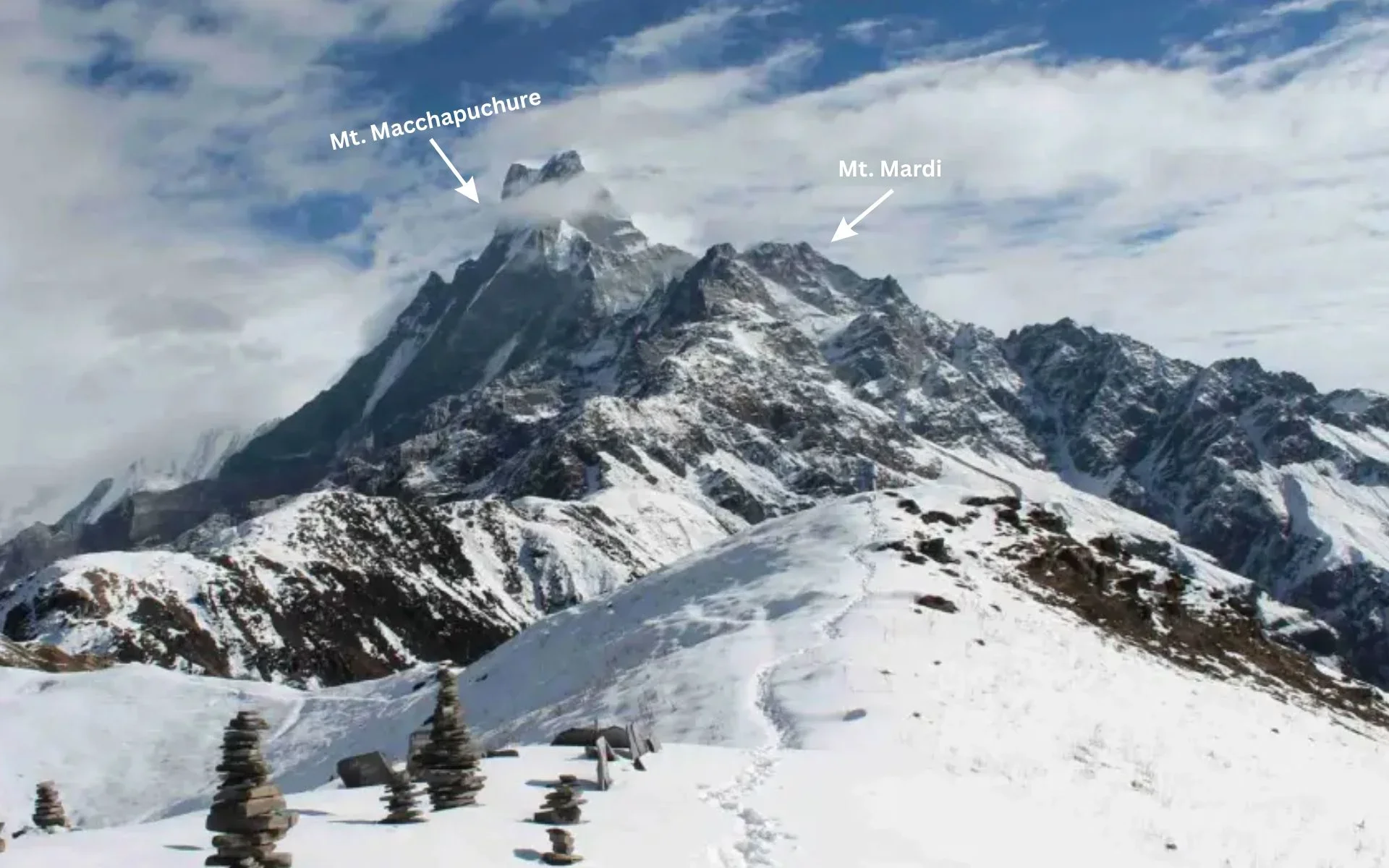
Mardi Himal is a peak and trekking route in the Annapurna region of central Nepal, sitting on a ridge directly below Machhapuchhre (Fishtail) on the eastern edge of the Annapurna Sanctuary. The trailhead lies about a 1-1.5 hour drive from Pokhara, the main trekking gateway city for any trek within the Annapurna range.
From the upper ridge you look straight into the south face of Annapurna South, Hiunchuli, and the unmistakable twin-summited Machhapuchhre, which Nepal keeps unclimbed out of respect for its sacred status. Mardi Himal Base Camp is the alpine terminus, a bare shoulder of scree and grass with the mountains crowding the skyline.
Why Trek to Mardi Himal?
Mardi Himal rewards trekkers with close, dramatic mountain views on a short itinerary that stays under two weeks. It is quieter than the classic Annapurna Base Camp routes, climbs through thick rhododendron forest onto an open high ridge, and finishes below the striking Fishtail summit, making it ideal for those wanting a genuine Himalayan trek without a long time commitment. It’s actually an alternative for those who want to experience a Himalayan trek but don’t have enough time.
What sets it apart is the ridge walking. Above Low Camp, the trail breaks out of the forest onto a narrow spine with drop-away views on both sides. In spring the lower forest glows red and pink with blooming rhododendrons; in autumn the air is so clear you can pick out individual snow gullies on Annapurna South. It suits trekkers who want a first Himalayan experience, a short add-on to a Nepal trip, or a peaceful alternative to more established trails.

Mardi Himal Trek Route
The Mardi Himal route runs from a road-head near Kande up a single high ridge through Forest Camp, Low Camp and High Camp to Mardi Himal Base Camp at around 4,500 meters, then descends the same ridge or drops down to Sidhing village for the drive back to Pokhara.
Mardi Himal Trek Starting Point
Most trekkers start at Kande (around 1,770 m) after a short drive from Pokhara, climbing to Australian Camp and Deurali before entering the forest. Some itineraries begin lower and walk in via Dhampus.
Forest Camp
Forest Camp (Kokar), at roughly 2,550 m, is a cluster of lodges buried in moss-draped rhododendron and oak forest. The climb here is steady and shaded, often damp underfoot.
Low Camp
Low Camp sits around 2,970 m, where the forest starts to thin and the first big views of Machhapuchhre open up on a clear morning.
High Camp
High Camp, at approximately 3,580 m, is the launch point for the base camp push. The ridge here is open and exposed, and this is where you should sleep before ascending higher for acclimatization safety.
Mardi Himal Base Camp
From High Camp the trail climbs the narrowing ridge past the Lower Viewpoint to Mardi Himal Base Camp (Upper Viewpoint) at around 4,500 meters. This is a demanding but non-technical walk of roughly 3-4 hours up, with the amphitheater of peaks directly ahead.
Return Route
You either retrace the ridge to Low Camp or take the descent trail to Sidhing (Siding) village, then drive back to Pokhara. The Sidhing exit is a popular loop that avoids repeating the entire ridge.
Mardi Himal Trek Itinerary
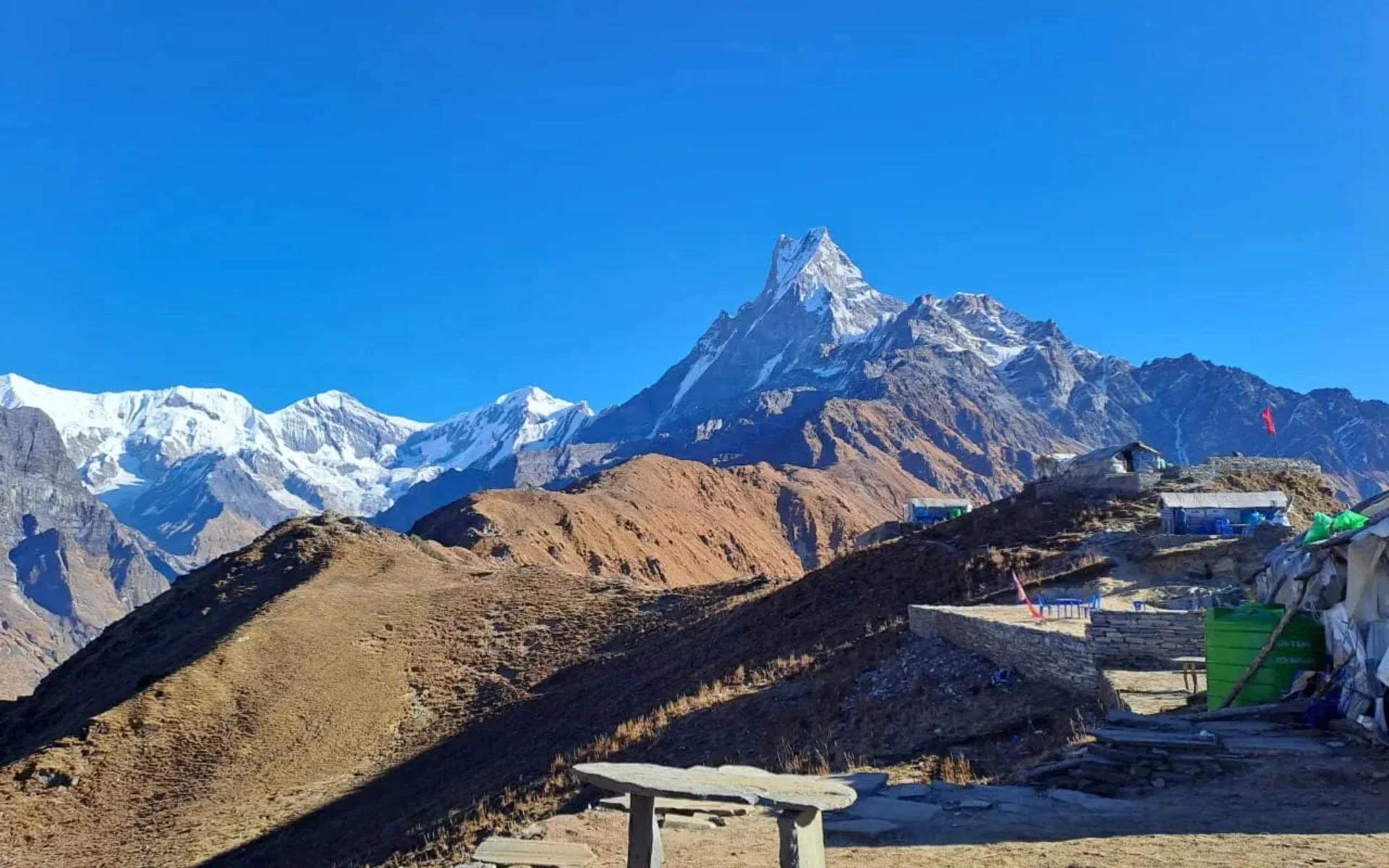
A comfortable Mardi Himal itinerary takes 5-6 days from Pokhara, sleeping at Forest Camp, Low Camp and High Camp before summiting to Base Camp and descending. Below is our standard, acclimatization-friendly plan. Actual schedules vary with your starting point, pace and weather.
Day 1: Pokhara to Trek Starting Point (Forest Camp)
Drive from Pokhara to Kande, climb to Australian Camp and Deurali, then trek into the forest to Forest Camp. Roughly a 4-5 hour walk.
Day 2: Forest Camp to Low Camp
A shorter forest climb to Low Camp, around 3-4 hours, with mountain views emerging as you gain the ridge.
Day 3: Low Camp to High Camp
Climb the open ridge to High Camp in about 3-4 hours. This keeps your sleeping elevation gain within safe limits.
Day 4: High Camp to Mardi Himal Base Camp and back
An early start for the 3-4 hour ascent to Base Camp, then return to High Camp or descend to Low Camp for the night.
Day 5: Descend and Return
Descend via Sidhing (or the ridge) and drive back to Pokhara, roughly a 5-6 hour combined walking and driving day.
Some groups add a buffer day for weather or a slower pace, which we always recommend for anyone new to altitude. Also, for a detailed itinerary, you can visit our Mardi trek page.
How Difficult Is the Mardi Himal Trek?
Mardi Himal is a moderate trek. Daily walking runs 3-6 hours with some steep, sustained climbs and exposed ridge sections near the top. The maximum altitude of around 4,500 meters is manageable with proper acclimatization, and no technical climbing or equipment is required.
The forest climbs are relentless but not dangerous. The real challenge is the final ridge above High Camp, which is narrow, steep and exposed to wind and cold. In poor visibility it demands care. For a broader sense of Annapurna trail grades, our Annapurna Base Camp difficulty guide is a useful comparison.
Is Mardi Himal Trek Suitable for Beginners?
Yes. Mardi Himal is one of the best treks in Nepal for beginners with basic fitness. The short days and moderate altitude make it forgiving, though the final push rewards those who trained on hills beforehand.
How Fit Do You Need to Be?
You should be able to walk uphill for several hours carrying a daypack. Two to three months of regular cardio and stair or hill training before the trek makes the ridge sections far more enjoyable.
Mardi Himal Trek Altitude
The Mardi Himal Trek starts near 1,770 m at Kande and climbs to Mardi Himal Base Camp at roughly 4,500 meters, with High Camp at 3,580 m serving as the key acclimatization stop. Total elevation gain to the top is close to 2,700 meters spread over several days.
Altitude matters here because Base Camp sits well above 3,000 meters, where AMS becomes a genuine risk. We build itineraries so that sleeping elevation rises by no more than 300-500 meters per night above 3,000 m. Sleeping at High Camp before the Base Camp push is essential rather than optional, and anyone feeling headaches, nausea or dizziness should descend rather than continue climbing.
Best Time for Mardi Himal Trek
The best time for Mardi Himal is spring (March-May) and autumn (September-November). Spring brings rhododendron blooms and mild temperatures; autumn offers the clearest skies and most stable weather of the year. Winter is possible but cold and snowy up high, while monsoon brings rain, cloud and leeches.
Mardi Himal Trek in Spring
March to May is warm on the lower forest and spectacular for flowering rhododendrons. Afternoon cloud can build, so aim for early morning views. This is our most popular window alongside autumn.
Mardi Himal Trek in Summer/Monsoon
June to August brings heavy rain, slippery trails and leeches in the forest, with mountains often hidden by cloud. If you're set on trekking in these months, the rain-shadow regions like Upper Mustang are far better bets, as we explain in which Nepal treks are safe during monsoon.
Mardi Himal Trek in Autumn
September to November delivers crisp air, dry trails and the sharpest mountain views. Nights get cold at High Camp, but the daytime clarity is unmatched. This is the classic season.
Mardi Himal Trek in Winter
December to February is quiet and clear on good days, but High Camp and Base Camp can be snowbound and bitterly cold. It's doable for prepared trekkers with warm gear, though some upper lodges may close.
Our overall recommendation: book for late March-April or October-November for the best balance of weather and views. For seasonal planning across the country, see the best time to visit Nepal.
Mardi Himal Trek Cost
A guided Mardi Himal Trek generally from USD 1299 per person, covering permits, a licensed guide, teahouse lodging, meals and Pokhara transfers. Remember, prices vary with group size, season and service level, so verify with your agent before booking a trek. Independent budget trekking costs less but a licensed guide is now strongly enforced across Annapurna.
Rough cost components include permits (ACAP + e-TIMS), a guide fee, optional porter, teahouse rooms (cheap, but you pay for extras), food, and Pokhara transport. Remember that lodges make their money on meals and add-ons, so the room is only part of your daily spend. Compare with the pricier and longer Annapurna Base Camp cost breakdown to see where Mardi Himal saves money.
Cash reality: there are no ATMs on the Mardi Himal ridge. Draw sufficient Nepalese Rupees in Pokhara before you leave. Budget extra for common trail upcharges: charging a phone or power bank, gas-heated hot showers, and Wi-Fi typically cost an extra 200 to 700 NPR per service.
Mardi Himal Trek Permits
Mardi Himal requires two permits: the Annapurna Conservation Area Permit (ACAP) at NPR 3,000 for foreigners and NPR 1,000 for SAARC nationals, plus a TIMS card, now issued as an e-TIMS QR at NPR 2,000 for foreigners and NPR 1,000 for SAARC nationals. Both are arranged in Kathmandu or Pokhara.
You'll need passport copies and passport photos. The ACAP is checked at conservation area entry points, and the e-TIMS QR is verified at checkpoints along the route. Carry both on you and keep them dry. Since permit and TIMS rules in Nepal are updated periodically, verify current requirements before departure.
Accommodation and Food on the Mardi Himal Trek
Mardi Himal is a teahouse trek. Lodges at Forest Camp, Low Camp and High Camp offer simple twin rooms, shared bathrooms, and a warm dining room heated by a central stove. Rooms are basic and get colder as you climb, so a good sleeping bag is worth carrying.
Meals are ordered from a set menu. We strongly advise prioritizing vegetarian food up high. The reliable, high-energy standard is Dal Bhat (lentil soup, rice and vegetable curry), which usually comes with free refills and keeps you fueled for the ridge. Meat is carried up on foot without refrigeration, so it's best avoided at altitude.
For water, never buy plastic bottled water on the trail. Carry a reusable bottle and treat water with a UV purifier, a Sawyer squeeze filter, or chlorine dioxide drops. Electricity for charging is limited at higher lodges and usually costs extra. On connectivity, Ncell gives good coverage across much of the Annapurna region, so a local SIM is handy for messages when signal reaches the ridge.
Mardi Himal Trek Packing List
Pack light but cover the essentials for cold, exposed high camps and warm lower forest. A quick checklist:
Broken-in trekking boots
Moisture-wicking base layers
Warm insulated jacket (down or synthetic)
Waterproof jacket and pack cover
Warm sleeping bag rated to at least -10°C
Trekking poles
Reusable water bottle plus purification (UV or filter)
Sunscreen, lip balm and sunglasses
Headlamp with spare batteries
Basic first-aid kit and any personal medication
Hat, gloves and buff for the cold ridge
How to Get to Mardi Himal Trek From Pokhara
Pokhara is the gateway. From Pokhara you drive roughly 1-1.5 hours to the Kande trailhead by private vehicle or local transport to begin walking. On return, you drive back from Sidhing village, usually a 2-3 hour road journey to Pokhara.
To reach Pokhara itself, you can fly from Kathmandu in about 25-30 minutes or take a tourist bus that runs 6-8 hours along the highway. Domestic flight and private jeep prices fluctuate, so confirm live rates when booking. If you're building a longer trip, our guides to things to do in Pokhara help you make the most of a rest day before or after the trek.
Mardi Himal Trek With or Without a Guide?
Under current Nepal Tourism Board rules, a licensed guide is strongly required for trekking in conservation and national park areas, including Annapurna. We recommend hiring a licensed guide for Mardi Himal and always verifying the latest regulations before you travel.
A guide handles navigation on the exposed upper ridge (which can be confusing in cloud), manages permits, arranges lodging in peak season when rooms fill fast, and adds a critical safety margin at altitude. A porter is optional but eases the forest climbs. Beyond compliance, a good local guide turns a walk into a far richer cultural experience.
Mardi Himal Trek vs Annapurna Base Camp
Both are moderate Annapurna teahouse treks, but Mardi Himal is shorter, quieter and ridge-focused, while Annapurna Base Camp is longer and finishes in a dramatic mountain amphitheater. Choose Mardi Himal for a compact adventure, ABC for the classic base-camp bucket-list experience.
Factor | Mardi Himal | Annapurna Base Camp |
Duration | Shorter (7 days) | Longer (9-12 days) |
Difficulty | Moderate | Moderate |
Crowds | Generally quieter | More established |
Landscape | Ridge & mountain views | Glacial amphitheater |
Best for | Short Himalayan trek | Classic base-camp experience |
Cultural Etiquette on the Trail
The Annapurna region is home to Gurung and other communities with Buddhist and Hindu traditions. Always walk clockwise around mani walls, chortens and stupas, keeping these sacred structures on your right. Remove shoes and hats before entering any temple or monastery, and never photograph inside monastery prayer halls unless a resident monk gives explicit permission.
At the end of the trek, tipping the crew is culturally expected as a vital supplement to their income. A standard guideline is 10% to 15% of the total trek cost, distributed among your guide and porter.
Safety and Insurance
Standard travel insurance is not enough for this trek. You must carry a policy that specifically covers high-altitude emergency helicopter evacuation (up to 6,000 m) and medical treatment for AMS, HAPE and HACE. Confirm the altitude limit in your policy wording before you fly to Nepal.
Is Mardi Himal Trek Worth It?
For the right trekker, absolutely. Mardi Himal is particularly suited to those who want a relatively short Himalayan trek, close mountain views without a long itinerary, a quieter alternative to the busiest Annapurna routes, an easy start point from Pokhara, and a manageable first high-altitude experience. If you have under a week and want genuine alpine scenery, few treks deliver more for the time invested.
FAQs
How many days do you need for the Mardi Himal Trek?
Most trekkers finish in 7 days of walking from Pokhara, with 8-9 days being the most comfortable and acclimatization-friendly plan.
Is Mardi Himal Trek suitable for beginners?
Yes. With basic fitness it's one of the most beginner-friendly Himalayan treks, thanks to short days and a moderate maximum altitude.
How high is Mardi Himal Base Camp?
The Upper Viewpoint (Base Camp) sits at roughly 4,500 meters, with High Camp at 3,580 m.
What is the best month for Mardi Himal Trek?
Late March-April and October-November offer the best mix of clear views, stable weather and comfortable temperatures.
Do you need a guide for Mardi Himal Trek?
Current rules strongly require a licensed guide in Annapurna's conservation area. We recommend hiring one and verifying live regulations before travel.
What permits are required for Mardi Himal Trek?
The ACAP (NPR 3,000 for foreigners) and the e-TIMS QR card (NPR 2,000 for foreigners). SAARC nationals pay reduced rates.
Can you do Mardi Himal Trek without previous trekking experience?
Yes, with reasonable cardio fitness and some hill training. It's a popular first Himalayan trek precisely because it doesn't demand prior high-altitude experience.
Ready to Trek Nepal?
Mardi Himal packs everything that makes a Himalayan trek worth doing into a short, manageable window: forest trails, ridge walking, and a close look at Machhapuchhre and the Annapurna range from 4,500 meters, all without months of planning or a long time commitment. Whether you're after a first taste of high altitude or a quieter alternative to the busier Annapurna routes, this trek delivers.
If you're ready to lock in your dates, our team at Walkthrough Nepal can help you plan the route, sort permits, and match you with a licensed local guide who knows this ridge well. Reach out and we'll help you build an itinerary around your fitness level, travel dates, and how much time you actually have.


