Swipe to explore
BEST SELLER
Tilicho Lake Trek Packages – Cost, Itinerary & 12, 14 & 16 Day Options
12, 14, & 16 Days
Duration
Breakfast, Lunch & Dinner
Meals
MODERATE
Difficulty
1–14+ (Private & Group Departures Available)
Group Size
↑
Tilicho Lake – 4,919 m (12-Day) | Thorong La Pass – 5,416 m (14 & 16-Day)
Max Altitude
March–May (Spring) & September–November (Autumn)
Best Season
3-Star Hotels (Kathmandu & Pokhara) + Teahouses (on trail)
Accommodation
Tourist Bus / Private Vehicle / Local Jeep
Transportation
Tilicho Lake Trek Overview
The Tilicho Lake Trek takes you to one of the highest lakes in the world, a turquoise alpine lake resting at 4,919 m (16,138 ft) beneath the towering Tilicho Peak (7,134 m) in the Annapurna region of Nepal.
Branching off from the classic Annapurna Circuit trail near Manang, the route passes through Chame, Pisang, and Manang before climbing through the remote village of Khangsar, the last settlement before the high alpine wilderness that surrounds the lake.
Along the way, trekkers pass through traditional Gurung and Manangi villages, dense pine and rhododendron forests, and dramatic high-altitude terrain shaped by the rain-shadow effect of the Annapurna and Mustang region.
The lake itself, encircled by the Annapurna Massif and Tilicho Peak, offers some of the most striking mountain scenery anywhere in Nepal.
At Walk Through Nepal, we offer three itinerary options: a 12-Day Express Tilicho Lake Trek that visits the lake and returns via the same route without crossing Thorong La Pass, and 14-Day and 16-Day itineraries that combine the Tilicho Lake side trip with the classic Annapurna Circuit, crossing Thorong La Pass (5,416 m) and descending through Muktinath, Jomsom, and (on the 16-Day itinerary) Marpha and Tatopani. Each itinerary is designed to match different schedules, fitness levels, and travel styles.
Trip Highlights
Visit Tilicho Lake, one of the world's highest alpine lakes.
Cross the iconic Thorong La Pass, one of the highest trekking passes in the Himalayas (14 & 16-Day itineraries).
Explore the traditional Himalayan village of Manang, known for its Tibetan-influenced culture and stunning mountain views.
Witness panoramic views of Annapurna II, Annapurna III, Annapurna IV, Gangapurna, Tilicho Peak, Chulu Peaks, Nilgiri, and Dhaulagiri.
Trek through diverse landscapes, including subtropical forests, alpine meadows, glacial valleys, and the high-altitude deserts of Mustang.
Experience authentic hospitality while staying in traditional family-run teahouses.
Visit the sacred pilgrimage site of Muktinath Temple, revered by both Hindus and Buddhists (14 & 16-Day itineraries).
Walk through charming Himalayan villages such as Chame, Upper Pisang, Manang, and Khangsar - plus Kagbeni and Marpha (14 & 16-Day itineraries).
Enjoy a quieter side trail to Tilicho Lake that many Annapurna Circuit trekkers miss.
Trek with experienced government-licensed local guides focused on safety, responsible tourism, and authentic cultural experiences.
Which Tilicho Lake Trek Should You Choose?
Choosing the right Tilicho Lake Trek itinerary depends on your available time, fitness level, and whether you want to visit Tilicho Lake only or combine it with the full Annapurna Circuit by crossing Thorong La Pass (5,416 m / 17,769 ft).
Note: The 14-Day Classic and 16-Day Extended itineraries both continue beyond Tilicho Lake to cross Thorong La Pass, making them true Annapurna Circuit with Tilicho Lake treks.
The 12-Day Express itinerary focuses on reaching Tilicho Lake and returns via the same route without crossing the pass, making it the best option for trekkers with limited time.
Choose the 12-Day Tilicho Lake Trek (Express) if:
You want to reach Tilicho Lake in the shortest possible time and are not planning to cross Thorong La Pass. This itinerary retraces the route back through Manang and Chame, making it ideal for trekkers with limited time who still want to experience one of the highest lakes in the world.
Choose the 14-Day Annapurna Circuit with Tilicho Lake Trek (Classic) if:
You want the most balanced experience — visiting Tilicho Lake and completing the classic Annapurna Circuit by crossing Thorong La Pass and descending through Muktinath and Jomsom. This is our most popular combined itinerary and the best choice for most first-time trekkers.
Choose the 16-Day Annapurna Circuit with Tilicho Lake Trek (Extended) if:
You prefer a slower, more immersive journey with extra time to explore Kagbeni, Marpha (famous for its apple orchards), and Tatopani's natural hot springs after crossing Thorong La Pass.
Note: The main differences between the three itineraries are the trip duration, trekking pace, route completion, departure style, and cultural experiences. While the 12-Day Express focuses on Tilicho Lake only, the 14-Day Classic and 16-Day Extended complete the Annapurna Circuit by crossing Thorong La Pass, with the extended itinerary including additional stops in Kagbeni, Marpha, and Tatopani for a richer cultural experience.
Departure & Pricing Information: The prices shown for the 12-Day Express, 14-Day Classic, and 16-Day Extended itineraries ($2,199 / $2,499 / $2,749 per person) are our standard per-person rates, valid for solo travelers, private groups, and fixed group departures alike.
Group discounts (below) apply automatically when 2 or more people book together on the same dates, regardless of whether it's a private or fixed departure. Contact us for a custom quote if your group size, season, or accommodation needs differ from the standard package
12-DAY EXPRESS
$ 2,199
- Route: Tilicho Lake Trek Only
- Highest Point: Tilicho Lake (4,919 m)
- Pace: Fast-Paced Adventure
- Route Design: Classic Tilicho Lake Trek (Thorong La Pass not included)
- Acclimatization: 1 Night in Manang
Best Value
14-DAY CLASSIC
$ 2,499
- Route: Annapurna Circuit + Tilicho Lake
- Highest Point: Thorong La Pass (5,416 m)
- Pace: Comfortable & Balanced
- Route Design: Includes both Tilicho Lake & Thorong La Pass
- Acclimatization: 1 Night in Manang
- Bonus: Overnight in Pokhara after completing the trek
- Includes: 1 night in Pokhara post-trek
16-DAY EXTENDED
$ 2,749
- Route: Extended Annapurna Circuit + Tilicho Lake
- Highest Point: Thorong La Pass (5,416 m)
- Pace: Relaxed & Scenic
- Route Design: Extended Annapurna Circuit with Tilicho Lake
- Acclimatization: 1 Night in Manang
- Flexible Return: Road or optional flight after Muktinath (as per itinerary)
- Includes: 1 night in Pokhara post-trek
Book this Trip
Tell us your preferences and we'll craft the perfect private tour for your group.
Itinerary
HotelWelcome Dinner
Welcome to Nepal! Upon arrival at Tribhuvan International Airport, a representative from Walk Through Nepal will greet you and transfer you to your hotel in the heart of Kathmandu. After checking in, you'll have time to rest after your journey or explore the lively streets of Thamel, Kathmandu's popular tourist district known for its trekking shops, cafés, and cultural atmosphere.
In the evening, you'll meet your trekking guide for a comprehensive pre-trek briefing. During this session, your guide will walk you through the Tilicho Lake and Annapurna Circuit itinerary, review current trail and weather conditions, discuss altitude safety protocols, check your trekking equipment, and answer any last-minute questions before the adventure begins. This is also the time to flag any dietary restrictions, medical conditions, or concerns so your guide can plan accordingly.
The day concludes with a traditional Nepali welcome dinner, giving you the opportunity to sample local cuisine such as dal bhat and momos while getting to know your guide and any fellow trekkers joining the group. Although no trekking takes place today, it's the perfect opportunity to adjust to the time zone, pick up any last-minute gear from Thamel's trekking shops, and mentally prepare for the two weeks ahead. A good night's rest will set you up well for tomorrow's long scenic drive toward the Annapurna region.
Today's Highlights:
Airport pickup by the Walk Through Nepal team
Comfortable transfer to your hotel in Kathmandu
Free time to explore the vibrant streets of Thamel
Detailed trek briefing and equipment check
Traditional Nepali welcome dinner
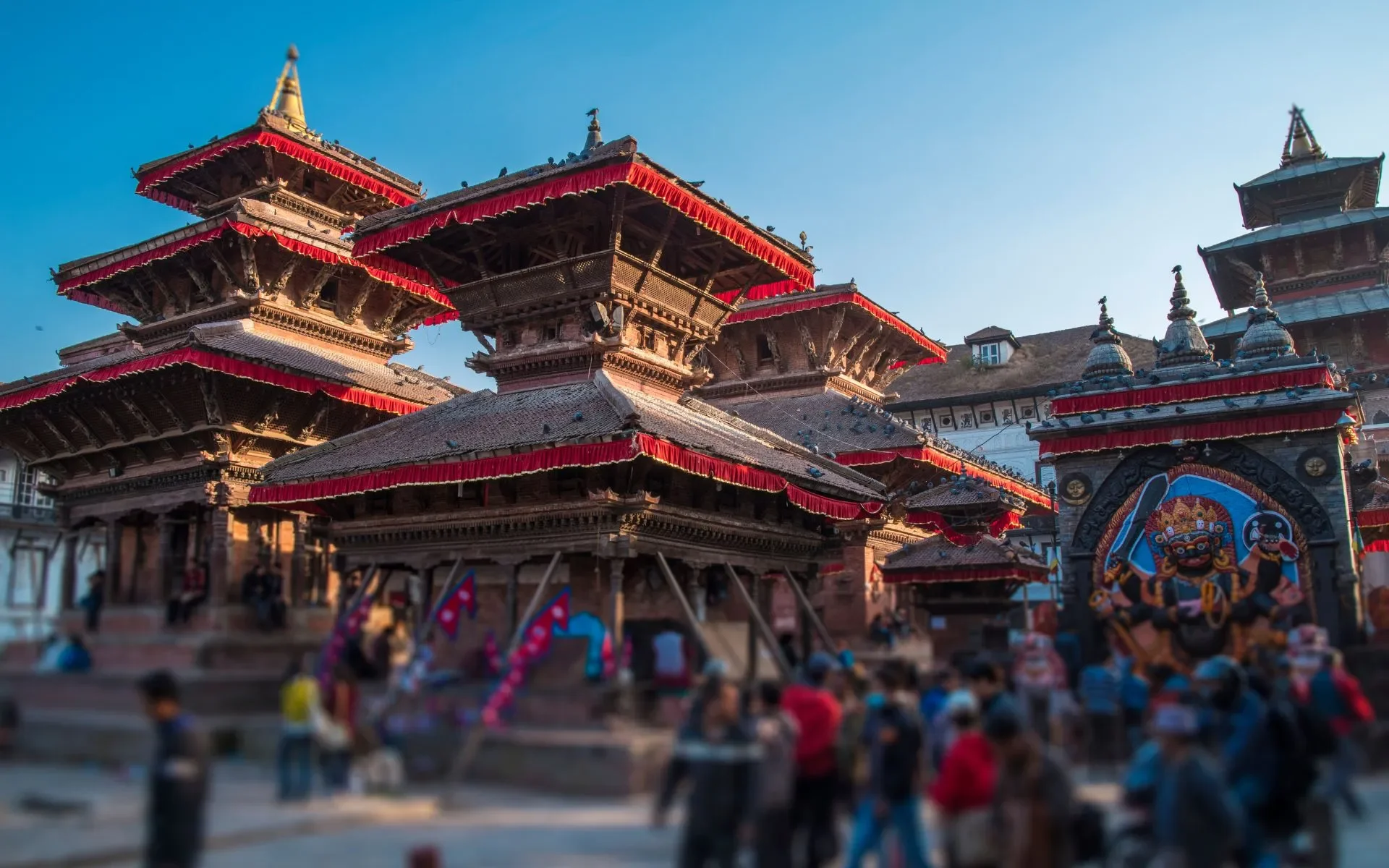
1,250 m / 4,101 ft Approx. 215 km / 134 mi | 9–10 hours TeahouseBreakfastLunchDinner
After an early breakfast, you'll leave Kathmandu and begin the long but scenic drive toward the Annapurna region. The route follows the Prithvi Highway alongside the Trishuli River before turning north at Dumre toward Besisahar, the traditional starting point of the Annapurna Circuit. From here, the road narrows and climbs steadily along the Marsyangdi River Valley, winding through terraced hillsides, waterfalls, suspension bridges, and small roadside villages.
As the vehicle gains altitude past Dharapani, the vegetation shifts from subtropical farmland to cooler pine and fir forest, and your first real views of the Manang Himal begin to open up. The road itself is rough in places, this is mountain driving, not a highway, so expect a bumpy but genuinely spectacular ride, with the Marsyangdi River roaring below for much of the journey.
By late afternoon, you'll reach Chame, the administrative headquarters of Manang District, tucked beneath dramatic cliffs and cloaked in forest. Chame is a proper mountain town with a natural hot spring, a handful of good bakeries, and views of Lamjung Himal and Annapurna II framing the valley. After a long day of travel, settle into your teahouse, enjoy a hearty dinner, and get an early night, real trekking begins tomorrow, and it's worth arriving rested.
Today's Highlights:
Scenic drive along the Prithvi Highway and Marsyangdi River Valley
Pass through Besisahar and Dharapani, gateways to the Annapurna Circuit
Watch the landscape shift from subtropical valley to alpine forest
Arrive in Chame beneath Lamjung Himal and Annapurna II
Optional soak in Chame's natural hot spring
Overnight in a traditional mountain teahouse
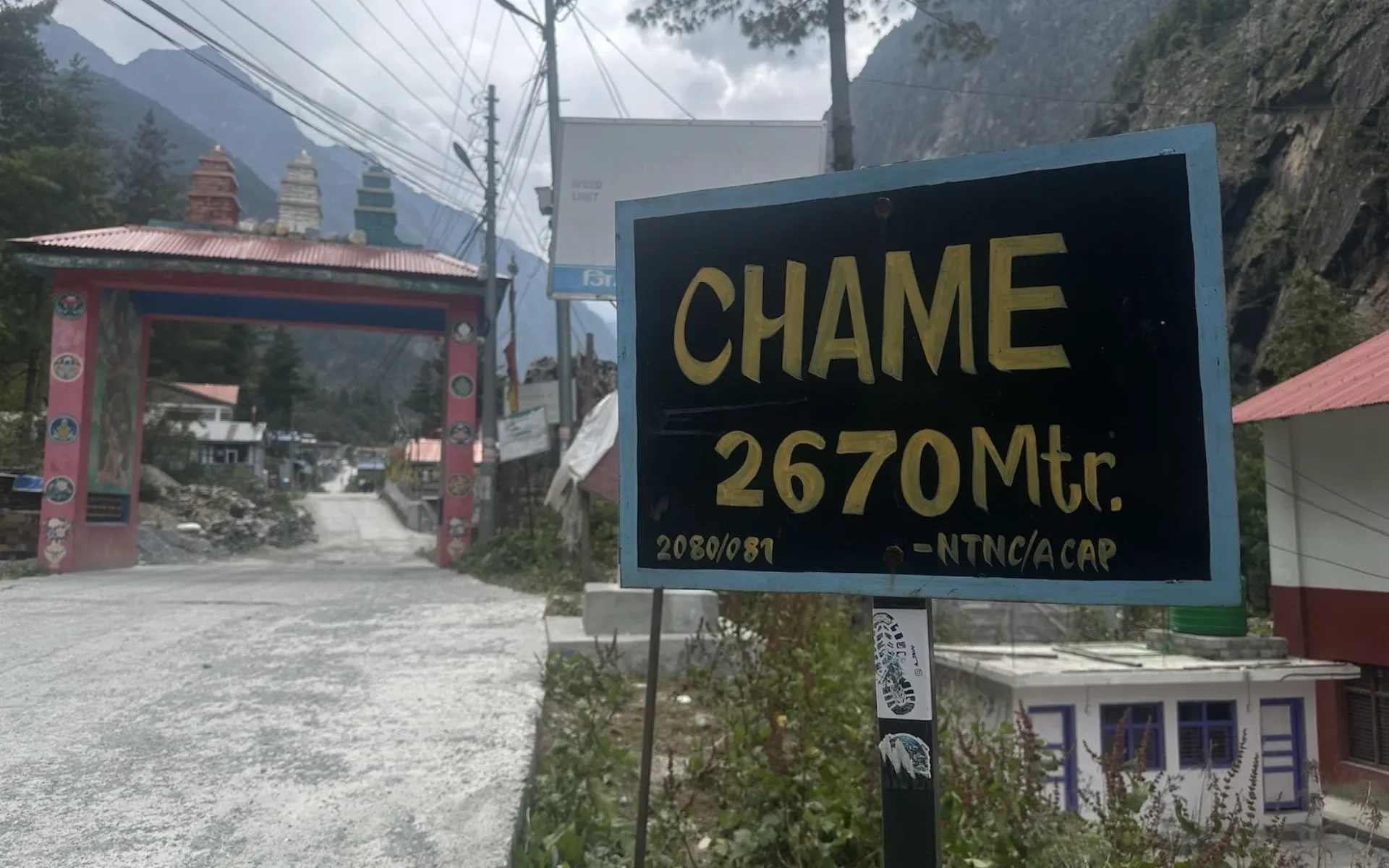
750 m / 2,461 ft 100 m / 328 ft Approx. 14 km / 8.7 mi 5–6 hours TeahouseBreakfastLunchDinner
Today marks the real start of your trek. Leaving Chame, the trail follows the Marsyangdi River through dense pine, fir, and rhododendron forest, crossing several suspension bridges as the valley narrows. The path is well-graded but steadily gains elevation, and you'll begin to feel the terrain and vegetation change noticeably compared to the previous day's drive.
A short but worthwhile detour takes you past a striking curved rock formation and, on clear mornings, your first proper glimpse of Paungda Danda, a vast, smooth rock face rising directly from the valley floor that local legend says souls climb on their way to heaven. Continuing on, the trail crosses the river one final time before the valley opens up dramatically at the base of the Pisang rock face, an enormous vertical cliff that dominates the skyline as you approach the village.
Upper Pisang, perched higher on the hillside than its lower counterpart, offers a noticeably different atmosphere, narrow stone alleyways, a monastery worth a short visit, and increasingly Tibetan-influenced architecture and culture as you move deeper into the rain-shadow region. From the village, you'll get your first real, unobstructed view of Annapurna II (7,937 m), whose massive north face fills much of the horizon. Take some time in the late afternoon to walk up toward the monastery for even better views before settling in for the evening.
Today's Highlights:
Trek through pine, fir, and rhododendron forest along the Marsyangdi River
Cross multiple suspension bridges
Pass beneath the towering Pisang rock face
Spectacular views of Annapurna II (7,937 m)
Visit the monastery in Upper Pisang
Overnight in a traditional Tibetan-influenced village
650 m / 2,133 ft 430 m / 1,411 ft Approx. 16 km / 10 mi 6–7 hours TeahouseBreakfastLunchDinner
Today offers a choice between two routes to Manang: a shorter, flatter path through the valley floor, or the higher, more scenic route via Ghyaru and Ngawal, the route we follow, as it offers significantly better acclimatization and some of the finest mountain views on the entire trek. After crossing the Marsyangdi River, a long series of stone staircases climbs steeply to Ghyaru (3,670 m), and the effort pays off almost immediately: from the village you get an uninterrupted panorama of Annapurna II, III, IV, Gangapurna, and Pisang Peak stacked across the horizon.
From Ghyaru, the trail continues along an old trading route to Ngawal, a beautifully preserved Tibetan Buddhist village with centuries-old monasteries, mani walls, and prayer flags strung between traditional stone houses. This section of trail sees far fewer trekkers than the valley route below, giving it a quieter, more authentic feel. Take time here to look for blue sheep on the surrounding hillsides and to appreciate the strong Tibetan cultural influence that defines this upper stretch of the Manang valley.
From Ngawal, the trail descends gradually through juniper scrub and open alpine meadow, passing near Braga's dramatic cliffside monastery before the final approach into Manang. As the largest and most developed village on the circuit, Manang offers real comforts, bakeries, pool tables, even a cinema showing mountaineering documentaries, making it a welcome stop before the demanding days ahead toward Tilicho Lake.
Today's Highlights:
Steep climb to Ghyaru with sweeping Annapurna Massif views
Walk the quieter high route through Ngawal
Visit centuries-old Tibetan Buddhist monasteries
Possible sightings of blue sheep on the hillsides
Arrive in Manang, the largest village on the circuit
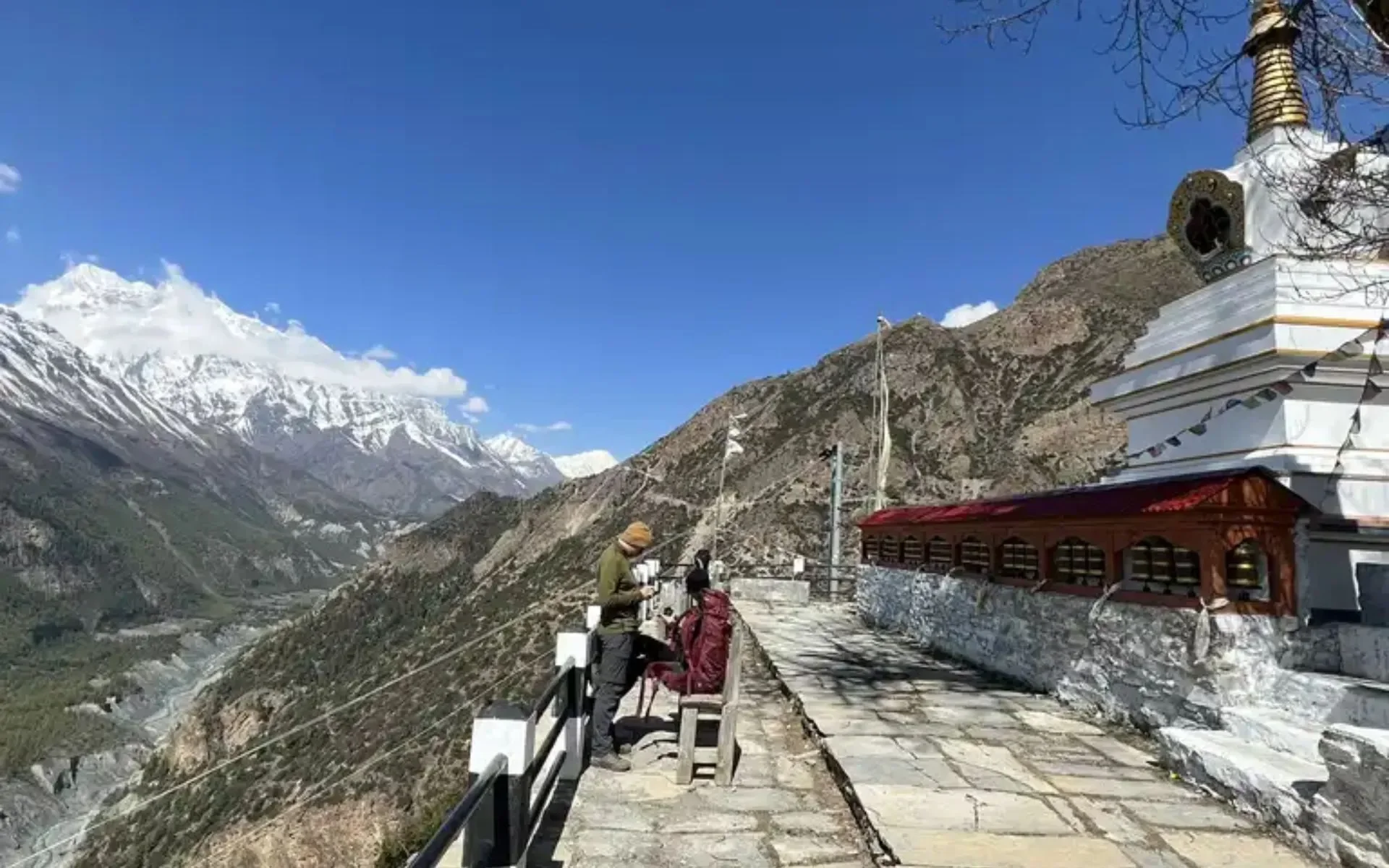
1,100 m / 3,609 ft 1,100 m / 3,609 ft Approx. 10–12 km round trip 5–6 hours TeahouseBreakfastLunchDinner
Today's acclimatization day is one of the most important on the entire trip, not a rest day in the strict sense, but an active one, following the well-established mountaineering principle of "climb high, sleep low." Given that the days ahead take you toward Tilicho Lake at nearly 4,920 m and, eventually, Thorong La Pass at 5,416 m, this hike plays a real role in reducing your risk of altitude sickness later in the trek.
After an early breakfast, the trail climbs steeply out of Manang through pine forest and open yak pasture, gaining over 1,000 meters in a relatively short distance. It's a genuinely demanding climb, and your guide will set a deliberately slow pace to help your body adjust. The reward at the top is Ice Lake (Kicho Tal), a striking alpine lake at 4,620 m surrounded by an amphitheater of peaks, Annapurna II, III, Gangapurna, Tilicho Peak, and the Chulu massif are all visible from here on a clear day.
After spending time at the lake taking photos and resting, you'll descend back to Manang for a second night at the same elevation, which is the key acclimatization benefit of the day. The afternoon and evening are yours to recover, many trekkers use the time to visit the Himalayan Rescue Association's information post, where volunteer doctors give a free daily talk on altitude sickness, or simply relax at one of Manang's famous bakeries with a coffee and apple pie before the trail leaves the main circuit route tomorrow.
Today's Highlights:
Essential acclimatization hike following "climb high, sleep low"
Reach Ice Lake (4,620 m) with panoramic Himalayan views
Views of Annapurna II, III, Gangapurna, Tilicho Peak, and the Chulu range
Optional altitude sickness talk at the Himalayan Rescue Association
Second night in Manang for proper acclimatization
300 m / 984 ft 85 m / 279 ft Approx. 8 km / 5 mi 3–4 hours TeahouseBreakfastLunchDinner
Today the route leaves the main Annapurna Circuit trail behind, branching west toward Tilicho Lake, from this point on, you'll see noticeably fewer trekkers, as most continue north toward Yak Kharka and Thorong La. The relatively short, gentle day is a welcome contrast after yesterday's demanding acclimatization hike, giving your body more time to adjust before the tougher terrain ahead.
The trail climbs gradually out of Manang, crossing open grassland and skirting the edge of the valley with Gangapurna and its glacial lake visible below. As you continue west, the landscape becomes noticeably drier and more exposed. a preview of the arid, high-altitude terrain that characterizes the entire Tilicho Lake approach. Along the way, keep an eye out for the ruins of old Khangsar Fort, perched on a ridge above the trail, a reminder of the region's history as a trading route between Nepal and Tibet.
Khangsar itself is a modest but atmospheric village of traditional stone houses, and holds the distinction of being the last Nepali-speaking settlement before the high alpine wilderness beyond. From the village, you get striking views of Kang Guru Peak (6,981 m), an often-overlooked but genuinely impressive mountain that dominates the skyline to the north. This is also your last chance to stock up on any final supplies before the more basic facilities of Tilicho Base Camp, so use the afternoon to rest, hydrate, and prepare for the increasingly remote terrain ahead.
Today's Highlights:
Leave the main Annapurna Circuit trail for Tilicho Lake
Views of Gangapurna and its glacial lake
Pass the ruins of old Khangsar Fort
Reach Khangsar, the last Nepali-speaking village on the route
Views of Kang Guru Peak (6,981 m)
470 m / 1,542 ft 54 m / 177 ft Approx. 10 km / 6.2 mi 5–6 hours TeahouseBreakfastLunchDinner
This is one of the more technically demanding days of the trek, both physically and mentally. Leaving Khangsar, the trail climbs steadily before reaching the section trekkers refer to as the "Great Landslide", a long, narrow, exposed traverse cut across a steep, loose scree slope above the Khangsar Khola. There's no real technical difficulty involved, but the drop below is significant, the path is often only a narrow exposed trail in places, and strong winds can pick up by early afternoon, so your guide will aim to cross this section as early in the day as possible.
Beyond the landslide crossing, the trail eases somewhat, continuing along the valley with the scenery becoming increasingly stark and high-altitude, sparse vegetation, glacial moraine, and huge open views up toward Tilicho Peak (7,134 m), which now dominates the skyline ahead. Yaks are frequently seen grazing on the sparse grass that clings to the hillsides, and the silence and remoteness of this stretch is genuinely striking compared to the busier main circuit trail.
Tilicho Base Camp itself sits in a dramatic bowl directly beneath Tilicho Peak, with basic but functional teahouses serving trekkers en route to the lake. Facilities here are noticeably simpler than lower down the valley, expect colder rooms, limited electricity, and higher prices for extras like charging and hot water, so it's worth mentally preparing for a more rustic night. Rest well; tomorrow's early start to the lake is the physical highlight of the entire trek.
Today's Highlights:
Cross the dramatic, exposed "Great Landslide" section
Walk beneath Tilicho Peak (7,134 m) through stark alpine terrain
Spot yaks grazing on the high pastures
Arrive at Tilicho Base Camp, the final stop before the lake
Basic but atmospheric high-altitude teahouse stay
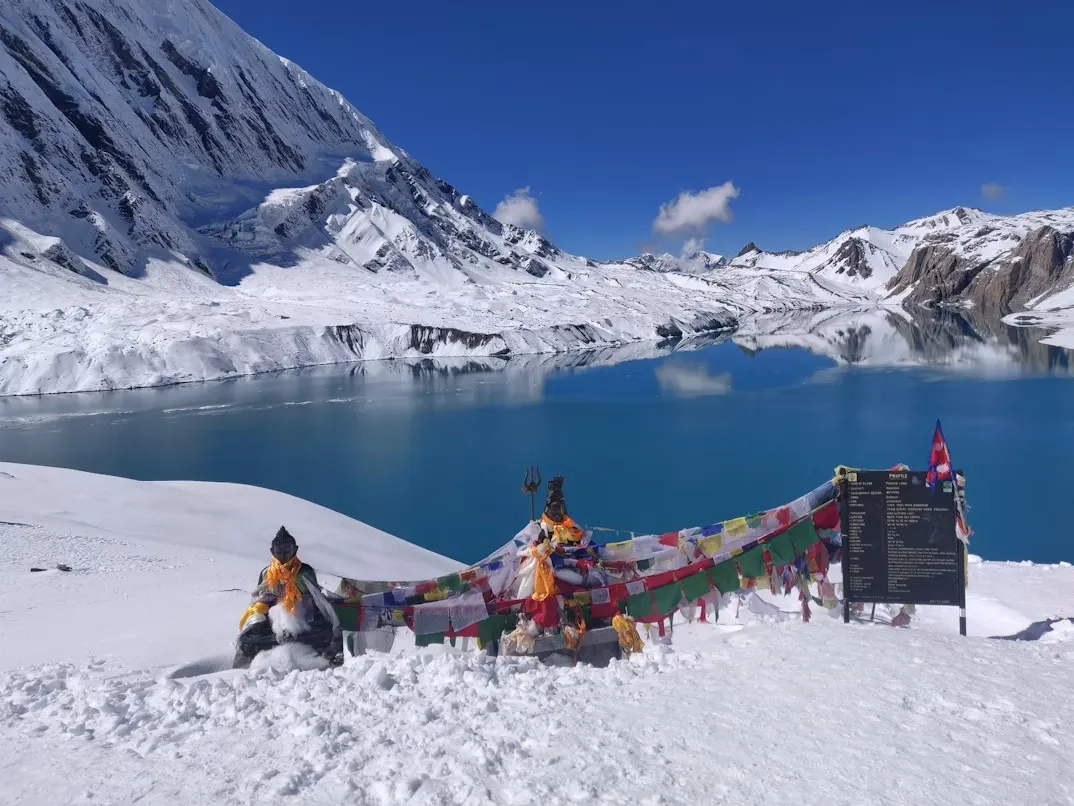
769 m / 2,523 ft 899 m / 2,949 ft Approx. 16 km / 10 mi 7–8 hours TeahouseBreakfastLunchDinner
Today is the highlight of the entire trek. You'll set off well before sunrise, as strong winds tend to pick up at the lake by mid-morning and the trail is far more pleasant, and safer, in calm early-morning conditions. The climb from Tilicho Base Camp is steep and relentless, switchbacking up loose scree and rock with the air noticeably thinner at this altitude, but the trail is well-marked and your guide will maintain a slow, steady pace throughout.
As you crest the final ridge, Tilicho Lake reveals itself all at once, a vast, glacial expanse of turquoise and deep blue water framed by the sheer walls of the Annapurna Massif and the pyramid of Tilicho Peak directly above. At 4,919 m, it's recognized as one of the highest lakes of its size in the world, and the scale of the surrounding scenery is genuinely difficult to capture in photographs. Depending on conditions, you may also spot Tilicho Peak's glaciers calving into the lake, and on clear days the reflection of the surrounding peaks on the water is spectacular.
After spending time at the lake, you'll descend back toward Base Camp and then continue further, rejoining the main Annapurna Circuit trail and continuing on to Yak Kharka to sleep. It's a genuinely long and tiring day, the single toughest of the trip in terms of total elevation change, but reaching Yak Kharka tonight keeps you on schedule for the Thorong La Pass crossing later in the itinerary.
Today's Highlights:
Reach Tilicho Lake (4,919 m), one of the world's highest lakes
Panoramic views of the Annapurna Massif and Tilicho Peak
Possible views of glacial activity feeding the lake
Rejoin the classic Annapurna Circuit trail
Longest and most physically demanding day of the trek
505 m / 1,657 ft Approx. 7 km / 4.3 mi 4–5 hours TeahouseBreakfastLunchDinner
After yesterday's demanding push to Tilicho Lake, today's shorter trek gives your body a chance to recover somewhat while continuing to gain the altitude needed for tomorrow's pass crossing. The trail climbs steadily along rocky, exposed hillsides above the Marsyangdi Valley, crossing a suspension bridge before reaching the small settlement of Ledar, a popular midday rest stop with good mountain views.
Beyond Ledar, the trail becomes noticeably steeper and more rugged, traversing beneath unstable cliffs and across a section prone to rockfall, so your guide will keep a close eye on timing and conditions here. Despite the more demanding terrain, the scenery is spectacular throughout, you're now well above the treeline, surrounded by bare rock, scree, and the first real sense of true high-altitude wilderness.
Thorong Phedi, meaning "the foot of Thorong Hill," sits in a narrow, dramatic valley directly below the pass. It's a small, functional settlement with just a handful of teahouses, all fairly basic given the extreme location. This is also a good point for a final health check, your guide will assess how you're feeling and, depending on your condition and the weather forecast, may recommend a short additional hike up to High Camp (4,880 m) for extra acclimatization before returning to Phedi to sleep, or staying the night at Phedi itself. Rest as much as possible today; tomorrow requires an early, pre-dawn start.
Today's Highlights:
Trek through increasingly rugged, high-altitude terrain
Cross a suspension bridge and pass through Ledar
Reach Thorong Phedi, the final stop before Thorong La Pass
Optional acclimatization hike to High Camp
Final rest before the pass crossing
891 m / 2,923 ft 1,616 m / 5,302 ft Approx. 15 km / 9.3 mi 8–10 hours TeahouseBreakfastLunchDinner
Today is the physical and emotional climax of the trek. You'll begin in the dark, typically around 4–5 a.m., climbing by headlamp to take advantage of calmer morning weather before strong winds typically pick up on the pass by early afternoon. The ascent from Thorong Phedi is steep, cold, and relentless, this is high-altitude trekking at its most demanding, but as dawn breaks over the Annapurna and Dhaulagiri ranges, the views make every step worthwhile.
Reaching the top of Thorong La Pass at 5,416 m is a genuine achievement, one of the highest trekking passes in the world, marked by a chaotic sprawl of prayer flags snapping in the wind and a small sign confirming the altitude. Take time here to celebrate, catch your breath, and take in the 360-degree panorama before the long descent begins; conditions at the top can change quickly, so your guide won't want to linger too long.
The descent is where the real physical toll of the day sets in over 1,600 meters of steep, knee-jarring downhill over loose rock and scree, dropping you from the barren high-altitude terrain into the dry, wind-carved landscape of Lower Mustang, which feels almost like a different country given the dramatic shift in climate and geography. By the time you reach Muktinath, one of Nepal's most important pilgrimage sites for both Hindus and Buddhists, most trekkers are exhausted but elated. Settle into your teahouse, and if energy allows, take a short walk to the temple complex to see its famous eternal flame and 108 sacred water spouts.
Today's Highlights:
Cross the legendary Thorong La Pass (5,416 m)
Watch sunrise over the Annapurna and Dhaulagiri ranges
Celebrate at the summit beneath the prayer flags
Descend into the dramatic, arid landscape of Lower Mustang
Arrive at the sacred pilgrimage site of Muktinath
1,080 m / 3,543 ft Approx. 16 km / 10 mi 5–6 hours TeahouseBreakfastLunchDinner
After the exertion of crossing Thorong La, today is a noticeably gentler, mostly downhill walk, a welcome change of pace. Start the morning with a proper visit to Muktinath Temple if you didn't have the energy yesterday; the complex is genuinely striking, with its 108 bull-headed water spouts, eternal natural flame, and a palpable sense of spiritual significance that draws pilgrims from across Nepal and India.
From Muktinath, the trail descends through increasingly barren, windswept terrain into the heart of Lower Mustang, with the Nilgiri and Dhaulagiri ranges dominating the horizon. You'll soon reach Kagbeni, one of the most atmospheric villages on the entire route, a maze of narrow stone alleyways, whitewashed mud-brick houses, and centuries-old monasteries that feels almost frozen in time. Kagbeni also marks the official checkpoint into Upper Mustang, the restricted region beyond, and even without continuing further, it's worth taking an hour or two to wander the village and explore its 15th-century monastery.
From Kagbeni, the trail follows the broad, windswept Kali Gandaki riverbed, one of the deepest gorges on Earth, toward Jomsom, the administrative hub of the Mustang district. The afternoon winds here are notoriously strong, funneling straight up the valley, so expect a bracing final stretch into town. Jomsom itself is a bustling little settlement with an airstrip, shops, and a noticeably different, more Tibetan-influenced feel compared to anywhere else on the trek so far.
Today's Highlights:
Visit Muktinath Temple's eternal flame and sacred water spouts
Explore the medieval walled village of Kagbeni
Walk the vast Kali Gandaki riverbed
Views of Nilgiri, Dhaulagiri, and Tukuche Peak
Arrive in the windswept town of Jomsom
1,898 m / 6,227 ft Approx. 155 km / 96 mi 7–8 hours HotelBreakfast & Lunch
Today's drive follows the Kali Gandaki Gorge, one of the deepest river gorges in the world, with Dhaulagiri (8,167 m) and Annapurna I (8,091 m) rising on either side, as you descend from the high, arid Mustang region back toward the lush mid-hills of central Nepal. The road passes through Marpha, a picturesque Thakali village famous for its apple orchards, stone-paved streets, and locally distilled apple brandy; if timing allows, this is a great spot for a short break and a taste of the local produce.
Continuing south through Tukuche, Larjung, and Ghasa, the landscape transforms dramatically over just a few hours, the barren, windswept terrain of Mustang gradually gives way to pine forest, then subtropical vegetation, then terraced farmland, as you drop nearly 1,900 meters in elevation. The road itself is rough and winding in sections, particularly through the gorge, so it's a long day of travel, but the constantly changing scenery keeps it engaging throughout.
By late afternoon, you'll arrive in Pokhara, Nepal's lakeside adventure capital and a striking contrast to the rugged mountain villages of the past two weeks. After checking into your hotel, most trekkers spend the evening simply relaxing, walking along the Lakeside promenade by Phewa Lake, enjoying a proper hot shower and a varied restaurant menu, and reflecting on what's been an extraordinary two weeks in the mountains.
Today's Highlights:
Scenic drive through the Kali Gandaki Gorge
Visit the apple-growing village of Marpha
Views of Dhaulagiri and Annapurna South
Dramatic shift from high desert to lush subtropical valley
Relax by Phewa Lake in Pokhara
A domestic flight between Jomsom and Pokhara is also available as an optional upgrade at an additional cost, not included in the package price.
578 m / 1,896 ft Approx. 200 km / 124 mi 6–7 hours HotelBreakfast
After breakfast, and depending on your bus schedule or via an optional Pokhara–Kathmandu flight upgrade, available at an additional cost and not included in the package, you'll take an optional early-morning stroll along Phewa Lake or a boat ride out to the Tal Barahi Temple. You'll then begin the drive back to Kathmandu along the Prithvi Highway, retracing much of the route from Day 2 in reverse. The road follows the Trishuli River for long stretches, winding through terraced hillsides, small roadside towns, and rural villages.
This final travel day offers a good opportunity to mentally decompress after the trek, many trekkers use the drive to look back through photos, chat with their guide about the highlights of the trip, or simply watch the Nepali countryside go by. Traffic approaching the Kathmandu Valley can add time to the journey in the late afternoon, so departure time is planned to account for this.
Upon arrival in Kathmandu, check into your hotel and spend the remainder of the day at your leisure. This is a good chance to pick up souvenirs in Thamel, pashmina scarves, singing bowls, hand-knotted rugs, and trekking gear are all widely available, or simply enjoy a proper restaurant meal after two weeks of teahouse dining. If you'd like, your guide can recommend a good spot for a farewell dinner to mark the end of the trek.
Today's Highlights:
Scenic return drive along the Trishuli River
Optional morning at Phewa Lake before departure
Free time to shop for souvenirs in Thamel
Optional farewell dinner
Final overnight stay in Kathmandu
Breakfast
Your 14-Day Annapurna Circuit with Tilicho Lake Trek comes to an end today. After breakfast, our team will transfer you to Tribhuvan International Airport according to your flight schedule, allowing enough buffer time for check-in and security.
As you depart Nepal, you'll take with you the memory of standing at Tilicho Lake, one of the highest lakes in the world, crossing the legendary Thorong La Pass at dawn, and experiencing the dramatic shift in landscape and culture from the lush Marsyangdi Valley to the arid highlands of Mustang. We look forward to welcoming you back to Nepal for your next Himalayan adventure.
Today's Highlights:
Airport transfer to Tribhuvan International Airport
Assistance with departure arrangements
End of your Annapurna Circuit with Tilicho Lake Trek
Tilicho Lake Trek Cost Breakdown
The total Tilicho Lake Trek cost depends on the itinerary you choose, the pace of the trek, and whether you want to complete the full Annapurna Circuit with Tilicho Lake or focus solely on reaching Tilicho Lake. At Walk Through Nepal, our pricing is transparent, with no hidden charges, and includes experienced government-licensed guides, required trekking permits, accommodation, meals during the trek, and transportation as outlined in each itinerary.
Whether you're looking for a fast-paced adventure, the classic Annapurna Circuit experience, or a more relaxed itinerary with additional cultural exploration, we have a package designed to match your schedule and trekking goals.
Feature | 12-Day Express (Tilicho Lake Only) | 14-Day Classic (Most Popular) | 16-Day Extended |
Price per Person | USD 2,199 | USD 2,499 | USD 2,749 |
Trip Duration | 12 Days | 14 Days | 16 Days |
Trek Type | Tilicho Lake Trek | Annapurna Circuit + Tilicho Lake | Extended Annapurna Circuit + Tilicho Lake |
Thorong La Pass (5,416 m) | No | Yes | Yes |
Tilicho Lake (4,919 m) | Yes | Yes | Yes |
Maximum Elevation | 4,919 m (Tilicho Lake) | 5,416 m (Thorong La Pass) | 5,416 m (Thorong La Pass) |
Classic Annapurna Circuit | Partial | Yes | Yes (Full Classic Start) |
Acclimatization Days | 1 (Manang) | 1 (Manang) | 1 (Manang) |
Tilicho Base Camp Overnight | Yes | Yes | Yes |
Pokhara Stay | No | 1 Night | 1 Night |
Kathmandu Stay | 2 Nights | 2 Nights | 2 Nights |
Transportation | Drive both ways via Chame | Road transport via Jomsom & Pokhara | Road or flight options after Muktinath (as per itinerary) |
Optional Flight Upgrade | Available (extra cost) | Available (extra cost) | Available (extra cost) |
Ideal For | Limited time & Tilicho Lake only | Most trekkers seeking Tilicho + Thorong La | Those wanting the complete classic approach with a slower pace |
Guide & Porter | Licensed Guide + 1 Porter per 2 Trekkers | Licensed Guide + 1 Porter per 2 Trekkers | Licensed Guide + 1 Porter per 2 Trekkers |
Meals During Trek | Breakfast, Lunch & Dinner | Breakfast, Lunch & Dinner | Breakfast, Lunch & Dinner |
Permits | Included | Included | Included |
Airport Transfers | Included | Included | Included |
Note: Prices are based on the listed itinerary. There is no minimum group size, and solo trekkers are always welcome. Please contact Walk Through Nepal for a personalized quotation.
Why Is Our Tilicho Lake Trek Pricing Different?
At Walk Through Nepal, we believe in fair, transparent pricing rather than advertising unrealistically cheap packages that often exclude essential services. Every Tilicho Lake Trek package is designed to provide a safe, comfortable, and professionally managed trekking experience from arrival to departure.
Our pricing reflects the real cost of responsible trekking in Nepal, including licensed local guides, fair porter wages, required permits, quality accommodation, nutritious meals on the trail, reliable transportation, and comprehensive logistical support. We never compromise on safety, ethical employment, or service quality simply to offer the lowest price.
With years of experience operating treks in the Annapurna region, our team continuously monitors trail conditions, weather, and altitude-related risks to ensure every departure is well organized. When you book with Walk Through Nepal, you're investing in experienced local expertise, responsible tourism, and a trekking experience that prioritizes your safety, comfort, and success from start to finish.
What's Included
Private vehicle airport pickup and drop-off at Tribhuvan International Airport for your international arrival and departure
Kathmandu hotel accommodation in a comfortable 3-star hotel with breakfast included - 2 nights for the 12-Day, 14-Day and 16-Day itineraries
Pokhara hotel accommodation in a comfortable 3-star hotel with breakfast included - 1 night for the 14-Day and 16-Day itineraries
All ground transportation outlined in the itinerary by tourist bus, private vehicle, or local jeep
Comfortable teahouse accommodation throughout the trek, based on twin sharing
Three meals daily during the trek - breakfast, lunch, and dinner, selected from local teahouse menus
Complimentary 1-Hour Post-Trek Massage - Rejuvenate after your adventure with a complimentary 1-hour trekker massage in Pokhara or Kathmandu.
A government-licensed, English-speaking trekking guide with extensive experience in the Annapurna region and first-aid training
Experienced porters to carry your luggage - 1 porter shared between every 2 trekkers, with a maximum combined luggage weight of 20 kg
Porter wages, insurance, meals, accommodation, and necessary equipment covered by the company
Annapurna Conservation Area Permit (ACAP) and all other required trekking permits
Comprehensive first-aid kit carried by your trekking guide throughout the trek
Walk Through Nepal duffel bag for use during the trek, returned after the trip if required
Welcome dinner in Kathmandu featuring authentic Nepali cuisine
All applicable government taxes, local tourism fees, and official service charges
What's Excluded
International airfare to and from Nepal.
Nepal entry visa fees (available on arrival at Tribhuvan International Airport).
Travel insurance (mandatory) covering high-altitude trekking up to 5,500 m, including emergency helicopter evacuation, medical treatment, and trip interruption.
Lunch and dinner in Kathmandu and Pokhara (except the complimentary welcome dinner).
Personal trekking equipment and clothing.
Additional porter services beyond the standard allocation.
Hot showers, Wi-Fi, battery charging, laundry services, and other personal expenses at teahouses.
Alcoholic beverages, soft drinks, bottled water, snacks, and desserts.
Optional domestic flights (Kathmandu–Pokhara, Pokhara–Kathmandu, or Jomsom–Pokhara) in place of road transport, available on request at additional cost.
Tips and gratuities for guides, porters, and drivers (customary but entirely at your discretion).
Expenses resulting from itinerary changes caused by weather conditions, natural disasters, road closures, flight cancellations (if applicable), illness, or other circumstances beyond our control.
Emergency rescue, evacuation, or medical expenses not covered by your travel insurance.
Any items or services not specifically mentioned under "Cost Includes."
Tilicho Lake Trek Route Map
The Tilicho Lake Trek follows one of the most scenic routes in Nepal's Annapurna Conservation Area, combining the classic Annapurna Circuit with a breathtaking side trip to Tilicho Lake (4,919 m / 16,138 ft). The journey begins with an overland drive from Kathmandu to Chame/Bhulbhule, then gradually ascends through traditional Gurung and Manangi villages, dense forests, alpine valleys, and dramatic mountain landscapes before reaching the turquoise waters of Tilicho Lake.
The 14-Day Classic and 16-Day Extended itineraries continue beyond Tilicho Lake to cross the legendary Thorong La Pass (5,416 m / 17,769 ft) before descending to Muktinath, Jomsom, and Pokhara, completing the iconic Annapurna Circuit. The 12-Day Express itinerary returns via the same route after visiting Tilicho Lake, making it an excellent option for trekkers with limited time.
14-Day Tilicho Lake Trek Distance, Duration & Altitude Chart
The Tilicho Lake Trek covers approximately 140–170 km, depending on the itinerary and return route. The table below outlines the standard 14-Day Annapurna Circuit with Tilicho Lake Trek, including approximate elevations, walking distances, and trekking times for each stage.
Note: Daily walking distances become more demanding above 3,500 m, where thinner air significantly reduces hiking speed. Our itineraries are designed with gradual altitude gain and dedicated acclimatization to help minimize the risk of altitude sickness.
Route | Elevation | Distance | Walking Time |
Kathmandu → Bhulbhule → Chame (Drive) | 1,400 m → 840 m → 2,650 m | — | 9–10 hrs |
Chame → Upper Pisang | 2,650 m → 3,300 m | 13–15 km | 5–6 hrs |
Upper Pisang → Manang | 3,300 m → 3,519 m | 16–18 km | 6–7 hrs |
Manang (Acclimatization) | Hike to Ice Lake (4,620 m) | 8–10 km | 4–6 hrs |
Manang → Tilicho Base Camp | 3,519 m → 4,150 m | 13–15 km | 5–6 hrs |
Tilicho Base Camp → Tilicho Lake → Yak Kharka | 4,150 m → 4,919 m → 4,050 m | 16–18 km | 7–9 hrs |
Yak Kharka → Thorong Phedi | 4,050 m → 4,540 m | 7–8 km | 3–4 hrs |
Thorong Phedi → Thorong La Pass → Muktinath | 4,540 m → 5,416 m → 3,800 m | 15–17 km | 7–9 hrs |
Muktinath → Jomsom | 3,800 m → 2,720 m | 20–22 km (or drive) | 6–7 hrs |
Jomsom → Pokhara | 2,720 m → 822 m | — | Flight or 7–9 hrs drive |
Major Stops Along the Trail
Bhulbhule: The traditional starting point of the Annapurna Circuit, located beside the Marsyangdi River and reached by road from Kathmandu.
Chame: The administrative headquarters of Manang District, surrounded by pine forests and spectacular views of Lamjung Himal and Annapurna II.
Upper Pisang: A beautiful Himalayan village offering panoramic mountain views and traditional Tibetan-influenced culture.
Manang: The region's main acclimatization hub at 3,519 m, featuring monasteries, bakeries, mountain museums, and stunning views of Gangapurna, Annapurna III, and surrounding peaks.
Tilicho Base Camp: The final overnight stop before reaching Tilicho Lake, set beneath dramatic cliffs and rugged alpine terrain.
Tilicho Lake: At 4,919 m, Tilicho Lake is one of the world's highest alpine lakes and the highlight of the trek, renowned for its crystal-clear turquoise water and spectacular mountain setting.
Thorong La Pass: At 5,416 m, Thorong La is one of Nepal's highest trekking passes and the highest point of the 14-Day and 16-Day itineraries.
Muktinath: A sacred pilgrimage destination for both Hindus and Buddhists, famous for its eternal flame temple and spiritual significance.
Jomsom: The administrative center of Mustang, known for its strong winds, apple orchards, and dramatic Kali Gandaki Valley.
Classic Route vs Alternative Routes
The 14-Day Classic Annapurna Circuit with Tilicho Lake Trek is our most popular itinerary, offering the ideal balance of acclimatization, trekking pace, and cultural experiences while visiting both Tilicho Lake and Thorong La Pass.
We also offer two alternative itineraries to suit different travel styles:
12-Day Tilicho Lake Trek (Express)
Perfect for trekkers with limited time who want to visit Tilicho Lake without crossing Thorong La Pass. This itinerary returns to Chame via the same route after visiting the lake, reducing the overall trekking duration.
16-Day Annapurna Circuit with Tilicho Lake Trek (Extended)
Designed for trekkers who prefer a slower pace and additional cultural experiences. After crossing Thorong La Pass, the route continues through Kagbeni, Marpha, and Tatopani, providing extra time to explore traditional Himalayan villages, apple orchards, and natural hot springs before returning to Pokhara.
Note: Domestic flights (Kathmandu–Pokhara, Pokhara–Kathmandu, or Jomsom–Pokhara) can replace any of these road segments as a paid upgrade on any of the three itineraries.
Altitude Profile
Packing List
Packing wisely is essential for a safe and comfortable Tilicho Lake Trek. Temperatures can vary from warm afternoons in the lower valleys to well below freezing near Tilicho Lake (4,919 m) and Thorong La Pass (5,416 m). Dressing in layers and carrying the right equipment will help you stay comfortable throughout the trek.
Packing Tip: Your porter carries your main duffel bag (maximum 20 kg shared between two trekkers), while you carry only a daypack with your daily essentials.
Clothing
Base Layers (2–3 sets): Moisture-wicking or merino wool thermal tops and bottoms.
Mid Layer (1–2): Fleece or lightweight insulated jacket for added warmth.
Down Jacket (1): Hooded down jacket rated for temperatures around -10°C to -15°C.
Outer Shell (1): Waterproof and windproof jacket and rain pants (Gore-Tex or similar recommended).
Trekking Pants (2 pairs): Lightweight, breathable, quick-drying hiking trousers.
Thermal Underwear (1–2 sets): For cold nights at higher elevations.
Headwear: Wide-brim sun hat or cap, warm beanie, and neck gaiter or buff.
Gloves: Lightweight liner gloves and insulated waterproof gloves.
Footwear
Waterproof trekking boots with good ankle support (well broken-in before your trek)
Lightweight camp shoes or sandals for evenings at teahouses
4–5 pairs of moisture-wicking hiking socks
1–2 pairs of thermal socks for colder nights
Backpack & Luggage
Daypack (30–35L): Carry your daily essentials, including water, snacks, camera, rain gear, extra layers, and personal items.
Duffel Bag: Pack the rest of your gear in a duffel bag carried by your porter throughout the trek.
Weight Limit: Porter allowance is 20 kg per two trekkers (10 kg per person), so pack efficiently.
Sleeping Gear
Sleeping Bag: A 4-season sleeping bag rated to -15°C or lower is highly recommended.
Teahouse Blankets: Most teahouses provide blankets, but they may not be sufficient during colder nights.
Cold Conditions: Temperatures can drop well below freezing at Tilicho Base Camp, Yak Kharka, and Thorong Phedi, especially during spring, autumn, and winter.
Rental Option: High-quality sleeping bags can be rented in Kathmandu if you prefer not to bring your own.
Electronics
Headlamp with spare batteries
Power bank (20,000mAh or larger recommended)
Phone and charging cable
Camera and spare batteries (optional)
Universal travel adapter
Charging cables for electronic devices
Documents
Passport (valid for at least six months)
Nepal visa
Travel insurance covering high-altitude trekking and emergency helicopter evacuation
Flight tickets and travel itinerary
Passport-sized photographs
Emergency contact information
Cash in Nepali Rupees (NPR), as ATMs become scarce beyond Chame and most teahouses accept cash only.
Personal Items
SPF 50+ sunscreen
Lip balm with UV protection
Sunglasses with UV400 protection
Reusable water bottles or hydration bladder (2–3 liters capacity)
Water purification tablets or portable water filter
Personal toiletries
Quick-dry towel
Wet wipes
Hand sanitizer
Toilet paper
Medical Items
Personal medications
Diamox (only after consulting your doctor)
Blister treatment (Compeed or moleskin)
Bandages and antiseptic wipes
Pain relief medication (Ibuprofen or Paracetamol)
Rehydration salts
Basic personal first-aid supplies
Your guide will also carry a comprehensive group first-aid kit throughout the trek.
What Can You Rent in Kathmandu?
If you don't own specialized trekking equipment, don't worry. Kathmandu has many reliable rental shops offering quality gear at affordable prices. You can easily rent:
Down jackets
Sleeping bags (-15°C or lower)
Trekking poles
Duffel bags
Gaiters (winter and monsoon)
Microspikes or crampons (seasonal, depending on trail conditions)
Useful Info
The Tilicho Lake Trek is an excellent choice for trekkers seeking a rewarding Himalayan adventure that combines stunning natural beauty, high-altitude trekking, and authentic cultural experiences. With multiple itinerary options available, the trek can accommodate a wide range of fitness levels and travel preferences.
This Trek Is Ideal For
Adventure travelers looking for one of Nepal's most scenic high-altitude treks.
Trekkers who want to visit Tilicho Lake, one of the world's highest alpine lakes.
Hikers interested in completing the Annapurna Circuit via Thorong La Pass (14 & 16-Day itineraries).
Active beginners who prepare well and choose the 14-Day Classic itinerary.
Experienced trekkers seeking a quieter alternative to the Everest region.
Photographers looking to capture dramatic mountain landscapes, alpine lakes, glaciers, and traditional Himalayan villages.
Nature lovers interested in Nepal's diverse ecosystems and wildlife.
Solo travelers, couples, friends, and small groups.
This Trek May Not Be Suitable For
Travelers with severe heart or respiratory conditions that could be affected by high altitude.
Anyone unwilling to walk 5–8 hours per day for multiple consecutive days.
Those seeking luxury accommodation throughout the journey.
Travelers with very limited time who cannot acclimatize properly.
Recommendation: If you're looking for the best balance of scenery, adventure, culture, and acclimatization, the 14-Day Classic Tilicho Lake Trek is our most popular and recommended itinerary.
Choosing the best time to trek Tilicho Lake plays a major role in your overall experience. Weather, trail conditions, visibility, and the accessibility of Tilicho Lake (4,919 m) and Thorong La Pass (5,416 m) vary throughout the year. While the trek is possible in most seasons, spring (March to May) and autumn (September to November) offer the most reliable weather, safer trail conditions, and spectacular Himalayan views.
Whether you're planning the 12-Day Tilicho Lake Trek or the 14 or 16-Day Annapurna Circuit with Tilicho Lake, understanding the seasonal differences will help you choose the itinerary that best matches your expectations.
Season | Months | Weather | Trail Conditions | Mountain Views | Recommended For |
Spring | March – May | Mild to warm days, cool nights | Excellent | Excellent | First-time trekkers, photographers, nature lovers |
Autumn | September – November | Stable, dry, crisp temperatures | Excellent | Outstanding | Best overall trekking season |
Winter | December – February | Cold with snowfall at high altitude | Moderate to Difficult | Good on clear days | Experienced trekkers seeking quieter trails |
Monsoon | June – August | Wet in lower valleys, relatively dry in Manang & Mustang | Moderate | Fair to Good | Experienced trekkers comfortable with variable weather |
Spring (March–May)
Spring brings warming daytime temperatures, blooming rhododendron forests through the lower valley, and generally stable weather windows for the Thorong La crossing. This is one of the most popular seasons for the circuit, with good visibility of the Annapurna and Dhaulagiri ranges and comfortable trekking conditions at lower elevations.
Autumn (September–November)
Autumn is widely considered the best season for this trek, arriving just after the monsoon clears the air of dust and haze. Skies are typically at their clearest, offering the sharpest mountain views of the year, and trail conditions are stable and dry. This is peak trekking season, so teahouses along the main circuit route can be busier, particularly around Manang and Muktinath.
Winter (December–February)
Winter trekking is possible on the lower sections but becomes significantly more challenging above Manang, with heavy snowfall often closing Thorong La Pass for stretches at a time. Trekkers considering this season should build flexibility into their schedule and be prepared for a possible alternate return via Manang if the pass is impassable.
Monsoon (June–August)
Monsoon season brings heavy rain and poor visibility to the lower valley, along with the risk of landslides on the trail sections before Chame. However, because the Manang and Mustang region sits in a rain-shadow area beyond the Annapurna Massif, the upper part of the trek—including Tilicho Lake and the approach to Thorong La, often remains relatively dry, making this a lesser-known option for experienced trekkers comfortable with wet lower-valley conditions.
Weather in the Annapurna region varies significantly throughout the year, especially at higher elevations. Understanding seasonal temperatures and trail conditions will help you choose the best departure date and pack appropriately.
Month | Day Temperature | Night Temperature | Trail Conditions |
January | -5°C to 5°C | -15°C to -10°C | Snowy, challenging |
February | -3°C to 7°C | -12°C to -8°C | Cold, occasional snow |
March | 2°C to 12°C | -8°C to -4°C | Excellent |
April | 5°C to 15°C | -5°C to 0°C | Excellent |
May | 8°C to 18°C | 0°C to 5°C | Excellent |
June | 10°C to 18°C | 2°C to 7°C | Rain in lower valleys |
July | 10°C to 18°C | 3°C to 8°C | Monsoon conditions |
August | 10°C to 18°C | 3°C to 8°C | Monsoon conditions |
September | 8°C to 17°C | 0°C to 5°C | Excellent |
October | 5°C to 15°C | -3°C to 2°C | Best overall conditions |
November | 2°C to 12°C | -8°C to -2°C | Clear and stable |
December | -2°C to 7°C | -12°C to -8°C | Cold with possible snowfall |
Note: Temperatures shown are approximate and vary depending on elevation, weather conditions, and season. Higher locations such as Tilicho Base Camp and Thorong La Pass are significantly colder than lower villages.
The Tilicho Lake Trek is generally rated moderate to challenging, making it suitable for trekkers with a good level of fitness and a positive mindset. While the trail does not require technical climbing or mountaineering skills, the combination of high altitude, long trekking days, rugged mountain terrain, and changing weather conditions makes it more demanding than many other treks in Nepal.
The 12-Day Express Tilicho Lake Trek is physically demanding due to its faster pace and shorter acclimatization period. The 14-Day Classic and 16-Day Extended itineraries offer a more gradual ascent, making them better choices for most trekkers and reducing the risk of altitude-related issues.
The most challenging sections include the hike to Tilicho Lake (4,919 m / 16,138 ft), the exposed Great Landslide trail above Khangsar, and, on the 14- and 16-day itineraries, crossing Thorong La Pass (5,416 m / 17,769 ft)—one of the highest trekking passes in the world. These days involve significant elevation gain, thinner air, and long descents that require endurance and careful pacing.
Fortunately, the itinerary has been designed with proper acclimatization, including a dedicated acclimatization day in Manang and a gradual ascent through Khangsar and Tilicho Base Camp, helping trekkers adjust safely to the increasing altitude.
Tilicho Lake Trek Difficulty at a Glance
Factor | Difficulty |
Overall Difficulty | Moderate to Challenging |
Maximum Altitude | 4,919 m (12-Day) / 5,416 m (14 & 16-Day) |
Daily Walking Time | 5–8 hours |
Trek Duration | 12, 14, or 16 Days |
Trail Condition | Rocky trails, stone steps, narrow mountain paths, scree sections |
Technical Climbing | Not Required |
Highest Challenge | High altitude and long trekking days |
Suitable For | Active beginners with preparation and experienced trekkers |
Is the Tilicho Lake Trek Suitable for Beginners?
Yes, beginners with good physical fitness can successfully complete the Tilicho Lake Trek, especially the 14-Day Classic itinerary, which provides a balanced pace and sufficient time for acclimatization. Previous high-altitude trekking experience is beneficial but not essential when trekking with experienced guides and following a gradual ascent.
The key to success is maintaining a slow, steady pace, staying well hydrated, eating nutritious meals, and listening to your guide's advice throughout the journey.
Fitness Requirements for the Tilicho Lake Trek
You don't need to be an athlete, but you should be comfortable walking for several consecutive days on uneven mountain trails while carrying a light daypack.
For the best trekking experience, we recommend preparing 6–8 weeks before your trip with activities such as:
Hiking on hills or uneven terrain
Stair climbing with a backpack
Running, cycling, or swimming to improve cardiovascular endurance
Strength training for your legs and core
Regular walking (10–15 km) several times a week
Improving your endurance before arrival will make the long trekking days more enjoyable and help your body adapt more easily to the higher elevations.
Altitude and Acclimatization
The greatest challenge of the Tilicho Lake Trek is altitude, not distance. As you climb above 3,500 m, oxygen levels decrease significantly, making even short uphill sections feel more strenuous.
Our itineraries are carefully planned to reduce the risk of Acute Mountain Sickness (AMS) by including:
A dedicated acclimatization day in Manang.
A gradual ascent toward Khangsar and Tilicho Base Camp.
Early morning departures for high-altitude sections.
Experienced, government-licensed guides trained to recognize and respond to altitude-related symptoms.
Following the itinerary, trekking at a comfortable pace, and communicating openly with your guide are the best ways to enjoy a safe and successful Tilicho Lake adventure.
Our Recommendation: If you're reasonably fit, can comfortably hike for several hours each day, and prepare before your trip, the Tilicho Lake Trek is an achievable and incredibly rewarding Himalayan adventure. For most trekkers, the 14-Day Classic itinerary offers the ideal balance of challenge, acclimatization, and overall experience.
To trek to Tilicho Lake and complete the Annapurna Circuit with Tilicho Lake, you'll need an Annapurna Conservation Area Permit (ACAP). All required permit arrangements are handled by Walk Through Nepal, allowing you to focus on preparing for your adventure instead of dealing with paperwork.
Annapurna Conservation Area Permit (ACAP)
The Annapurna Conservation Area Permit (ACAP) is the primary permit required for trekking in the Annapurna region, including Tilicho Lake, Manang, Muktinath, and the Annapurna Circuit. The permit supports environmental conservation, trail maintenance, wildlife protection, and community-based tourism projects throughout Nepal's largest protected area. It is checked at several official checkpoints along the route.
Permit | Foreign Nationals | SAARC Nationals | Included in Package |
Annapurna Conservation Area Permit (ACAP) | NPR 3,000 (approx. USD 22) | NPR 1,000 | Yes |
What Documents Do You Need?
To arrange your trekking permit before departure, we'll require:
A valid passport
A passport-sized photograph (or digital photo if accepted at the time of processing)
Nepal entry details
Our team will collect the necessary information and complete all permit formalities before your trek begins.
Do You Need a TIMS Card?
At the time of writing, independent TIMS cards are generally not required for trekkers booking through registered trekking agencies on the Annapurna Circuit, including the Tilicho Lake Trek. Trekking regulations in Nepal may change, and Walk Through Nepal will arrange any required permits or documentation before your departure.
Do You Need Any Restricted Area Permit?
No. The standard Tilicho Lake Trek and Annapurna Circuit with Tilicho Lake remain entirely within the Annapurna Conservation Area and do not enter restricted regions such as Upper Mustang or Nar Phu Valley, so no Restricted Area Permit (RAP) is required.
Good to know: Your permit fees are already included in all Walk Through Nepal Tilicho Lake Trek packages, so there are no additional permit charges after booking. Our team ensures all trekking documentation complies with the latest regulations before your departure.
One of the biggest challenges of the Tilicho Lake Trek is the high altitude. The trail reaches Tilicho Lake (4,919 m / 16,138 ft) on all itineraries, while the 14-Day and 16-Day treks continue over Thorong La Pass (5,416 m / 17,769 ft). At these elevations, oxygen levels are significantly lower than at sea level, making proper acclimatization essential for a safe and enjoyable trek.
At Walk Through Nepal, our itineraries are carefully designed to minimize the risk of Acute Mountain Sickness (AMS) through gradual altitude gain, strategic acclimatization, and experienced local guides who continuously monitor your health throughout the journey.
Our Acclimatization Strategy
To help your body adjust naturally to higher elevations, our itineraries include:
Gradual ascent from Kathmandu through Chame, Upper Pisang, and Manang, allowing your body time to adapt.
A dedicated acclimatization day in Manang, including the recommended "climb high, sleep low" hike to Ice Lake (4,620 m / 15,157 ft).
A steady progression through Khangsar and Tilicho Base Camp, avoiding unnecessary altitude gain in a single day.
For the 14-Day and 16-Day itineraries, an optional overnight at High Camp (depending on weather, trail conditions, and your physical condition) before crossing Thorong La Pass.
Daily health monitoring by your government-licensed trekking guide, who is trained to recognize and respond to the early signs of altitude sickness.
Common Symptoms of Acute Mountain Sickness (AMS)
While many trekkers experience mild effects of high altitude, it's important to recognize the early warning signs:
Persistent headache
Nausea or loss of appetite
Dizziness or light-headedness
Unusual fatigue or weakness
Difficulty sleeping
Shortness of breath while resting
If any symptoms develop, inform your guide immediately. Early recognition and proper management are the most effective ways to prevent more serious altitude-related illnesses.
How to Reduce the Risk of Altitude Sickness
Following a few simple guidelines can greatly improve your chances of a successful trek:
Walk at a slow, steady pace and avoid rushing.
Drink 3–4 liters of water each day to stay well hydrated.
Eat regular, nutritious meals even if your appetite decreases.
Avoid alcohol and smoking at higher elevations.
Dress appropriately to conserve energy and stay warm.
Listen to your guide and never ignore symptoms of altitude sickness.
Emergency Support & Travel Insurance
Although serious altitude illness is uncommon when proper acclimatization is followed, safety is always our highest priority. If necessary, our guides are trained to make immediate decisions, including arranging a descent or emergency helicopter evacuation.
Comprehensive travel insurance is mandatory for the Tilicho Lake Trek and should include:
High-altitude trekking coverage up to 5,500 m (or higher for additional protection)
Emergency helicopter evacuation
Medical treatment and hospitalization
Trip interruption and rescue expenses
Our Commitment to Your Safety: At Walk Through Nepal, we never prioritize reaching the destination over your health. If your guide believes continuing the trek could compromise your safety, the itinerary will be adjusted accordingly. Our goal is not only to help you reach Tilicho Lake and Thorong La Pass, but to ensure you complete your Himalayan adventure safely and confidently.
Comfortable accommodation and nutritious meals are essential for a successful high-altitude trek. During the Tilicho Lake Trek, you'll experience a combination of modern hotels in Nepal's cities and authentic mountain teahouses along the trail, giving you both comfort and a genuine taste of Himalayan hospitality.
Accommodation
Kathmandu & Pokhara
Before and after your trek, you'll stay in carefully selected 3-star hotels in Kathmandu and Pokhara. Each hotel offers comfortable rooms with private en-suite bathrooms, hot showers, Wi-Fi, and breakfast, providing a relaxing environment before heading into the mountains or after completing your adventure.
Mountain Teahouses
During the trek, accommodation is provided in traditional family-run teahouses, the standard lodging option throughout the Annapurna region. These lodges offer a warm, welcoming atmosphere and an opportunity to experience the local culture and hospitality.
Most rooms are twin-sharing with comfortable beds, blankets, and shared bathroom facilities. At lower elevations, some teahouses may offer private rooms with attached bathrooms for an additional charge, while facilities become more basic as you gain altitude, particularly around Khangsar, Tilicho Base Camp, and Thorong Phedi.
As these remote villages have limited infrastructure, services such as hot showers, Wi-Fi, battery charging, and laundry are usually available for an extra fee and may be limited depending on weather conditions and electricity supply.
Meals
All breakfasts, lunches, and dinners are included throughout your trek, ensuring you receive the energy needed for long days in the mountains. Meals are freshly prepared at the teahouses using locally available ingredients and are designed to provide a balance of carbohydrates, protein, and essential nutrients.
Popular menu options include:
Traditional Dal Bhat (rice, lentil soup, seasonal vegetables, and curry)
Fried rice and fried noodles
Tibetan bread and chapati
Momos (Nepali dumplings)
Soups and noodle dishes
Pasta, macaroni, and spaghetti
Pancakes, porridge, eggs, toast, and muesli
Tea, coffee, hot chocolate, and herbal drinks
Among all meals, Dal Bhat is the most recommended for trekkers. Often referred to as "Dal Bhat Power, 24 Hour," it provides a nutritious combination of carbohydrates, protein, and vegetables, and many teahouses offer complimentary refills, making it the ideal meal for maintaining energy at high altitude.
Dietary Requirements
Walk Through Nepal can accommodate vegetarian, vegan, gluten-free, and other dietary preferences with advance notice. While menu choices become more limited at higher elevations, our guides will help you select safe and nutritious meals throughout the journey.
Food & Water Safety
Your health is a top priority during the trek. We recommend drinking purified or boiled water instead of bottled water to reduce plastic waste and support sustainable tourism in the Annapurna Conservation Area. Water purification tablets and refill stations are available at many teahouses along the route.
Local Tip: As you gain altitude, stick to freshly cooked meals such as Dal Bhat, soups, rice, and noodles, and avoid alcohol and heavy foods. These meals are easier to digest, help maintain your energy, and support better acclimatization during your Tilicho Lake Trek.
Comprehensive travel insurance is mandatory for all trekkers joining the Tilicho Lake Trek. Because the route reaches elevations of up to 5,416 m (17,769 ft), your insurance policy must provide adequate coverage for high-altitude trekking and emergency medical situations.
Your Insurance Should Cover
High-altitude trekking up to 5,500 m or higher.
Emergency helicopter evacuation.
Medical treatment and hospitalization.
Search and rescue expenses.
Trip cancellation or interruption.
Personal baggage and equipment loss (recommended).
Before your trek begins, our team will ask for your insurance details so we can assist quickly in the unlikely event of an emergency.
Important: Emergency helicopter evacuations in Nepal can cost several thousand US dollars without insurance. We strongly recommend purchasing a comprehensive policy before arriving in Nepal to ensure you're fully protected throughout your Himalayan adventure.
When planning an adventure in the Annapurna region, many trekkers face an important decision: Should you visit Tilicho Lake, cross Thorong La Pass, or combine both? While each destination is spectacular on its own, experiencing both creates one of Nepal's most rewarding high-altitude trekking journeys.
The 12-Day Express itinerary focuses on reaching the breathtaking Tilicho Lake, while the 14-Day Classic and 16-Day Extended itineraries continue across the legendary Thorong La Pass (5,416 m), completing the classic Annapurna Circuit experience.
Tilicho Lake vs. Thorong La at a Glance
Feature | Tilicho Lake | Thorong La Pass |
Altitude | 4,919 m (16,138 ft) | 5,416 m (17,769 ft) |
Experience | Remote alpine lake | High mountain pass |
Scenery | Turquoise glacial lake surrounded by towering peaks | 360° panoramic Himalayan views |
Crowds | Fewer trekkers | More popular section of the Annapurna Circuit |
Difficulty | Moderate to Challenging | Challenging due to higher altitude |
Best For | Nature lovers, photographers, quieter trails | Adventure seekers completing the Annapurna Circuit |
Why Visit Tilicho Lake?
Tilicho Lake is one of the world's highest lakes and one of the Annapurna region's most spectacular natural attractions. Located beneath the towering cliffs of Tilicho Peak and surrounded by snow-covered mountains, it offers a peaceful and remote experience far from the busier sections of the Annapurna Circuit.
The trail to Tilicho Lake passes through Khangsar and Tilicho Base Camp, following a less-traveled route that rewards trekkers with dramatic landscapes, pristine alpine scenery, and incredible photography opportunities.
Why Cross Thorong La Pass?
At 5,416 m (17,769 ft), Thorong La Pass is the highest point of the Annapurna Circuit and one of Nepal's most famous trekking passes. Reaching the colorful prayer flags at the summit is a memorable achievement, rewarded with panoramic views of the Annapurna and Dhaulagiri ranges before descending to the sacred pilgrimage town of Muktinath.
By completing the modern Annapurna Circuit route with Tilicho Lake and Thorong La Pass, you will experience an extraordinary cultural transition, moving from the Tibetan-influenced villages of Manang to Mustang's arid landscapes.
Combining Tilicho Lake and Thorong La Pass gives you the best of both worlds:
Visit one of the world's highest alpine lakes.
Cross the iconic Thorong La Pass at 5,416 m.
Experience both the remote Tilicho side trail and the classic Annapurna Circuit.
Explore traditional Himalayan villages including Manang, Khangsar, Muktinath, Kagbeni, and Marpha.
Enjoy greater landscape diversity, from lush valleys and alpine lakes to high mountain passes and the desert-like terrain of Mustang.
The 16-Day Extended itinerary is particularly recommended for trekkers seeking a more relaxed pace. With additional trekking time and better acclimatization, it reduces physical strain while allowing more opportunities to enjoy the scenery, local culture, and mountain villages without feeling rushed.
Our Recommendation: If your schedule allows, choose the 14-Day Classic or 16-Day Extended Tilicho Lake Trek. Combining Tilicho Lake with Thorong La Pass offers the most complete Annapurna trekking experience, blending remote natural beauty, world-class mountain scenery, rich Himalayan culture, and one of Nepal's most iconic high-altitude adventures.
The Tilicho Lake Trek begins with a scenic overland journey from Kathmandu to Bhulbhule (or Dharapani, depending on your itinerary), the traditional gateway to the Annapurna region. This drive offers an excellent introduction to Nepal's diverse landscapes, passing through river valleys, terraced hillsides, traditional villages, and mountain scenery before the trek begins.
All transportation is arranged by Walk Through Nepal, allowing you to relax and enjoy the journey without worrying about logistics.
Transportation Overview
Starting Point: Kathmandu
Trailhead: Bhulbhule or Dharapani (depending on the selected itinerary)
Travel Time: Approximately 7–10 hours
Transportation: Tourist bus, private vehicle, or local jeep (as specified in your package)
Road Route: Kathmandu → Besisahar → Bhulbhule → Dharapani
The Journey
The drive follows the Prithvi Highway alongside the Trishuli River before continuing through Besisahar, the administrative center of Lamjung District. From there, the road enters the beautiful Marsyangdi River Valley, passing waterfalls, terraced farmland, suspension bridges, and traditional Gurung and Tibetan-influenced villages.
Road conditions are generally paved until Besisahar, while the section beyond becomes rougher and more adventurous as it climbs deeper into the Annapurna region. Although the final stretch can be bumpy, the spectacular Himalayan scenery makes the journey an enjoyable part of the overall adventure.
Return Journey
The return route depends on your chosen itinerary:
12-Day Express: Drive from the end of the trek back to Kathmandu.
14-Day Classic & 16-Day Extended: Drive from Muktinath/Jomsom to Pokhara, followed by a scenic tourist bus or private vehicle journey back to Kathmandu.
All ground transportation throughout the trip is organized by Walk Through Nepal, ensuring a smooth and hassle-free travel experience from arrival to departure.
Travel Tip: We recommend keeping your camera, water bottle, snacks, and a light jacket in your daypack during the drive, as there are plenty of scenic viewpoints and rest stops before you begin trekking.
The Tilicho Lake Trek is more than a mountain adventure—it's also a journey through some of Nepal's most fascinating Himalayan communities. As you travel deeper into the Annapurna region, you'll experience a unique blend of Gurung, Manangi, and Tibetan-influenced cultures, each with its own traditions, architecture, and way of life.
Villages such as Chame, Upper Pisang, Manang, Khangsar, Kagbeni, and Marpha showcase centuries-old stone houses, colorful prayer flags, ancient monasteries, chortens, mani walls, and traditional farming practices that continue to shape daily life in the high Himalayas.
Buddhism plays an important role throughout the region. Along the trail, you'll encounter prayer wheels, carved mani stones, and peaceful monasteries that reflect the area's deep spiritual heritage. Following local customs—such as walking clockwise around stupas and respecting religious sites—is a meaningful way to engage with the local culture.
The trek also offers opportunities to sample regional cuisine, meet welcoming local families, and learn about traditional mountain lifestyles that have remained remarkably unchanged for generations.
Cultural Tip: Always ask permission before photographing local people or entering monasteries, and dress respectfully when visiting religious sites.
At Walk Through Nepal, your safety, comfort, and overall trekking experience are our highest priorities. Every Tilicho Lake Trek is led by experienced local professionals who know the Annapurna region inside and out. From navigating mountain trails to monitoring your health at high altitude, our guides and porters play a vital role in ensuring a safe, enjoyable, and memorable adventure.
Government-Licensed Trekking Guide
Every trek is led by a government-licensed, English-speaking trekking guide with extensive experience in the Annapurna Circuit and Tilicho Lake region.
Your guide will:
Lead the trek safely along the planned route.
Monitor your health and watch for signs of Acute Mountain Sickness (AMS).
Carry a comprehensive first-aid kit and provide basic first aid when needed.
Assist with permits, accommodation, transportation, and daily logistics.
Share insights into the local culture, history, traditions, and Himalayan landscapes.
Adjust the itinerary if required due to weather, trail conditions, or altitude-related concerns.
Our guides receive regular training in mountain safety, first aid, and responsible trekking practices, ensuring you're in experienced hands throughout the journey.
Porter Service
To make your trek more comfortable, we provide one porter for every two trekkers.
Maximum luggage allowance: 20 kg combined (approximately 10 kg per person)
Porters carry your main duffel bag throughout the trek.
You only need to carry a 30–35L daypack with your daily essentials, such as water, snacks, camera, rain gear, extra clothing, and personal items.
We believe in ethical and responsible trekking, ensuring our porters are equipped with appropriate clothing, accommodation, fair wages, and safe working conditions.
Local Knowledge & Cultural Experience
Our guides and porters are local to the Himalayan region and have extensive knowledge of the trail, seasonal weather patterns, mountain villages, and local traditions. Beyond leading the route, they help you connect with the culture and communities of the Annapurna region, making your journey far more meaningful than simply reaching the destination.
Whether explaining Buddhist monasteries in Manang, introducing local customs, or recommending the best viewpoints along the trail, their local expertise adds tremendous value to your trekking experience.
Tipping Your Guide & Porter
Tipping is a long-standing tradition in Nepal's trekking industry and is greatly appreciated as a way of recognizing excellent service. While never mandatory, it is customary to tip your guide and porter at the end of the trek if you are satisfied with their professionalism and support.
If you're unsure about appropriate tipping amounts, your guide or our office team will be happy to provide general recommendations before your trek concludes.
The Tilicho Lake Trek passes through the Annapurna Conservation Area (ACA), Nepal's largest protected area, covering more than 7,600 square kilometers. The region is renowned for its remarkable biodiversity, ranging from lush subtropical forests to alpine meadows and rugged high-altitude landscapes.
Wildlife You May Encounter
Although wildlife sightings are never guaranteed, trekkers may spot:
Himalayan Tahr
Blue Sheep (Bharal)
Musk Deer
Himalayan Monal (Danphe), Nepal's national bird
Himalayan Griffon Vulture
Lammergeier (Bearded Vulture)
Pikas and Himalayan Marmots
The elusive Snow Leopard also inhabits the upper Annapurna region, though sightings are extremely rare.
Vegetation Along the Trail
As you gain elevation, the landscape changes dramatically:
Subtropical forests of oak and pine
Rhododendron forests (especially vibrant in spring)
Juniper and alpine shrubs
High-altitude grasslands
Glacial terrain surrounding Tilicho Lake and Thorong La Pass
This constant change in scenery is one of the reasons the Tilicho Lake Trek is considered one of Nepal's most diverse trekking experiences.
Although the Tilicho Lake Trek passes through remote Himalayan villages, most teahouses offer basic communication and charging facilities. As you gain altitude, however, internet connectivity becomes slower, electricity less reliable, and mobile coverage more limited.
Wi-Fi Availability
Most villages along the route, including Chame, Upper Pisang, Manang, Yak Kharka, and Muktinath, offer Wi-Fi for an additional fee. Connection speeds are generally sufficient for messaging and basic browsing but may not support video calls or large file uploads.
At Tilicho Base Camp, internet service is extremely limited and may not be available depending on weather and local infrastructure.
Electricity & Charging
Most teahouses have electricity or solar power for charging electronic devices.
Mobile phone charging: Usually available for an additional fee.
Camera and power bank charging: Available at most teahouses.
Power supply becomes less reliable at higher elevations.
Carry a 20,000mAh (or larger) power bank to keep your devices charged during the trek.
Mobile Network
Nepal's two main mobile providers are NTC (Nepal Telecom) and Ncell.
NTC generally provides better coverage throughout the Annapurna region.
Ncell works well at lower elevations but becomes less reliable in remote mountain areas.
Mobile signal is usually available in larger villages but may disappear completely around Tilicho Base Camp and sections near Thorong La Pass.
Travel Tip: Download offline maps, booking confirmations, and important documents before leaving Kathmandu, as internet connectivity becomes increasingly limited at higher elevations.
Most expenses during your Tilicho Lake Trek are covered by your package, but you'll still need cash for personal purchases and optional services along the trail.
ATMs & Cash
Reliable ATMs are available in Kathmandu, Pokhara, and Besisahar. After entering the higher Annapurna region, ATM availability becomes very limited and machines may not always be operational.
We recommend withdrawing sufficient Nepali Rupees (NPR) before starting your trek.
What You'll Need Cash For
Bring extra cash for personal expenses such as:
Hot showers
Wi-Fi access
Battery charging
Snacks and bakery items
Soft drinks, tea, coffee, and bottled beverages
Laundry services (where available)
Souvenirs
Tips for guides and porters
Most teahouses accept cash only, and credit cards or digital payment methods are generally unavailable in remote villages.
How Much Extra Money Should You Bring?
A budget of approximately NPR 2,000–4,000 per day is usually sufficient for personal expenses, depending on your spending habits and optional purchases.
Money Tip: Carry a mix of smaller denomination notes, as many mountain teahouses may not have enough change for large bills.
The Tilicho Lake Trek passes through the beautiful Annapurna Conservation Area, one of Nepal's most environmentally and culturally significant protected regions. Responsible trekking helps preserve these fragile mountain ecosystems while supporting the local communities that welcome trekkers each year.
At Walk Through Nepal, we encourage every traveler to follow sustainable trekking practices throughout the journey.
How You Can Trek Responsibly
Carry a reusable water bottle instead of purchasing single-use plastic bottles.
Use water purification tablets or refill stations whenever possible.
Dispose of waste responsibly and carry out any non-biodegradable rubbish.
Stay on designated trails to help protect fragile alpine vegetation.
Respect local customs, traditions, monasteries, and religious sites.
Ask permission before photographing local people.
Support locally owned teahouses, shops, and businesses.
Use electricity and hot water responsibly, especially at higher elevations where resources are limited.
Follow your guide's instructions to help protect both the environment and your own safety.
Our Commitment
Walk Through Nepal believes that responsible tourism benefits both visitors and local communities. We work with experienced local guides, support family-run teahouses, promote fair employment practices for guides and porters, and encourage environmentally responsible trekking throughout the Annapurna region.
Travel Responsibly: Small actions such as reducing plastic waste, respecting local culture, and supporting local businesses, help preserve the beauty of the Annapurna region for future generations of trekkers.
Your safety is our highest priority throughout the Tilicho Lake Trek. At Walk Through Nepal, we follow responsible trekking practices, employ experienced local guides, and design our itineraries with proper acclimatization to help minimize the risks associated with high-altitude trekking.
From the moment your trek begins until you return safely, our team continuously monitors your health, weather conditions, and trail safety to ensure the best possible trekking experience.
Our Safety Measures
Every Tilicho Lake Trek includes comprehensive safety support, including:
Government-licensed, English-speaking trekking guides with extensive Annapurna region experience.
Guides trained in first aid, Acute Mountain Sickness (AMS) recognition, and emergency response.
Carefully planned itineraries with gradual altitude gain and dedicated acclimatization days.
Comprehensive first-aid kit carried by your guide throughout the trek.
Daily monitoring of your health and acclimatization progress.
Flexible itinerary adjustments if weather or altitude conditions require changes.
Coordination with local health posts and emergency services when necessary.
Emergency Evacuation
Although serious emergencies are rare, rapid response is essential if a trekker develops severe altitude sickness or another medical condition that cannot be safely managed on the trail.
If necessary, your guide will immediately arrange the safest course of action, which may include:
Immediate descent to a lower altitude.
Assistance from local medical facilities where available.
Emergency helicopter evacuation to Pokhara or Kathmandu for advanced medical treatment.
Our guides are experienced in coordinating emergency evacuations and communicating with rescue agencies to ensure prompt assistance when required.
Travel Insurance Requirements
Comprehensive travel insurance is mandatory for all trekkers joining the Tilicho Lake Trek.
Your policy should include:
High-altitude trekking coverage up to 5,500 m or higher.
Emergency helicopter evacuation.
Medical treatment and hospitalization.
Search and rescue expenses.
Trip cancellation or interruption (recommended).
Please note that emergency evacuation and medical expenses are not included in the trek package and must be covered by your travel insurance provider or paid directly by the trekker.
Your Role in Staying Safe
You can significantly reduce the risk of altitude-related problems by following these simple guidelines:
Trek at a slow and steady pace.
Stay well hydrated throughout the journey.
Eat nutritious meals and get adequate rest.
Avoid alcohol and smoking at higher elevations.
Inform your guide immediately if you experience symptoms such as headache, nausea, dizziness, unusual fatigue, or shortness of breath.
Walk Through Nepal's Safety Commitment: Reaching Tilicho Lake or Thorong La Pass is never more important than your health. If your guide believes continuing the trek could put your safety at risk, the itinerary will be adjusted accordingly. Our goal is to ensure every trekker enjoys a safe, responsible, and unforgettable Himalayan adventure.
Choosing the right trekking company can make all the difference in your Himalayan adventure. At Walk Through Nepal, we combine local expertise, personalized service, and responsible trekking practices to ensure your Tilicho Lake Trek is safe, enjoyable, and truly memorable.
What Makes Us Different?
Experienced Local Guides: Government-licensed, English-speaking guides with extensive knowledge of the Annapurna region, high-altitude trekking, and local culture.
Safety-First Approach: Carefully planned itineraries with proper acclimatization, daily health monitoring, and guides trained in first aid and altitude awareness.
Transparent Pricing: No hidden charges—our packages clearly outline what's included before you book.
Ethical Porter Policy: Fair wages, proper equipment, accommodation, and responsible working conditions for every porter.
Guaranteed Departures: Solo trekkers are welcome, and we operate departures without requiring a minimum group size.
Quality Accommodation: Carefully selected hotels in Kathmandu and Pokhara, along with trusted teahouses throughout the trek.
Flexible Itineraries: Private departures and customized trekking plans are available to match your schedule and interests.
Local Support: Our Nepal-based team is available before, during, and after your trek to ensure a smooth and worry-free experience.
Couldn't find what you're after?
Reach out to our travel experts.
$2,499/pp$2,749
Group booking discount
| No. of people | Price per person |
|---|---|
| 2-3 Pax | $2,24910% Off |
| 4-7 Pax | $2,12415% Off |
More than 7 people? Inquire us!
Need Help Planning?
Our travel experts are here to help you plan your perfect trip.
+977-9866266688
info@walkthroughnepal.com
Frequently Asked Questions
Planning & General
The Tilicho Lake Trek is a spectacular Himalayan adventure in Nepal's Annapurna region that takes you to Tilicho Lake (4,919 m / 16,138 ft), one of the world's highest alpine lakes. Depending on your itinerary, the trek can also include crossing Thorong La Pass (5,416 m) as part of the classic Annapurna Circuit.
Tilicho Lake is located in Nepal's Manang District within the Annapurna Conservation Area. The lake lies at an elevation of 4,919 m (16,138 ft) beneath Tilicho Peak and is reached via a scenic side trail from the Annapurna Circuit.
Walk Through Nepal offers 12-Day Express, 14-Day Classic, and 16-Day Extended itineraries. The best option depends on your fitness level, available time, and whether you want to cross Thorong La Pass.
The highest point depends on your itinerary. The 12-Day Express reaches Tilicho Lake (4,919 m), while the 14-Day and 16-Day itineraries continue over Thorong La Pass (5,416 m / 17,769 ft), the highest point of the trek.
Yes. At 4,919 m (16,138 ft), Tilicho Lake is widely recognized as one of the world's highest alpine lakes and is one of Nepal's most iconic high-altitude trekking destinations.
The trek combines stunning mountain scenery, traditional Himalayan villages, and the unforgettable experience of visiting Tilicho Lake. The longer itineraries also include Thorong La Pass, making it one of Nepal's most rewarding trekking adventures.
Yes. Our 14-Day Classic and 16-Day Extended itineraries combine the Tilicho Lake side trip with the classic Annapurna Circuit, allowing you to experience both Tilicho Lake and Thorong La Pass in one trek.
The 14-Day Classic is our most recommended itinerary. It offers the ideal balance of acclimatization, scenery, trekking pace, and value while including both Tilicho Lake and Thorong La Pass.
Difficulty & Fitness
The Tilicho Lake Trek is rated moderate to challenging. Trekkers walk 5–8 hours daily over varied terrain while reaching elevations above 4,900 m, making good physical fitness essential.
Yes. Beginners with good fitness, proper preparation, and a well-paced itinerary can successfully complete the trek. The 14-Day Classic is generally the best option for first-time high-altitude trekkers.
You should be comfortable walking 5–8 hours a day on consecutive days while carrying a light daypack. Regular hiking, stair climbing, cycling, or cardio training for several weeks before the trek is highly recommended.
Most trekking days involve 5 to 8 hours of walking, depending on the itinerary and trail conditions. Summit days to Tilicho Lake and Thorong La Pass are typically the longest.
Yes. The Tilicho Lake Trek is generally more challenging because it reaches much higher elevations and often includes crossing Thorong La Pass, requiring better acclimatization and endurance than the Annapurna Base Camp Trek.
Both are challenging, but the Tilicho Lake Trek with Thorong La Pass is often considered slightly more demanding due to its higher maximum altitude and the long pass crossing. Everest Base Camp involves longer trekking days but a slightly lower highest point.
Previous trekking experience is helpful but not essential. With proper preparation, a reasonable fitness level, and guidance from our experienced team, many first-time trekkers successfully complete the Tilicho Lake Trek.
Altitude & Safety
Because the trek reaches nearly 5,000–5,400 meters, altitude sickness is a possibility for anyone, regardless of age or fitness. Our itineraries include gradual ascent and acclimatization days to minimize the risk.
Our itineraries include gradual altitude gain, a dedicated acclimatization day in Manang, and the recommended "climb high, sleep low" strategy. Your guide will also monitor your health throughout the trek.
Common symptoms include headache, nausea, dizziness, fatigue, loss of appetite, and difficulty sleeping. If symptoms worsen, your guide will recommend descending immediately and arrange further assistance if necessary.
Your guide will assess your condition and decide whether rest, medication, or descent is required. In serious cases, emergency helicopter evacuation can be arranged if covered by your travel insurance.
Yes. Helicopter evacuation is available in the event of a medical emergency or severe altitude sickness. Comprehensive travel insurance covering high-altitude helicopter rescue is mandatory for all trekkers joining the Tilicho Lake Trek.
Cost & Booking
The cost depends on your chosen itinerary. At Walk Through Nepal, prices are USD 2,199 per person for the 12-Day Express (Tilicho Lake Only), USD 2,499 for the 14-Day Classic, and USD 2,749 for the 16-Day Extended package. All prices are transparent, with no hidden fees.
Group discounts of 10–15% apply automatically for 2 or more travelers booking together, see the Group Booking Discount table for details.
Our packages include accommodation, meals during the trek, an experienced licensed guide, porter service, ground transportation, required permits, airport transfers, and government taxes. Please refer to the Cost Includes section for the complete list.
No. We believe in transparent pricing. However, personal expenses such as hot showers, Wi-Fi, battery charging, drinks, laundry, travel insurance, and guide or porter tips are not included.
Yes. Solo trekkers are welcome, and we offer guaranteed departures without requiring a minimum group size. You can join a group departure or request a private trek.
Absolutely. We can customize your itinerary, departure date, pace, accommodation, and transportation to suit your schedule, fitness level, and travel preferences.
Accommodation & Meals
You'll stay in comfortable 3-star hotels in Kathmandu and Pokhara, while the trek itself features traditional family-run teahouses. Rooms are generally twin-sharing, with more basic facilities at higher elevations.
Yes. Breakfast, lunch, and dinner are included throughout the trekking portion of your journey. Teahouses serve a variety of Nepali, Tibetan, and basic Western dishes prepared fresh each day.
Yes. Most teahouses offer vegetarian meals, and vegan options are available in many locations. Please let us know your dietary requirements before the trek so we can assist you throughout the journey.
Yes. Safe drinking water is available at teahouses through boiled water or refill stations. We recommend carrying a reusable bottle and using water purification tablets or a portable filter to reduce plastic waste.
Yes, hot showers are available in many villages for an additional charge. Availability becomes more limited at higher elevations, and services depend on local electricity or solar power.
Transportation & Logistics
The trek begins with a scenic drive from Kathmandu to Bhulbhule or Dharapani, depending on your itinerary. All transportation is arranged by Walk Through Nepal.
The 12-Day Express itinerary concludes after returning from Tilicho Lake, while the 14-Day and 16-Day itineraries continue over Thorong La Pass before finishing at Muktinath and returning via Jomsom and Pokhara.
Yes, Wi-Fi is available in most villages for an additional fee. However, internet speeds become slower and less reliable as you gain altitude, particularly near Tilicho Base Camp.
Yes. Most teahouses provide charging facilities for an additional fee. We recommend bringing a power bank, as electricity may be limited at higher elevations.
Reliable ATMs are available in Kathmandu, Pokhara, and Besisahar. Beyond these areas, ATM access is limited, so it's best to carry enough Nepali Rupees for personal expenses before starting the trek.
Packing & Preparation
Pack layered clothing, waterproof trekking boots, a warm sleeping bag, trekking poles, sun protection, personal medications, and travel documents. A detailed packing checklist is included in this guide to help you prepare.
Yes. Kathmandu has many reputable trekking gear rental shops where you can hire down jackets, sleeping bags, trekking poles, duffel bags, and other essential equipment at affordable prices.
One porter is provided for every two trekkers and carries a maximum combined load of 20 kg. You'll only need to carry a lightweight daypack with your daily essentials.
Your travel insurance must cover high-altitude trekking up to at least 5,500 meters, emergency helicopter evacuation, medical treatment, and rescue expenses. Proof of insurance is required before the trek begins.
Walk Through Nepal combines experienced local guides, transparent pricing, ethical porter practices, carefully planned itineraries, and personalized service to deliver a safe and memorable trekking experience. From arrival to departure, our team is committed to providing reliable support and authentic Himalayan adventures.
From
$2,499$2,749/pp