Contents
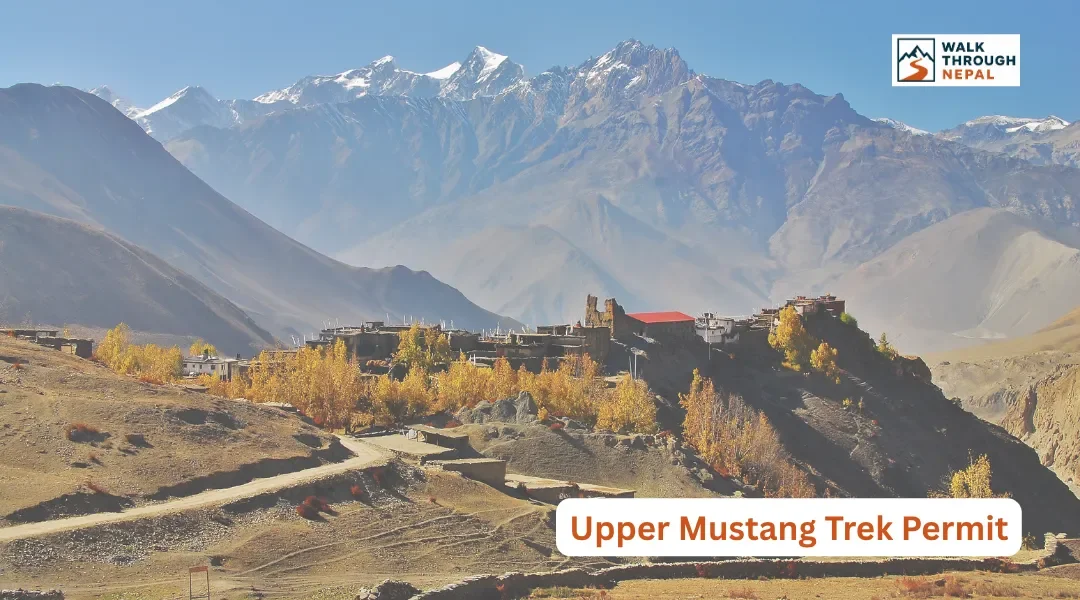
Upper Mustang was closed to outsiders until 1992, and it remains one of Nepal's most tightly controlled restricted zones. Before you picture yourself walking into the walled city of Lo Manthang, you need to understand exactly what permits you require, what they cost, and how they're legally arranged, because you cannot buy your way past this checkpoint with a standard trekking pass.
Our field coordinators process these permits every season, and the rules changed meaningfully in 2026. This guide covers the permits only, in full detail.
What Permits Do You Need for Upper Mustang?
Upper Mustang requires two mandatory permits: the Restricted Area Permit (RAP) and the Annapurna Conservation Area Permit (ACAP). You cannot enter the restricted zone north of Kagbeni without both, and a licensed guide is legally required to accompany you.
Unlike standard trekking regions, Upper Mustang does not use the general TIMS card as its primary entry document. The RAP replaces it as the controlling permit here. The two permits serve different purposes: the RAP is a national security and cultural preservation document managed by the Department of Immigration, while the ACAP funds conservation and community projects across the wider Annapurna region that the route passes through.
Upper Mustang Restricted Area Permit (RAP) Cost 2026
The Upper Mustang RAP costs USD 500 per person for the first 10 days. After that, each additional day costs USD 50 per person, a fixed, government-mandated fee that applies uniformly to all foreign nationals regardless of passport.
Most classic Lo Manthang itineraries run 12 to 14 days inside the restricted zone once you count the walk in and out from Jomsom, so budget for the base fee plus a handful of extra days. The permit is quoted in USD but paid in equivalent Nepalese Rupees (NPR) through your agency at the prevailing exchange rate.
Permit | Foreigner Cost | Validity |
|---|---|---|
Upper Mustang RAP (first 10 days) | USD 500 | 10 days |
RAP additional day | USD 50 / day | Per extra day |
ACAP (foreigners) | NPR 3,000 | Single entry |
ACAP (SAARC nationals) | NPR 1,000 | Single entry |
What a Typical Trip Actually Costs in Permit Fees
Run the math for a realistic 13-day itinerary and the RAP alone comes to USD 500 for the first 10 days plus USD 150 for the remaining 3 days (3 x USD 50), totaling USD 650 per person before you add the ACAP. Add the flat NPR 3,000 ACAP fee on top, and permit costs alone sit well above what most other Nepal treks charge for entry, which is exactly why Upper Mustang is priced and marketed as a premium restricted-area trek rather than a standard teahouse route.
A key point our team stresses every season: the RAP fee is non-refundable and non-transferable. If your trek is cut short by weather, illness, or a missed flight, you do not get a partial refund on days you didn't use. Plan your day count realistically before your agency submits the application.
Is There a SAARC or Local Discount on the RAP?
No. Unlike the ACAP and standard national park fees, the Upper Mustang Restricted Area Permit has no discounted SAARC rate. All foreign passport holders, including Indian citizens, pay the full USD 500 base fee. Only Nepali citizens are exempt from the RAP itself, though local district rules still apply to them separately.
This surprises a lot of travelers who assume SAARC pricing carries over from other permits in Nepal. It doesn't here, and no amount of agency negotiation changes the government-set rate.
The 2026 Guide Rule: Can You Go Solo?
According to the latest 2026 update from Nepal's Department of Immigration, a single traveler can now obtain an Upper Mustang RAP. The old two-person minimum has been removed entirely. However, you still must hire a licensed, government-registered guide, and the guide-to-trekker ratio in restricted areas is capped at 1:7. Independent solo trekking without a guide remains illegal.
This is the single most misunderstood rule our team corrects every season. Travelers read older posts claiming they need a trekking partner, panic, and try to pair up with a stranger online just to qualify. You no longer need to. One trekker, one guide, one permit works fine now. What has not changed is the guide requirement itself, and it's enforced strictly, not loosely, at checkpoints along the way.
Guide Requirement and Checkpoint Enforcement
Your guide carries all permits during the trek and presents them at fixed checkpoints, most notably at Kagbeni on entry and again at Chele and Lo Manthang as you move deeper into the restricted zone. Officers cross-check your passport against the permit, so keep it accessible rather than buried at the bottom of your pack.
Guides are not a formality here the way they can feel on unrestricted routes. A trekker caught in the restricted zone without a licensed guide and valid RAP faces fines, immediate removal from the area, and potential complications for future Nepal visas. The checkpoint system exists specifically because this is a security-sensitive border region, not just a scenic one.
How to Apply for the Upper Mustang Permit: Step by Step
Upper Mustang permits cannot be issued directly to individuals. Only a registered Nepali trekking agency can apply on your behalf, either at the Department of Immigration in Kathmandu or the Immigration Office in Pokhara. You provide the documents, the agency submits the application, and the permit is typically issued the same day.
Documents You Must Provide
Your original passport with at least 6 months validity remaining
A valid Nepal tourist visa, arranged on arrival or in advance
Two passport-sized photographs
A copy of travel insurance covering high-altitude helicopter evacuation
The name and license details of your assigned guide, which your agency handles
Since processing happens through your agency rather than a government counter, please plan at least one day of slack in Kathmandu or Pokhara before your Jomsom flight so the paperwork clears without rushing your departure.
The Nepal Tourist Visa: The Permit People Forget
Don't forget your Nepal tourist visa, which is entirely separate from both trekking permits and easy to overlook while focused on the RAP. As of 2026, visa-on-arrival fees run USD 30 for 15 days, USD 50 for 30 days, and USD 125 for 90 days. For a full Upper Mustang trip that also includes days in Kathmandu and Pokhara, the 30-day visa is the sensible default for most travelers.
Where the ACAP Fits In
The ACAP costs NPR 3,000 for foreigners and NPR 1,000 for SAARC nationals. Because the entire Upper Mustang route runs through the Annapurna Conservation Area before you even reach the restricted zone, this permit is required in addition to the RAP, not instead of it. It's issued by Nepal Tourism Board offices in Kathmandu or Pokhara and can be arranged in the same visit as your RAP paperwork.
Unlike the RAP, the ACAP does carry a SAARC discount, which is one of the few places in this permit stack where regional nationality actually changes your fee.
Mandatory High-Altitude Insurance for the RAP
Standard travel insurance is not sufficient for Upper Mustang. You need a policy that specifically covers high-altitude emergency helicopter evacuation up to 6,000 meters and treatment for AMS, HAPE, and HACE. This isn't a nice-to-have; it's effectively a prerequisite for restricted area permit processing, and agencies will ask to see proof before they submit your application.
Upper Mustang's high point sits near 4,200 meters around the Lo La area, with Lo Manthang itself at roughly 3,840 meters. That's gentler than Everest or Manaslu, but the remoteness means a helicopter is often the only realistic way out if something goes wrong, which is exactly why the insurance requirement is enforced rather than suggested. For a deeper look at altitude-specific risks on this route, see our Upper Mustang altitude guide.
Refund and Cancellation Policy
The RAP fee is fixed once paid: non-refundable and non-transferable, regardless of why your trek ends early. A grounded flight, an illness, or a family emergency doesn't entitle you to a partial refund on unused days, and the permit cannot be reassigned to another traveler if your plans change. Build a 1 to 2 day buffer into your schedule before applying so a weather delay in Jomsom doesn't eat into permit days you've already paid for.
Common Upper Mustang Permit Mistakes We See Every Season
A few errors come up often enough that they're worth naming directly. Travelers frequently underestimate their day count and pay for fewer days than their itinerary actually needs, only to face the USD 50 per day overage fee mid-trek. Others assume the SAARC discount that applies to ACAP also applies to the RAP, and are surprised at the full USD 500 rate. A smaller number try to apply for the RAP independently, not realizing only a registered agency can submit it, which simply isn't possible under current rules.
The most common mistake, though, is arriving in Nepal without insurance that explicitly names high-altitude helicopter evacuation, assuming a general travel policy will pass review. Confirm your policy's wording before you fly, not after your agency asks for it.
How Upper Mustang's Permit System Compares
Upper Mustang's RAP puts it in a different category from unrestricted routes like Annapurna Base Camp, which uses the standard TIMS and ACAP system without a restricted area fee at all; our Annapurna Base Camp permit guide breaks down that simpler process for comparison. Within the restricted-area category, Manaslu and Upper Dolpo follow a similar structure to Upper Mustang: a dedicated RAP, a mandatory licensed guide, and the same 2026 rule change allowing solo trekkers to apply. The core logic across all of Nepal's restricted zones is consistent even when the exact fees differ by region.
Frequently Asked Questions
How much is the Upper Mustang permit for 2026?
The Restricted Area Permit costs USD 500 for the first 10 days, plus USD 50 for each additional day. You also need the ACAP at NPR 3,000 for foreigners.
Can a single person get an Upper Mustang permit now?
Yes. As of 2026, the two-person minimum has been removed. A solo traveler can obtain the RAP but must still hire a licensed guide.
Do I need a guide for Upper Mustang?
Yes, absolutely. A government-licensed guide is legally mandatory in this restricted zone, with the guide-to-trekker ratio capped at 1:7.
Can I apply for the RAP myself?
No. Only a registered trekking agency can process the Restricted Area Permit at the Department of Immigration or the Pokhara Immigration Office.
Is TIMS required for Upper Mustang?
No. The Restricted Area Permit replaces the standard TIMS card as your controlling document, though you still need the ACAP.
How many days does the base RAP cover?
The base RAP covers 10 days inside the restricted zone. Additional days are charged at USD 50 per day.
Is the RAP fee refundable?
No. The Restricted Area Permit fee is non-refundable and non-transferable, even if your trek ends early.
Do SAARC nationals get a discount on the RAP?
No. All foreign nationals, including Indian citizens, pay the full USD 500 RAP fee. Only the ACAP carries a SAARC rate.
Where is my permit checked along the route?
Checkpoints sit at Kagbeni, Chele, and Lo Manthang, where your guide presents the RAP and officers may cross-check it against your passport.
What insurance do I need for the permit application?
You need coverage for high-altitude helicopter evacuation up to 6,000 meters and treatment for AMS, HAPE, and HACE, confirmed explicitly in your policy wording.
How long before my trek should I apply for the RAP?
Most agencies process it within a day, but build in at least 1 to 2 days of buffer in Kathmandu or Pokhara in case of delays.
Do I need a separate visa on top of the trekking permits?
Yes. The Nepal tourist visa is separate from both the RAP and ACAP, priced at USD 30, USD 50, or USD 125 depending on duration.
Can I extend my RAP once I'm already inside Upper Mustang?
Extensions are handled through your guide and agency and are charged at the standard USD 50 per day rate, but they depend on days remaining on your visa as well.
Does the ACAP fee change if I'm also visiting Annapurna Base Camp?
No, the ACAP is a single-entry conservation area permit that covers the whole Annapurna Conservation Area, including the Upper Mustang route.
What happens if I'm caught trekking without the correct permits?
You risk fines, immediate removal from the restricted area, and potential complications with future Nepal visa applications, since this is an actively enforced security zone.
Ready to Apply for Your Upper Mustang Permit?
Our team handles the full RAP and ACAP application process for every trekker we guide into Upper Mustang, so you're not navigating Department of Immigration paperwork alone. Browse our Upper Mustang trek itinerary or reach out through our inquiry page and we'll walk you through the exact documents and timeline for your dates.