The Ghorepani Poon Hill Trek cost depends on your itinerary length, transportation choice, guide, accommodation standard, and what is bundled into your price. However, this trek remains one of the best value Himalayan treks in Nepal because of its short, low altitude, and easy to reach from Pokhara.
Before you compare numbers, you need to understand three very different figures that travelers often confuse: the independent trek cost, the guided trek cost, and the full package cost. Each includes different things, and the cheapest headline number is rarely the true total you will spend. We work these trails every season, and this guide lays out the real 2026 costs so you can budget with confidence.
How Much Does the Ghorepani Poon Hill Trek Cost?
A guided Ghorepani Poon Hill Trek typically costs between $650 to $1200 USD per person for a 4 to 8 day trip, covering permits, a licensed guide, teahouse lodging, meals, and ground transport. Independent trekkers pay less per day but must still hire a licensed guide under the 2026 Annapurna region rules, which narrows the savings gap considerably.
Here is a realistic per-person cost breakdown for a standard 4-day trek based on two people sharing:
Expense
Estimated Cost (per person)
Permits (ACAP)
NPR 3,000 (~$20 USD)
Transportation (Pokhara return + trailhead)
$25 – $70 USD
Accommodation (3 nights)
NPR 1,500 – 4,500 (~$11 – $34 USD)
Food (4 days)
NPR 10,000 – 16,000 (~$75 – $120 USD)
Guide (shared between 2)
$50 – $70 USD
Porter (shared, optional)
$40 – $50 USD
Drinks, water purification, charging, showers
NPR 3,000 – 6,000 (~$22 – $45 USD)
Miscellaneous & tips
$30 – $60 USD
Estimated total
$300 – $650 USD
Your final total depends mainly on whether you trek independently or book a guided package, how many days you spend on the trail (a 4-day, 5-day, 8-day Poon Hill trek), and exactly what your package includes. This is the section most travelers searching for Poon Hill trek cost care about, so use it as your anchor and read on for the detail behind each line.
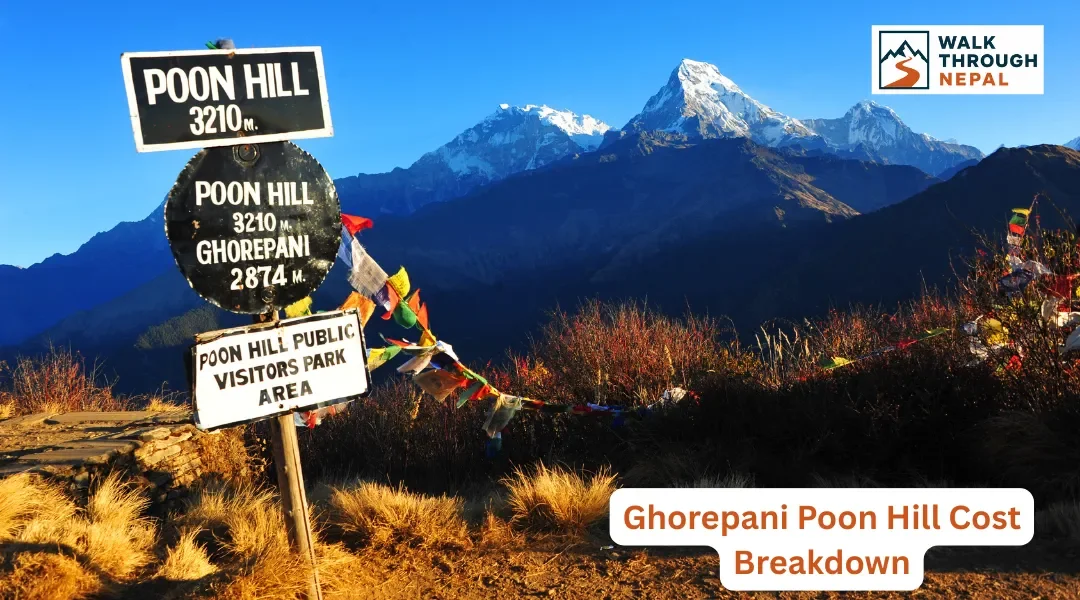
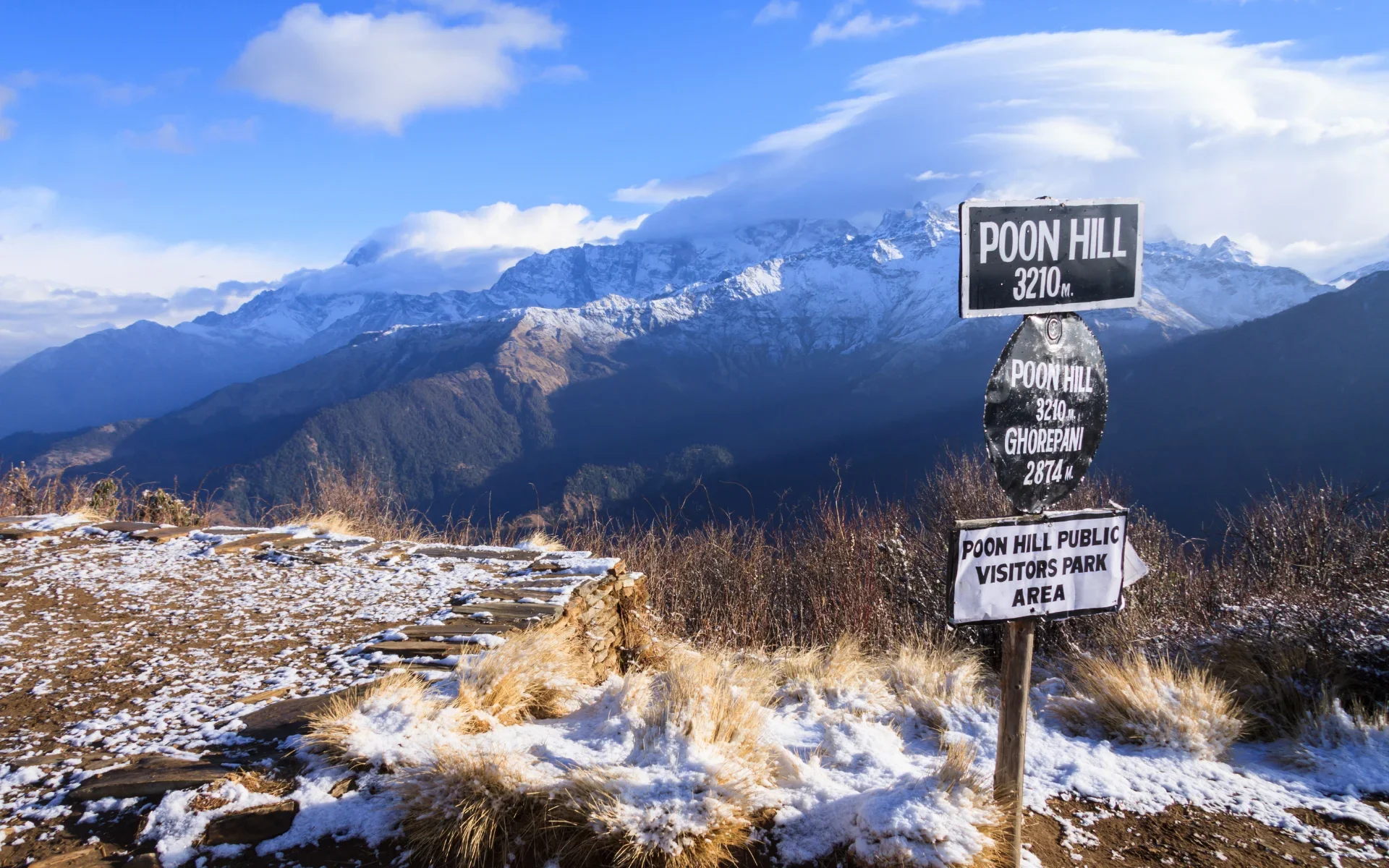
Source: Canva; The viewpoint at Poon Hill, located at an altitude of 3,210 meters (10,531 feet) in the Annapurna region of Nepal
Ghorepani Poon Hill Trek Cost Breakdown
The Ghorepani Poon Hill trek cost breaks down into transportation, accommodation, food, guide, porter, permits, and paid trail extras. Transport and food are the two categories that swing your total the most, while permits are fixed and predictable. Understanding each line stops you from underbudgeting once you are actually on the trail.
Transportation Cost
Transport covers three legs: Kathmandu to Pokhara, Pokhara to the trailhead, and the return from Ghandruk or Nayapul back to Pokhara. Costs vary widely by vehicle type, so verify live rates before you travel, as fuel prices and seasonal demand shift these numbers.
A tourist bus from Kathmandu to Pokhara costs roughly $12 – $25 USD and takes 6 to 8 hours. A domestic flight runs a general range and should be checked live. From Pokhara, a shared jeep to the classic trailheads at Nayapul or Tikhedhunga is cheap, while a private jeep to Ghandruk or the higher road-heads costs more per vehicle but can be split across your group.
Most guided packages include all ground transport between Pokhara and the trailheads. If you book independently, budget both directions and confirm whether the driver takes you all the way to the walking start or drops you at a road junction.
Accommodation Cost
Accommodation on the Poon Hill trail is simple teahouse lodging, costing NPR 500 to NPR 1,500 per night for a basic twin room with shared bathrooms. In the larger hubs of Ghorepani and Ghandruk, and in peak season, rooms sit at the higher end and fill fast by early afternoon.
A long-standing trail custom is that lodges offer very cheap or even free rooms provided you eat dinner and breakfast there. Attached bathrooms and hot water cost extra. Some places in Ghorepani book out during the March–May and October–November peaks, so a package that pre-reserves rooms genuinely saves you stress here.
Food Cost
Plan on NPR 2,500 to NPR 4,000 (roughly $18 – $30 USD) per person per day for food, with prices climbing as you gain elevation. Everything is carried up by mule and porter, so a plate that is cheap in Pokhara costs noticeably more in Ghorepani at 2,874 meters.
Here is what to expect on the menu:
Dal Bhat (lentils, rice, vegetable curry): NPR 600 – 900, with free refills
We strongly recommend the local Dal Bhat as your main fuel. It is freshly cooked, energy-dense, comes with free seconds, and is safer at altitude than trail meat, which is carried for days without refrigeration. Stick to fresh, locally grown carbohydrates and vegetarian meals wherever possible.
Guide Cost
A licensed trekking guide costs roughly $25 to $35 USD per day, which usually covers the guide's own food, lodging, insurance, and transport. As of 2026, hiring a licensed guide is required across most Annapurna region trails, so this is no longer an optional line for independent trekkers to skip.
A good guide handles navigation on the many trail junctions between Ulleri, Ghorepani, and Tadapani, manages your teahouse bookings, watches for early signs of altitude issues, and explains the Gurung villages and culture you pass through. Because one guide serves your whole group, the per-person guide cost drops sharply as your group grows, which is why a guided package often costs little more than a well-organized independent trip.
Porter Cost
A porter costs about $20 to $25 USD per day and typically carries up to 20 to 25 kg. That means a single porter can comfortably carry the bags of two trekkers, halving the per-person cost. This price generally includes the porter's meals, lodging, and insurance.
Many budget travelers ask whether they can skip the porter entirely. On Poon Hill you can, since the trek is short and the daily distances are moderate. But the climb from Tikhedhunga to Ghorepani includes the famous stone staircase of over 3,000 steps, and carrying your own full pack up that section is hard work. A porter-guide, who both carries a light load and guides, is a popular middle option for solo travelers and couples wanting to trim costs.
Ghorepani Poon Hill Trek Permit Cost
The Ghorepani Poon Hill Trek requires two permits: the Annapurna Conservation Area Project (ACAP) permit and the TIMS card. Poon Hill sits inside the Annapurna Conservation Area, so no national park entry fee applies here, but both documents are checked at official checkpoints along the trail.
The fixed 2026 government fees are:
Permit
Foreigners
SAARC Nationals
Nepali
ACAP Permit
NPR 3,000 (~$22 USD)
NPR 1,000
Free / minimal
Carry two passport photos and a copy of your passport to obtain these in Pokhara or Kathmandu. If you book a package, confirm the operator processes both permits for you, since this is standard practice with reputable companies and saves you a queue at the tourism board office.
How Much Does a Ghorepani Poon Hill Trek Package Cost?
A full Ghorepani Poon Hill Trek package generally costs between $650 to $1200 USD per person, with the exact price driven by group size, trip length, and accommodation standard. Larger groups pay less per head because guide and transport costs spread across more people.
Package pricing differs between operators depending on inclusions and service quality. Our Walk Through NepalGhorepani Poon Hill packages are built to bundle the permits, licensed guide, teahouse lodging, meals on the trail, and Pokhara ground transport into one transparent price, so you know your core cost before you land. Reach out to our team for a current, itemized quote matched to your dates and group size.
What Is Included in a Ghorepani Poon Hill Trek Package?
A standard Poon Hill package includes permits, guide, accommodation, meals, ground transport, and government taxes. Inclusions vary between operators, so a package price on its own is almost meaningless until you see exactly what it covers. Always compare the checklist, not just the headline number.
Typically included in a quality package:
Teahouse accommodation on the trail
Meals during the trek (usually breakfast, lunch, dinner)
Licensed, experienced trekking guide
Porter (in most mid-range and above packages)
ACAP permit
Ground transportation to and from the trailheads
Pokhara–Kathmandu logistics where applicable
Guide and porter insurance, food, and lodging
All government taxes and service charges
Our Walk Through Nepal package clearly lists what is covered so there are no surprises. When comparing any operator, ask them to confirm in writing whether porters and permits are inside the price or billed separately.
What Is Not Included in the Trek Cost?
Package prices exclude international flights, your Nepal visa, personal insurance, and paid trail extras like hot showers, Wi-Fi, and charging. Never assume the package figure is your total spend, because these personal costs add up quickly over a few days on the trail.
Personal snacks, extra drinks, and bottled beverages
Wi-Fi access, phone charging, and hot gas showers (NPR 100 – 700 each)
Tips for your guide and porter
Personal shopping and souvenirs
Emergency evacuation and hospital costs
Extra nights of accommodation before or after the trek
Any personal expenses of a discretionary nature
On altitude and safety, standard travel insurance is not enough. Make sure your policy specifically covers high-altitude emergency helicopter evacuation and treatment for AMS, HAPE, and HACE. Poon Hill tops out at a moderate 3,210 meters, so serious altitude illness is uncommon, but a comprehensive policy is still non-negotiable for any Himalayan trip.
How Much Extra Money Should You Take on the Poon Hill Trek?
Even on a fully organized package, carry NPR 10,000 to NPR 20,000 per person in cash for the trail. This covers drinks, hot showers, phone charging, Wi-Fi, snacks, tips, and any emergency buffer. ATMs are unreliable once you leave Pokhara, so withdraw enough Nepalese Rupees before you start walking.
Build your cash buffer around these realities:
Hot showers: NPR 200 – 500 each
Device charging: NPR 200 – 400 per session
Wi-Fi (where available): NPR 200 – 500
Extra drinks and snacks: variable, adds up fast
Crew tips: a meaningful part of your budget
The trail runs on a cash micro-economy. Lodges and small shops in Ghorepani, Ghandruk, and Tadapani rarely take cards reliably, so digital payment cannot be your only plan.
Independent Trek vs Package Trek: Which Is Cheaper?
Independent trekking looks cheaper on paper, but once you add the now-required licensed guide, your own permit processing, and separate transport bookings, the gap with a package narrows sharply. A package trades a small premium for convenience, pre-booked rooms, and someone handling the logistics.
Cost Factor
Independent
Package
Permits
Arrange separately
Usually handled
Accommodation
Pay as you go
Included
Meals
Pay separately
Depends on package
Guide
Required, arrange yourself
Included
Porter
Optional, arrange yourself
Often included
Transportation
Book each leg
Included in most packages
Planning
Your responsibility
Operator handles
Flexibility
Higher
Depends on itinerary
Convenience
Lower
Higher
So is the cheapest option actually the best value? For most travelers, no. Once a licensed guide is mandatory, the true cost difference is modest, and a package removes the risk of arriving at a full lodge in Ghorepani during peak season with no room. If you have plenty of time, speak good travel-Nepali, and want maximum flexibility, independent trekking still works. For everyone else, a well-priced package is the smarter spend.
Is the Ghorepani Poon Hill Trek Worth the Cost?
Yes. For the money and the few days it takes, Poon Hill delivers one of the best sunrise mountain panoramas in Nepal, wrapped into a short, accessible, low-altitude trek. It is exceptional value for travelers short on time who still want a genuine Himalayan experience.
What your budget buys you:
The famous Poon Hill sunrise over Dhaulagiri and the Annapurna range
Spring rhododendron forests in full bloom from March to April
Traditional Gurung villages including Ghandruk and Ghorepani
A short 4 to 8 day itinerary that fits into a wider Nepal trip
Moderate altitude, well below the danger zone of higher treks
Quick access from Pokhara, with no expensive mountain flights needed
Poon Hill also links beautifully into longer routes. Many trekkers combine it with the Annapurna Base Camp trek via Tadapani, or use it as a warm-up before tackling the Annapurna Circuit.
Cultural Etiquette and Responsible Trekking
Trek respectfully and your budget also supports the local community. Always walk clockwise around mani walls, stupas, and chortens, keeping these sacred structures on your right. Remove your shoes and hat before entering any monastery, and never photograph inside prayer halls unless a resident monk gives you explicit permission.
On tipping, it is culturally expected and a vital supplement to your crew's base income. A fair guideline is 10% to 15% of your total trek cost, distributed between your guide and porter at the end of the trip. Finally, skip plastic bottled water to protect these trails, carry a reusable bottle, and treat water with a UV purifier, Sawyer filter, or chlorine dioxide drops.
Frequently Asked Questions
How much does the Ghorepani Poon Hill Trek cost?
A guided Ghorepani Poon Hill Trek typically costs around $650–$1,200 USD per person for a 4–8 day trip, depending on group size, itinerary, accommodation standard, and inclusions. A shorter 4-day trek can cost considerably less, particularly when guide and transportation costs are shared.
How much does a 4-day Poon Hill Trek cost?
A standard 4-day Ghorepani Poon Hill Trek can cost roughly $320–$550 USD per person, depending on the group size and package inclusions. Your actual cost may vary based on whether you choose shared or private transportation, whether a porter is included, and the standard of accommodation and services provided.
How much money should I take for the Poon Hill Trek?
You should carry around NPR 10,000–20,000 in cash per person for expenses that may not be included in your trek package. This can cover hot showers, charging, Wi-Fi, snacks, extra drinks, tips, and an emergency buffer. Since reliable ATM access becomes limited once you leave Pokhara, it is best to withdraw enough Nepalese Rupees before starting the trek.
How much does food cost on Poon Hill Trek?
Budget around NPR 2,500–4,000 per person per day for food on the trail. Prices generally increase with elevation because food and supplies have to be transported to the mountain villages. Dal Bhat is one of the best-value options, while breakfast, noodles, tea, coffee, snacks, and other meals add to your daily spending.
How much does accommodation cost on Poon Hill Trek?
Basic teahouse accommodation generally costs around NPR 500–1,500 per night for a twin room with shared bathroom facilities. Prices can be higher in popular villages such as Ghorepani and Ghandruk, particularly during the peak trekking seasons. Hot showers, attached bathrooms, and other additional facilities may cost extra
Are permits included in the Poon Hill Trek package?
The Ghorepani Poon Hill Trek requires an Annapurna Conservation Area Project (ACAP) permit and a TIMS card. The article's 2026 permit breakdown lists the applicable fees by nationality. If you book a package, confirm whether the operator handles both permits for you.
Can I do Poon Hill Trek on a budget?
Yes. You can reduce your Poon Hill Trek expenses by traveling in a group, sharing guide and transportation costs, choosing standard teahouse accommodation, eating local meals such as Dal Bhat, and limiting paid extras such as hot showers, Wi-Fi, charging and unnecessary snacks. A shorter itinerary with shared services can bring the cost toward the lower end of the typical budget range.
Ready to Trek Nepal?
The Ghorepani Poon Hill Trek is one of the easiest ways to see the Annapurna giants without a big budget or a long holiday, and with clear numbers in hand you can plan it with real confidence. When you are ready to lock in dates, connect with our verified local guides and browse tailored Ghorepani Poon Hill itineraries on our platform for an honest, itemized quote built around your group and travel style.
When you're ready to turn your plans into reality, Walk Through Nepal can help you organize every detail, from permits and transportation to experienced local guides and trekking itineraries. Our team works directly with local trekking experts to provide transparent advice and honest, itemized pricing based on your travel style, group size, and preferred trekking season.
Ready to watch the sunrise over Annapurna and Dhaulagiri from Poon Hill? Contact Walk Through Nepal today and start planning your trek with local experts who know the trail best.