Contents

Few mountaineering stories have changed how the world sees the highest peaks quite like that of Nirmal Purja, known across the climbing world as Nimsdai. His name became shorthand for speed, unshakable resolve, and the belief that a goal everyone calls impossible can still be reached.
His most famous achievement came through Project Possible, when he climbed all 14 of the world's 8,000-meter peaks in just 189 days in 2019. To put that in perspective, the previous record stood at nearly eight years.
But the story of Nimsdai is bigger than any record. It is the story of a Nepali mountaineer, a former British military serviceman, an expedition leader, and a figure whose influence reached far beyond the summit ridge.
This is the story of Nirmal Purja: his early life, his military career, his rise in mountaineering, Project Possible, his record-breaking achievements, his final expedition, and the legacy he leaves behind.
Who Was Nirmal Purja?
Nirmal Purja, commonly called Nimsdai or Nims Dai, was a Nepali mountaineer, former British military serviceman, and expedition leader. He rose to global fame for climbing all 14 eight-thousanders in 189 days, and for shifting how the public understood human potential at extreme altitude.
Born in Nepal, Purja carried the Himalayas with him throughout his life. He served in an elite British military unit before turning to high-altitude climbing full time. His connection to Nepal's mountains, combined with a military mindset built on discipline and problem-solving, made him one of the most recognizable climbers of his generation.
Nirmal Purja's Early Life and Background
Nirmal Purja was born in Nepal and grew up far from the elite climbing circles he would later dominate. His path to the world's highest peaks ran through the British military rather than a traditional mountaineering apprenticeship, and that unusual route shaped everything about how he approached climbing.
Growing Up in Nepal
Purja was raised in a modest Nepali household, and like many young people from his background, the mountains were part of daily life rather than a distant dream. Nepal's landscape, from lowland hills to the giants of the Himalaya, formed the backdrop of his childhood and gave him an early comfort with rugged terrain.
From Nepal to the British Military
Purja joined the British military, serving in demanding roles that pushed his physical and mental limits. His time in special forces selection and service demanded elite fitness, discipline, and the ability to operate under extreme pressure, foundations that would later prove decisive on 8,000-meter peaks.
How the Military Shaped His Mentality

The link between his military years and his climbing career is direct. Discipline built endurance. Endurance sharpened decision-making. Decision-making fed leadership. And leadership let him drive an entire expedition team through the most punishing conditions on Earth. He did not simply become an athlete who decided to climb; he became a man trained to execute impossible missions.
How Nimsdai Became a Mountaineer
Nirmal Purja transitioned from military service to full-time high-altitude mountaineering after discovering an extraordinary aptitude for the peaks. He climbed several major Himalayan summits in a remarkably short span, then made the bold decision to leave his military pension behind to chase an unprecedented goal.
Climbing became serious for Purja relatively late compared to most professional mountaineers, but his progress was staggering. He reached high summits within his first few years on the big mountains, revealing rare physiology and an almost fearless tolerance for altitude and effort.
The world's highest mountains drew him because they matched the scale of his ambition. He wasn't looking to simply tick summits; he wanted to prove that a Nepali climber could set a global benchmark. That ambition crystallized into a single mission that would define his life.
The 14 Eight-Thousanders and Why They Matter
The 14 eight-thousanders are the only mountains on Earth that rise above 8,000 meters. They sit across the Himalaya and Karakoram ranges in Nepal, China, Pakistan, and India, and standing on all 14 summits is considered one of mountaineering's ultimate achievements.
What Is an Eight-Thousander?
An eight-thousander is a mountain whose summit exceeds 8,000 meters above sea level. There are exactly 14 of them. Above roughly 8,000 meters lies the "death zone," where oxygen is too thin to sustain human life for long, making every one of these peaks a serious life-or-death undertaking.
Mountain | Elevation |
Everest | 8,848.86 m |
K2 | 8,611 m |
Kangchenjunga | 8,586 m |
Lhotse | 8,516 m |
Makalu | 8,485 m |
Cho Oyu | 8,188 m |
Dhaulagiri | 8,167 m |
Manaslu | 8,163 m |
Nanga Parbat | 8,126 m |
Annapurna I | 8,091 m |
Gasherbrum I | 8,080 m |
Broad Peak | 8,051 m |
Gasherbrum II | 8,035 m |
Shishapangma | 8,027 m |
If you want to understand where these giants sit and how the highest of them fits into Nepal's landscape, our detailed piece on where Mount Everest is located gives useful geographic context.
Project Possible: The Mission That Changed Mountaineering

Project Possible was Nirmal Purja's plan to climb all 14 eight-thousanders in under seven months. Most of the mountaineering community considered it delusional. He completed it in 189 days in 2019, obliterating a record that had stood for years and rewriting the limits of what was thought achievable.
What Was Project Possible?
The objective was blunt and enormous: summit every 8,000-meter peak on the planet in a single, continuous push measured in months, not years. It required constant travel between Nepal, Pakistan, and China, back-to-back summit pushes, and a physical recovery schedule that left almost no room to rest.
Why the Goal Seemed Impossible
Every element worked against him. Extreme altitude drains the body faster than it can recover. Weather windows on each peak are narrow and unpredictable. Logistics across three countries meant flights, permits, and border crossings between climbs. On top of that came the physical toll of repeated exposure to the death zone and the mental strain of never truly stopping. Stacking all 14 into a few months multiplied every risk.
The 14 Peaks in 189 Days
No. | Mountain | Elevation | Summit Date | Location |
|---|---|---|---|---|
1 | Annapurna I | 8,091 m | April 23, 2019 | Nepal |
2 | Dhaulagiri I | 8,167 m | May 12, 2019 | Nepal |
3 | Kangchenjunga | 8,586 m | May 15, 2019 | Nepal |
4 | Mount Everest | 8,849 m | May 22, 2019 | Nepal |
5 | Lhotse | 8,516 m | May 22, 2019 | Nepal/Tibet |
6 | Makalu | 8,485 m | May 24, 2019 | Nepal |
7 | Nanga Parbat | 8,126 m | July 3, 2019 | Pakistan |
8 | Gasherbrum I | 8,080 m | July 15, 2019 | Pakistan |
9 | Gasherbrum II | 8,035 m | July 18, 2019 | Pakistan |
10 | K2 | 8,611 m | July 24, 2019 | Pakistan |
11 | Broad Peak | 8,051 m | July 26, 2019 | Pakistan |
12 | Cho Oyu | 8,188 m | September 23, 2019 | Tibet |
13 | Manaslu | 8,163 m | September 27, 2019 | Nepal |
14 | Shishapangma | 8,027 m | October 29, 2019 | Tibet |
Nirmal Purja's Most Remarkable Mountaineering Achievements
Nirmal Purja's achievements span speed records, first winter ascents, and expedition leadership. His most celebrated feat is Project Possible, but his rapid high-altitude ascents and his role in supporting other climbers established him as far more than a record-chaser.
The 14 Eight-Thousanders in 189 Days
This remains his defining accomplishment. Climbing all 14 peaks above 8,000 meters in under seven months is a feat of endurance, logistics, and willpower that no one had approached before.
The K2 Winter First
Purja was part of the team of Nepali climbers who made the first-ever winter ascent of K2, reaching the summit in January 2021. K2 had long been the last eight-thousander never climbed in winter, and the all-Nepali team's success was a landmark moment celebrated across the country.
Rapid High-Altitude Ascents
Beyond the headline records, Purja repeatedly demonstrated an exceptional ability to move fast at altitude, linking multiple summits in short windows and recovering quickly enough to push again. This capacity underpinned nearly every one of his major achievements.
Leading and Supporting Other Climbers
His influence was not limited to his own summit tally. Through his expedition company he led and supported many other climbers to the top of major peaks, and he became known for turning back to assist stranded mountaineers when he could. His impact was measured in the summits of others as much as his own.
The Everest Traffic Jam Photograph
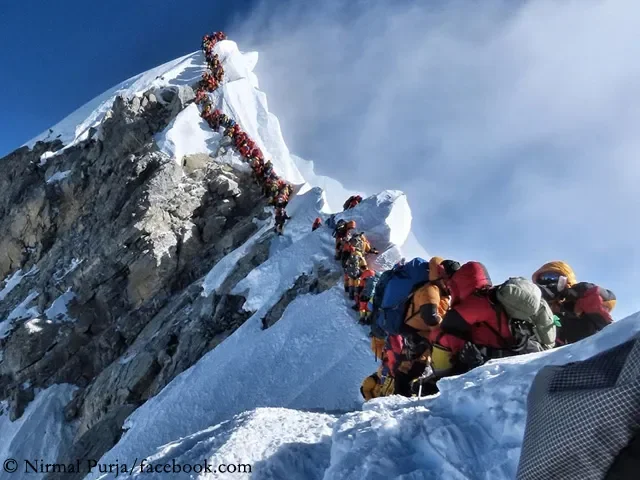
The image of climbers queued in a long single-file line near Everest's summit ridge, captured by Nirmal Purja during Project Possible in May 2019, became one of the defining photographs in modern mountaineering and brought him worldwide attention.
The photograph showed dozens of climbers stacked along a narrow, exposed ridge, waiting in the death zone. It went viral instantly because it made an abstract concern visible: Everest had become dangerously crowded. The picture sparked a global conversation about overcrowding, permit numbers, and safety on the world's highest mountain.
Purja's perspective carried weight because he had just moved through that same crowd at record speed. His firsthand view gave the debate credibility, and the image cemented him in the public imagination even before Project Possible was complete. For climbers weighing when the mountain is most crowded, our overview of the Everest climbing season explains the timing behind those famous queues.
14 Peaks: Nothing Is Impossible
14 Peaks: Nothing Is Impossible is the 2021 Netflix documentary that told the story of Project Possible to a global audience. It transformed Nirmal Purja from a name known within climbing circles into an internationally recognized figure.
How the Documentary Introduced Nimsdai to a Global Audience
Before the film, Purja's achievement was largely understood by mountaineers and Himalayan enthusiasts. The documentary put his mission in front of millions of viewers who had never followed climbing, giving his story reach far beyond the sport.
What the Documentary Shows
The film follows the logistics, setbacks, funding struggles, and physical extremes behind Project Possible. It captures the human cost of the mission, the strain on his team, and the moments where the entire project nearly collapsed, making the eventual success feel earned rather than inevitable.
Why "Nothing Is Impossible" Became Associated With His Story
The phrase became his signature because it summed up the mission's core idea. The documentary framed his life around the belief that limits are often assumptions, and that framing turned a climbing record into a widely shared message about ambition.
Nirmal Purja's Approach to Impossible Goals
Nirmal Purja approached impossible goals by setting an extraordinary target, breaking it into manageable objectives, preparing intensely for the environment, building a strong team, and refusing to stop when conditions changed. These principles, drawn from his own story, apply well beyond mountaineering.
Set an extraordinary target. Purja did not aim for a modest improvement. He chose a goal so large it forced a completely different approach.
Break the impossible into individual objectives. Fourteen peaks became fourteen separate missions, each with its own plan, rather than one overwhelming task.
Prepare for the environment, not just the goal. He trained and planned around weather windows, altitude, and logistics, treating the conditions as the real opponent.
Build a strong team. His success relied on skilled Nepali climbers and support staff. He rarely framed his achievements as solo triumphs.
Keep moving when conditions change. When plans broke, he adapted rather than abandoned the mission, treating setbacks as problems to solve.
Nimsdai's Impact on Nepalese Mountaineering
Nirmal Purja brought unprecedented global visibility to Nepali mountaineers, highlighting the skill and leadership of climbers who had long powered expeditions without recognition. His success helped shift the international perception of Nepali climbers from support roles toward front-line achievement.
Nepal has always been central to high-altitude mountaineering, and Sherpa and other Nepali climbers have carried expeditions for decades, often without the credit their expertise deserved. Purja's fame put that expertise in the spotlight and inspired a new generation of Nepali mountaineers to lead their own record-setting projects.
It would be wrong to suggest that Purja alone built Nepal's mountaineering reputation, which rests on generations of climbers. But he amplified it powerfully, and his visibility helped the world take Nepali expedition leadership seriously. If his story inspires you to experience Nepal's mountains yourself, our guide to the best treks in Nepal for beginners is a good starting point.
Nirmal Purja's Final Expedition and Death
According to Reuters, Nirmal Purja died on Broad Peak after an avalanche struck his expedition on July 30, 2026. The rugged terrain and rescue limitations complicated recovery efforts, and his body was later recovered during a subsequent operation.
Purja returned to Broad Peak, one of the 14 eight-thousanders he knew well from Project Possible, for an expedition in the summer of 2026. On July 30, an avalanche struck the mountain, resulting in the deaths of Purja and other climbers.
The remoteness and steepness of the terrain made rescue and recovery extremely difficult, and operations were hampered by the conditions that make Broad Peak dangerous in the first place. A later report confirmed that his body was recovered during the ongoing operation.
His death was a profound loss for Nepal and for the global climbing community. The purpose here is remembrance and context rather than the tragedy itself, honoring a man who spent his life at the edge of what mountains allow.
What Is Nirmal Purja's Legacy?
Nirmal Purja's legacy is the redefinition of what is possible at extreme altitude, the elevation of Nepali mountaineers onto the world stage, and a philosophy that treats impossible goals as a series of possible steps. His influence reaches far beyond his summit count.
A record that changed the conversation. Project Possible did not just break a record; it forced the mountaineering world to reconsider human limits at altitude.
A new generation of Nepali mountaineers. His visibility inspired younger Nepali climbers to pursue ambitious, front-line projects rather than remaining unseen support.
The meaning of "impossible." He reframed the word as a starting assumption to be tested, not a final answer.
A legacy beyond summit numbers. His story should not be reduced to how fast he climbed 14 mountains. It is about mindset, leadership, and the courage to attempt what others dismiss.
Nirmal Purja's Most Important Achievements at a Glance
Achievement | Why It Matters |
Project Possible | All 14 eight-thousanders in 189 days, shattering the previous record |
K2 winter first ascent | Part of the all-Nepali team that first summited K2 in winter |
Everest photograph | Brought global attention to Everest's summit congestion |
14 Peaks: Nothing Is Impossible | Introduced his story to a worldwide audience via Netflix |
Expedition leadership | Extended his influence beyond personal climbing records |
Nirmal Purja: More Than a Record
Nirmal Purja's story is ultimately not only about climbing 14 of the world's highest mountains. It is about the willingness to challenge assumptions about what can be achieved, the discipline required to pursue an extraordinary goal, and the courage to keep going where the margin for error is incredibly small.
His life and career changed how millions of people viewed the world's highest mountains. His final expedition ended in tragedy, but the idea behind his most famous mission, that what appears impossible can be approached as a series of possible steps, remains central to the story he leaves behind.
FAQs
1. Who is Nirmal Purja?
Nirmal Purja, widely known as Nimsdai or Nims Dai, was a Nepali mountaineer, former British military serviceman and expedition leader. He became world-famous for Project Possible, climbing all 14 of the world's 8,000-meter peaks in 189 days in 2019.
2. What is Nirmal Purja famous for?
He is most famous for Project Possible, summiting all 14 eight-thousanders in just 189 days in 2019, shattering the previous record of nearly eight years. He also gained global attention for his viral 2019 Everest summit queue photograph and the Netflix documentary 14 Peaks: Nothing Is Impossible.
3. What is Nimsdai's real name?
Nimsdai's real name is Nirmal Purja. “Nimsdai” is a nickname, with “dai” being a respectful Nepali term for older brother.
4. How many 8,000-meter peaks did Nirmal Purja climb?
During Project Possible he climbed all 14 of the world's 8,000-meter peaks, from Annapurna I to Shishapangma.
5. How long did Nirmal Purja take to climb all 14 peaks?
He completed all 14 eight-thousanders in 189 days, from April to October 2019, a mission he called Project Possible.
6. What was Project Possible?
Project Possible was Nirmal Purja's mission to climb all 14 of the world's 8,000-meter peaks in under seven months, a task most experts considered impossible. He achieved it in 189 days in 2019.
7. Did Nirmal Purja climb Mount Everest?
Yes. Everest was one of the 14 peaks he summited during Project Possible in May 2019, alongside Lhotse and Makalu in a rapid multi-summit push.
8. What is the 14 Peaks documentary?
14 Peaks: Nothing Is Impossible is a 2021 Netflix documentary that chronicles Nirmal Purja's Project Possible mission and introduced his story to a worldwide audience.
9. When did Nirmal Purja die?
According to the Reuters, Nirmal Purja died on Broad Peak after an avalanche struck his expedition on July 30, 2026.
10. What is Nirmal Purja's legacy?
His legacy extends beyond his climbing records. He redefined perceptions of what is achievable at extreme altitude, raised global visibility for Nepali mountaineers, and championed the idea that impossible goals can be broken into a series of possible steps.