Ghorepani Poon Hill Trek Permit Altitude: Elevation Profile, Gain & Tips
RRojan BasnetAugust 16, 2026
Local trekking experts, wherever you go
Trips planned around your pace, interests, and time.
Real People, Quick and Helpful Support
Find the best time for the Mardi Himal Trek with a month-by-month guide to weather, mountain views, crowds, trail conditions, and rhododendrons.
How difficult is the Mardi Himal Trek? A moderate walk with steep climbs and 3,500m+ altitude. Get fitness tips, daily breakdown & trail conditions here.
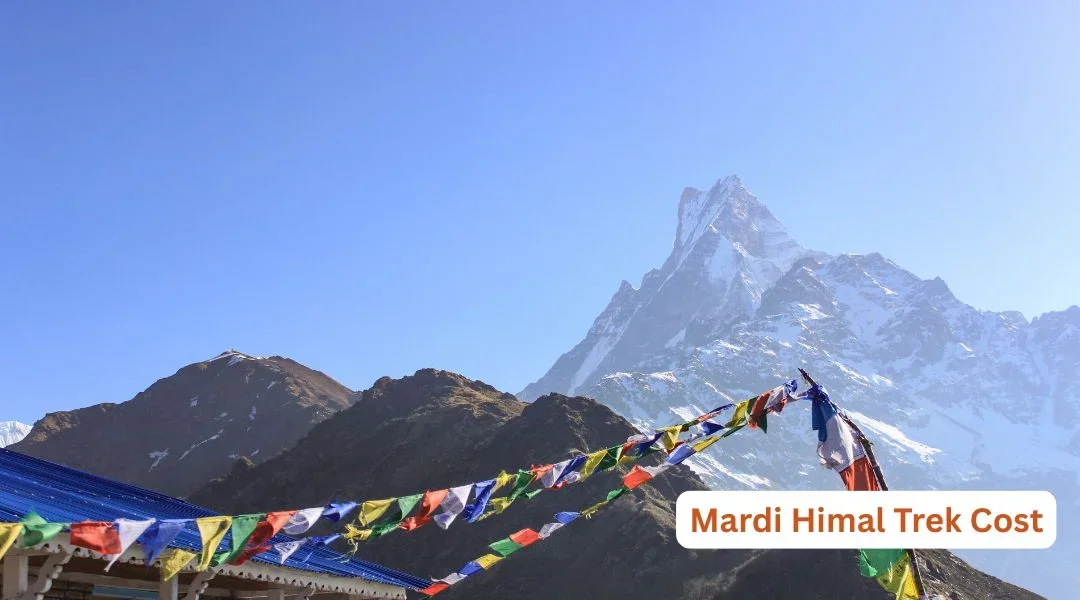
See the real Mardi Himal Trek cost in 2026: permits, guide, porter, food, transport, and hidden fees. Compare budget vs comfort trekking prices.
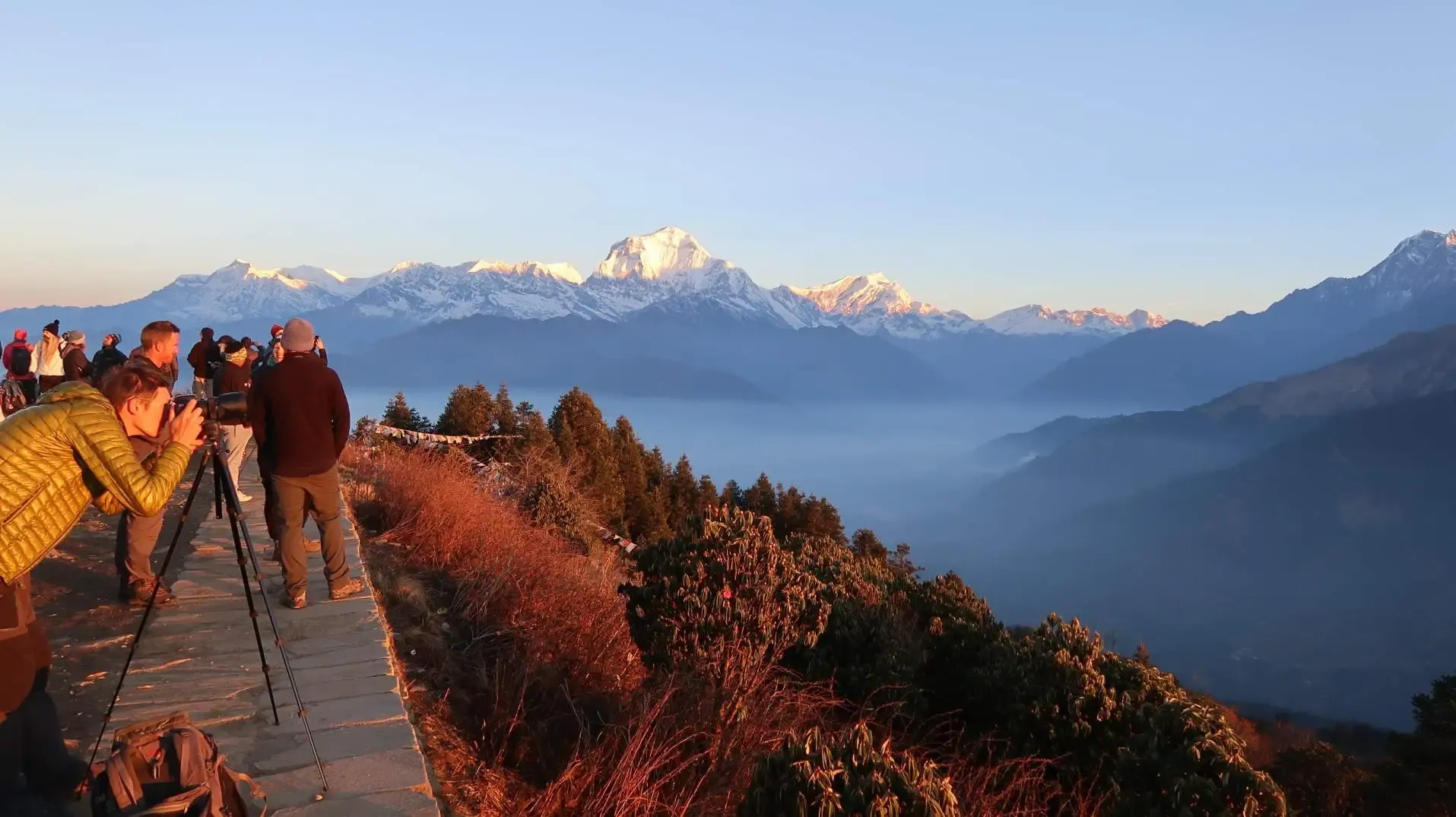
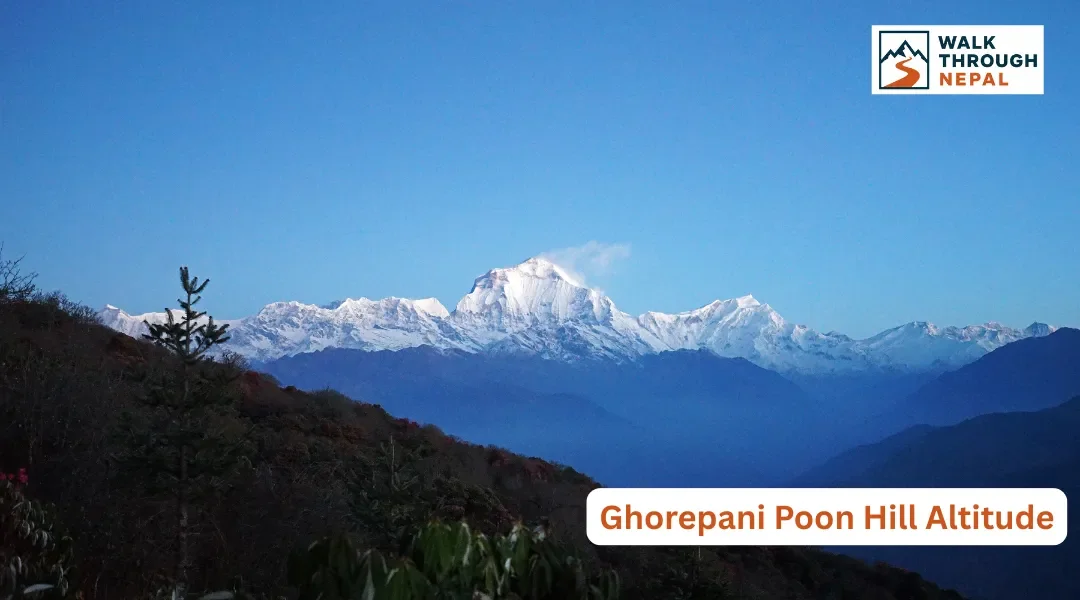
The Ghorepani Poon Hill Trek tops out at Poon Hill, 3,210 meters (10,531 feet), the viewpoint most trekkers come for.
You won't sleep that high though. The highest overnight stop is Ghorepani at around 2,874 meters. The trek itself starts near Nayapul at roughly 1,070 meters, so you're gaining a little over 2,100 meters across the whole route.
That gain happens gradually, spread over several days. It's also well below what you'd face on Annapurna Base Camp or the Tilicho Lake trek, which is exactly why Poon Hill has a reputation as one of the most accessible treks in the Annapurna region.
Accessible doesn't mean altitude is a non-issue. Some trekkers still feel it, and knowing the numbers ahead of time makes the whole trip easier to plan for.
We coordinate these treks year-round, and three questions come up more than any others: how high does it actually get, where do you sleep each night, and can a first-timer realistically handle it. This guide covers the exact elevation profile, daily elevation gain, and the altitude tips our field teams give every group before they set out.
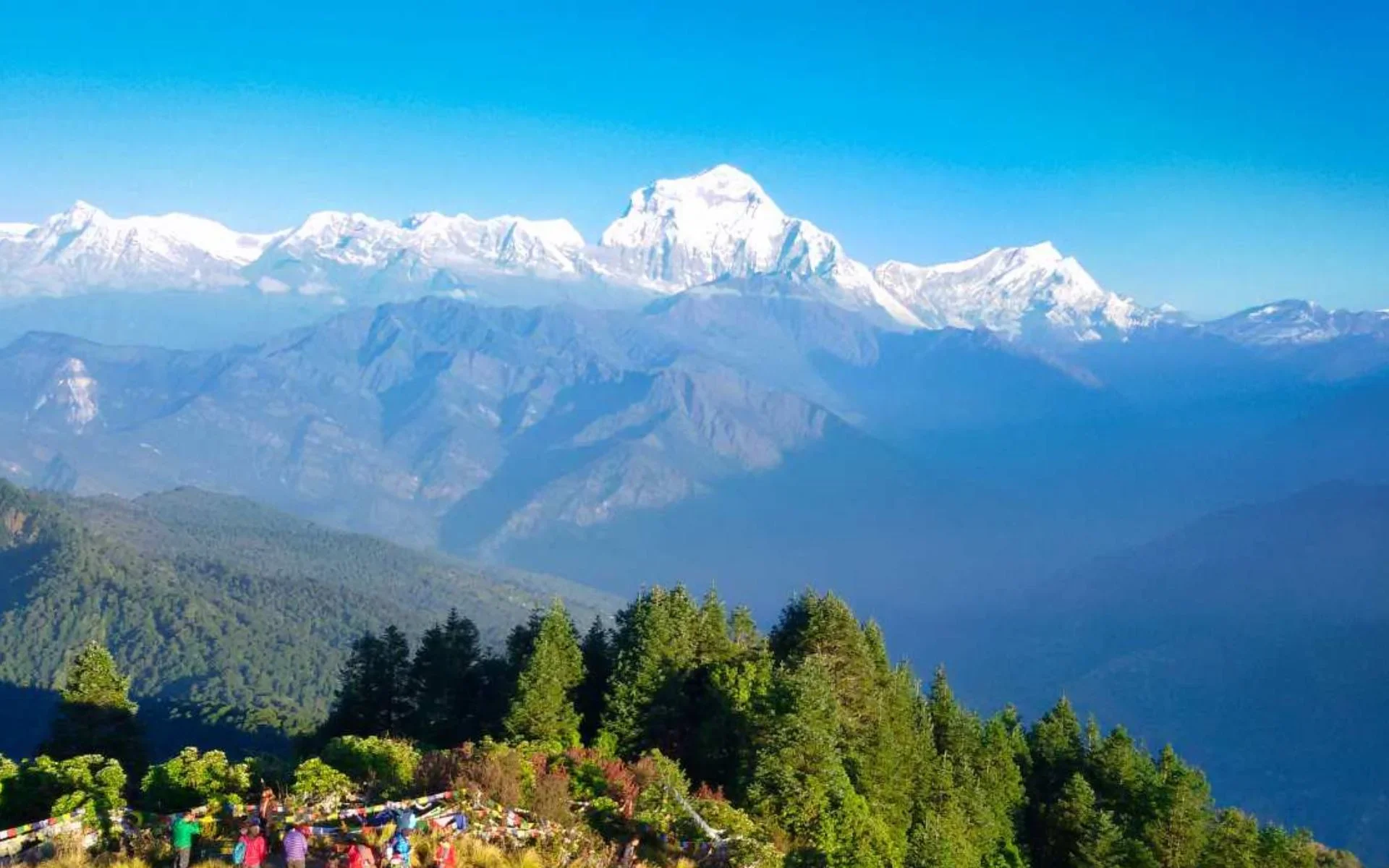
The Ghorepani Poon Hill Trek ranges from about 820 meters in Pokhara to its highest point at Poon Hill (3,210 meters). The highest place you sleep is Ghorepani (approximately 2,874 meters). The trail climbs steadily through terraced hills and rhododendron forest before the sunrise viewpoint, then drops sharply on the return via Tadapani and Ghandruk.
Different maps list slightly different figures for the smaller villages, so treat the numbers below as approximate reference points based on the classic Nayapul–Ulleri route. They are consistent enough for planning your pace and altitude expectations.
Location | Approximate Elevation |
Pokhara | ~820–850 m |
Nayapul (trailhead) | ~1,070 m |
Tikhedhunga | ~1,540–1,570 m |
Ulleri | ~2,050 m |
Ghorepani (overnight) | ~2,874 m |
Poon Hill (viewpoint) | 3,210 m |
Tadapani | ~2,610 m |
Ghandruk | ~1,940 m |
Poon Hill sits at 3,210 meters (10,531 feet). It is the single highest point of the standard trek, reached on a pre-dawn climb for sunrise over the Dhaulagiri and Annapurna ranges. You typically spend only 30 to 60 minutes at the top before heading back down, so you never sleep at this altitude.
This is worth stressing because "Poon Hill altitude" gets confused with sleeping altitude all the time. You touch 3,210 meters briefly in the cold morning air, then descend more than 300 meters back to Ghorepani for breakfast. That short exposure at the top is a big reason the trek stays gentle on the body compared with routes where you actually sleep above 3,000 meters night after night.
Ghorepani sits at about 2,874 meters (9,429 feet), making it the highest overnight location on the trek. Your sleeping altitude matters far more for acclimatization than the brief Poon Hill summit, because your body recovers and adapts during the hours you spend resting, not during a quick viewpoint visit.
Ghorepani is a ridge-top village of clustered teahouses where the wood stove in the dining hall becomes the social center every evening. Sleeping at 2,874 meters is comfortable for the large majority of trekkers, and because the climb to Poon Hill and back keeps your peak exposure short, the altitude curve here is much friendlier than treks that push you higher to sleep. The sunrise hike feels different precisely because you are climbing on cold, stiff legs from a fixed overnight base rather than arriving at a high point mid-afternoon.
The elevation profile follows a clear shape: a steady climb from the trailhead, a major sustained ascent to Ghorepani, a short sharp push to Poon Hill at sunrise, and then a long descent through forest to Ghandruk. The route flows Nayapul → Tikhedhunga → Ulleri → Ghorepani → Poon Hill → Tadapani → Ghandruk.
The first day builds gradually through farmland and small settlements. The second day contains the hardest work, with the relentless stone staircase above Ulleri lifting you into the rhododendron zone toward Ghorepani. The sunrise morning is a short, steep out-and-back to 3,210 meters. From there, the trail generally trends downhill, though it undulates plenty through Tadapani before the final drop into the Gurung village of Ghandruk. If you want to see how altitude shapes overall effort, our Ghorepani Poon Hill Trek difficulty guide breaks the terrain down day by day.
The biggest sustained elevation gain comes on the climb from Tikhedhunga or Ulleri up to Ghorepani. Depending on your exact starting village, this single day can lift you well over 1,300 meters, which is why it feels far tougher than any other stretch on the trek.
Here is the honest part: the exact gain figure varies. If your itinerary starts the day at Tikhedhunga (~1,540 m), the climb to Ghorepani (~2,874 m) works out to roughly 1,300 meters. If you begin higher at Ulleri (~2,050 m), the same-day gain drops to around 800 meters. Rather than treating one number as universal, always check the altitude profile against your specific itinerary and trailhead. That variation is normal and simply reflects where your group spends the night.
Altitude is only one part of what makes Poon Hill tiring, and for most trekkers it is not the main one. The steep, endless stone stairs and consecutive uphill days usually feel harder than the thin air, because the maximum altitude of 3,210 meters is modest by Himalayan standards.
Compared with the sustained high-altitude nights on Annapurna Base Camp or Everest routes, Poon Hill barely registers on the altitude scale. What catches people out is the leg-burning ascent above Ulleri and the early-morning cold at the viewpoint. Individual response still varies, so a few trekkers do feel the altitude even here.
Yes, altitude-related symptoms are possible at 3,210 meters, but Poon Hill sits well below the danger zone of classic high-altitude Himalayan treks. The risk here is low to moderate, and it drops further because you sleep lower at Ghorepani rather than at the viewpoint itself. The risk is never exactly zero, so awareness matters even on a beginner trek.
Acute Mountain Sickness (AMS) can begin above roughly 2,500 meters, so a small number of trekkers do notice mild effects around Ghorepani and Poon Hill. The safeguards we build into every itinerary keep the sleep-elevation gain reasonable and never rush the ascent.
Headache
Nausea
Dizziness
Unusual fatigue
Loss of appetite
Sleep disturbance
Stop ascending if symptoms worsen
Rest and give your body time to adjust
Tell your guide and trekking companions immediately
Descend if symptoms do not improve
Seek medical help for any severe or persistent symptoms
These are general trekking guidelines, not medical advice. If you have underlying health conditions, consult a doctor familiar with high-altitude travel before departure.
Preparing for Poon Hill altitude is mostly about steady conditioning and sensible pacing rather than intense training. Because the trek peaks at only 3,210 meters, the goal is to arrive with good cardiovascular endurance and to walk the ascent slowly rather than to chase a schedule.
Walk regularly in the weeks before your trek, ideally on hills or stairs
Build cardiovascular endurance through hiking, running, or cycling
Never rush the climb to Ghorepani, even if you feel strong
Stay consistently hydrated on the trail
Get proper sleep the nights before and during the trek
Limit alcohol, especially at Ghorepani
Pay attention to how your body feels and follow your guide's pacing
Poon Hill is high enough to feel like a genuine Himalayan trek, but it sits far below Nepal's famous high-altitude routes. At 3,210 meters, it is one of the lowest classic viewpoint treks in the Annapurna region, which is exactly why it suits first-timers and families.
Trek | Highest Point |
Poon Hill | 3,210 m |
Langtang Valley | ~3,870 m |
Annapurna Base Camp | ~4,130 m |
Mardi Himal | ~4,500 m |
Everest Base Camp | ~5,364 m |
The gap is significant. If you are weighing Poon Hill against a higher route, our Annapurna Base Camp altitude guide shows how the elevation demands change once you commit to sleeping above 4,000 meters.
Generally yes. The low maximum altitude of 3,210 meters makes Poon Hill one of the safest introductions to Himalayan trekking. But beginner-friendly does not mean effortless, and the altitude advantage does not remove the physical work.
Trekkers still need to handle long uphill sections, thousands of stone stairs, several consecutive walking days, and a cold pre-dawn ascent. What the modest altitude does is remove the biggest variable that trips up new trekkers on higher routes, letting you focus on enjoying the sunrise rather than worrying about serious AMS. If this is your first trek, plan your season carefully using our best time to trek Ghorepani Poon Hill guide.
The sunrise climb feels distinct from any other part of the trek because you are ascending in darkness and cold, on legs stiff from the previous day, straight up to 3,210 meters. You then stand still for a long stretch at the viewpoint, which is when the chill and thin air are most noticeable.
You leave Ghorepani well before dawn, climb roughly 1.5 kilometers of steps over 45 to 60 minutes, and reach the top as temperatures sit near or below freezing in the cooler months. Because you are not moving much once you arrive, layering properly matters more here than almost anywhere else on the trail. For seasonal temperature expectations at the viewpoint, our seasonal guide is worth a read before you pack.
Managing the elevation on Poon Hill comes down to pacing, hydration, and honest communication with your guide. Since the trek peaks below 3,300 meters, small habits keep the experience comfortable rather than exhausting.
Walk slowly — especially on the major ascent to Ghorepani, where a slow rhythm beats short bursts
Don't chase the clock — your walking speed should fit the group, not the paper itinerary
Carry a manageable backpack — a heavy load makes every climb feel steeper
Hydrate consistently — sip regularly instead of waiting until you feel thirsty
Layer properly — temperatures swing sharply from trail-level walking to standing at the Poon Hill viewpoint
Speak up early — tell your guide the moment you feel unwell rather than hiding symptoms to keep pace
Don't confuse fitness with altitude tolerance — being fit does not guarantee immunity from altitude symptoms
The numbers make it clear. A 3,210-meter high point, a comfortable overnight altitude at Ghorepani, and a gradual climb over several days make Poon Hill one of the easiest introductions to Himalayan trekking in Nepal. You still get sunrise over the Annapurna and Dhaulagiri ranges, without the tough acclimatization schedule of higher routes.
Easier doesn't mean unplanned though. The stairs above Ulleri, the cold at sunrise, and occasional mild AMS symptoms are all real.
That's where Walk Through Nepal helps. Our field teams run this trek year-round, pace the climb properly, and brief every group on altitude before sunrise. Check our Ghorepani Poon Hill Trek itinerary and let us handle the planning.
The highest point of the Ghorepani Poon Hill Trek is Poon Hill at 3,210 meters (10,531 feet). It is reached on an early-morning sunrise hike from Ghorepani, which is the highest overnight stop at roughly 2,874 meters.
Poon Hill sits at 3,210 meters (10,531 feet). It is the highest point of the trek but you only stay briefly at sunrise before descending back to Ghorepani for breakfast.
Ghorepani sits at approximately 2,874 meters (9,429 feet). This is the highest overnight altitude on the standard trek and the base for the pre-dawn Poon Hill climb.
Yes, mild altitude symptoms are possible above 2,500 meters, so Poon Hill at 3,210 meters carries a low-to-moderate risk. Most trekkers are fine because they sleep lower at Ghorepani, but the risk is never zero.
The climb from Tikhedhunga or Ulleri up to Ghorepani is the biggest sustained ascent, with elevation gains that can exceed 1,300 meters depending on your exact starting point and trailhead.
The climb from Ghorepani to Poon Hill covers roughly 1.5 kilometers of stone steps and takes about 45 to 60 minutes at a steady pace, done in the dark before sunrise.
Yes, Poon Hill is one of the most beginner-friendly Himalayan treks because the maximum altitude stays low. However, it still involves long uphill stone stairs and consecutive trekking days, so basic fitness helps.
Poon Hill tops out at 3,210 meters while Annapurna Base Camp reaches around 4,130 meters. Poon Hill is considerably lower, which is why it carries much less altitude risk.